





Masters in Business Analytics Online: Complete Guide
The demand for professionals who can translate complex data into actionable business strategies continues to grow. Organizations across all sectors are seeking individuals equipped with the analytical skills to drive informed decision-making and foster innovation. For many aspiring and current professionals, pursuing a masters in business analytics online offers a flexible and effective pathway to meet this critical need and advance their careers. This article explores the nuances of these programs, from what they entail to career prospects and financial considerations, providing a comprehensive overview for those considering this educational investment.
What is an Online Business Analytics Degree?
An online business analytics degree focuses on equipping students with the knowledge and tools to analyze large datasets, identify trends, predict outcomes, and optimize business processes. Unlike traditional on-campus programs, an online format provides the flexibility to study from anywhere, often accommodating the schedules of working professionals. The core of these programs lies in applying statistical methods, data mining techniques, and predictive modeling to real-world business challenges. Graduates gain practical skills in areas such as data visualization, machine learning, and strategic planning, all geared towards improving organizational performance.
What Should You Look for in an Online Business Analytics Master’s Program?
When comparing a masters in business analytics online, prospective students should look beyond tuition and program rankings. A strong evaluation should consider accreditation, curriculum quality, faculty qualifications, experiential learning, career support, technology requirements, program format, and graduate outcomes.
Accreditation is particularly important because it provides information about whether an institution or program has been evaluated against established educational standards. Students should verify accreditation directly through the appropriate accrediting organization rather than relying solely on marketing materials.
The curriculum should also match the student’s intended career path. Someone interested in business intelligence may prioritize database management, SQL, visualization, and business intelligence courses, while someone targeting more technical analytics roles may want deeper coursework in statistics, programming, machine learning, and predictive modeling.
Before applying, prospective students should also determine whether the program includes applied projects, capstone work, internships, case studies, or opportunities to work with realistic datasets. These experiences can help students demonstrate practical skills to prospective employers.
Why Pursue a Masters in Business Analytics Online?
Opting for a masters in business analytics online presents several compelling advantages. Foremost is the flexibility it offers, allowing individuals to continue their professional careers while pursuing advanced education. This means applying newly acquired knowledge and skills directly to their current roles, fostering immediate professional growth. Online programs also provide access to a wider array of institutions and specialized curricula, regardless of geographic location. This diversity allows students to select programs that best align with their career aspirations and learning preferences, often benefiting from faculty expertise and peer networks that might not be available locally.
What Is the Online Learning Experience Like?
The experience of completing a master’s degree online can differ considerably between institutions. Some programs use live virtual classes, while others rely primarily on recorded lectures, discussion boards, independent assignments, and scheduled assessments. Students should review the delivery format before enrolling because the level of interaction can affect how the program fits around employment and other responsibilities.
A practical way to evaluate an online program is to ask:
- Are classes primarily live, asynchronous, or a combination of both?
- How frequently do students work in teams?
- Are professors available for live office hours?
- How are exams and assessments administered?
- Are capstone projects based on realistic business problems?
- Can students access career services remotely?
- What technical equipment and software are required?
Students who work full-time should also estimate the weekly study commitment and compare it with their existing schedule. This can provide a more realistic picture of whether a full-time or part-time format is appropriate.
Choosing the Right Online Business Analytics Masters Program
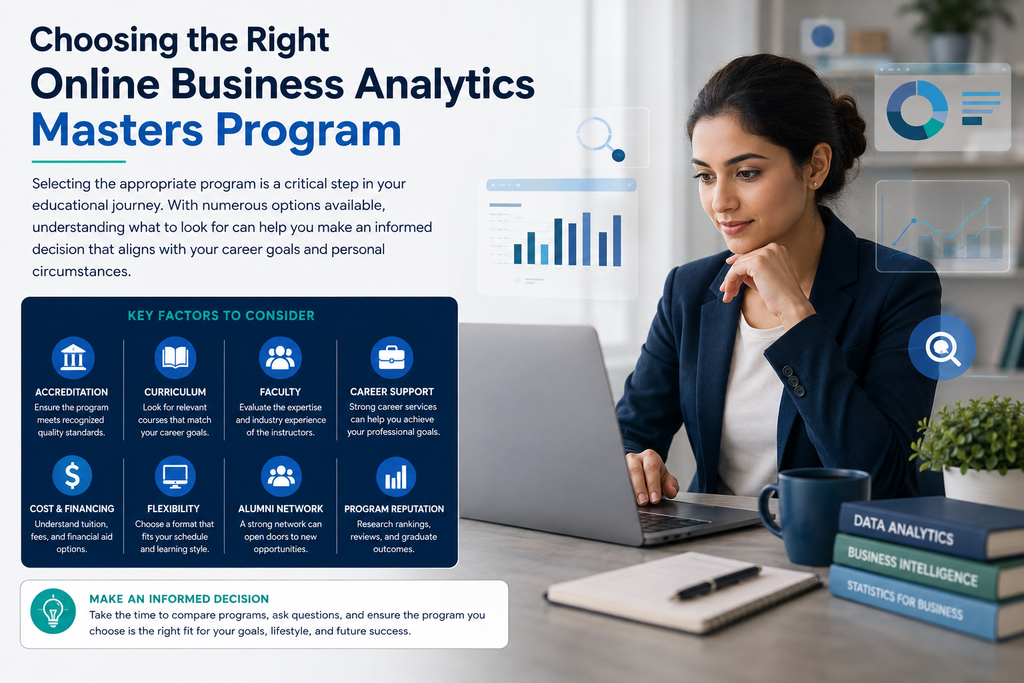
Selecting the appropriate program is a critical step in your educational journey. With numerous options available, understanding what to look for can help you make an informed decision that aligns with your career goals and personal circumstances.
Identifying the Best Online Business Analytics Masters Programs
When evaluating the best online business analytics masters programs, several criteria warrant close attention. Accreditation is paramount, ensuring the program meets recognized quality standards. Researching the faculty’s expertise and industry experience can provide insight into the quality of instruction and practical relevance of the curriculum. Program reputation, often reflected in rankings and alumni success stories, indicates the value employers place on the degree. Additionally, consider the strength of the alumni network, as this can be invaluable for career opportunities and professional development. Reviewing program reviews and testimonials can also offer perspectives from current and former students.
Online Business Analytics Master’s Program Comparison Checklist
Before selecting a program, prospective students can use a structured comparison rather than relying on a single ranking or advertised benefit. The following checklist can make the evaluation more objective:
| Evaluation factor | What to investigate |
| Accreditation | Verify the institution and, where applicable, the program’s accreditation through an authoritative source. |
| Curriculum | Compare statistics, programming, databases, machine learning, visualization, and business strategy coursework. |
| Faculty | Review academic credentials, research areas, and relevant industry experience. |
| Applied learning | Look for capstone projects, case studies, internships, or client-based assignments. |
| Career support | Examine career coaching, employer connections, networking, and job-search resources. |
| Program format | Determine whether courses are synchronous, asynchronous, or hybrid. |
| Total cost | Review tuition plus fees, technology, software, books, and other required expenses. |
| Completion time | Compare full-time and part-time pathways and the number of required credits. |
| Technology | Identify required hardware, software, programming environments, and database tools. |
| Graduate outcomes | Look for transparent employment, graduation, retention, or other outcome information where available. |
Using these criteria can help students distinguish between programs based on factors that directly affect their educational experience and career preparation.
Online Masters in Business Analytics Requirements for Admission
Admission to an online masters in business analytics typically requires a bachelor’s degree from an accredited institution, often in a quantitative field such as business, engineering, computer science, or mathematics. Many programs look for a strong academic record, often demonstrated by a minimum GPA. While some programs may require Graduate Record Examinations (GRE) or Graduate Management Admission Test (GMAT) scores, many offer waivers for applicants with significant professional experience or a strong quantitative background. Other common requirements include a statement of purpose or essay, letters of recommendation, and a professional resume highlighting relevant work experience. Some programs may also require foundational coursework in statistics, calculus, or programming.
How to Prepare for an Online Business Analytics Master’s Program
Applicants who do not have a strong quantitative background can benefit from reviewing foundational concepts before beginning a program. Useful preparation areas include statistics, probability, algebra, spreadsheet analysis, and basic programming.
It can also be helpful to become familiar with commonly used analytics concepts such as descriptive statistics, regression, data cleaning, data visualization, databases, and predictive modeling. Preparation does not necessarily mean mastering every technical skill in advance; instead, the goal is to identify potential knowledge gaps early and use introductory courses or reputable educational resources to address them.
Prospective students should also review the prerequisites of each university individually because admission standards and required coursework can differ significantly between programs.
Understanding the Business Analytics Online Masters Curriculum
The business analytics online masters curriculum is designed to provide a robust foundation in data analysis and its application to business problems. Common courses often include:
- Statistical Modeling and Inference: Techniques for understanding data patterns and making predictions.
- Data Mining and Machine Learning: Methods for discovering insights from large datasets.
- Predictive Analytics: Tools and models for forecasting future trends and behaviors.
- Data Visualization: Communicating complex data insights effectively through visual representations.
- Database Management: Principles of organizing, storing, and retrieving data.
- Business Intelligence: Strategies for using data to support organizational decision-making.
- Optimization and Simulation: Techniques for improving business processes and outcomes.
- Programming for Analytics: Often involving languages like Python or R.
- Business Strategy and Ethics: Applying analytical insights within a strategic and ethical framework.
Many programs also incorporate capstone projects or internships, allowing students to apply their skills to real-world business challenges.
Building a Business Analytics Portfolio During Your Degree
A master’s degree can demonstrate formal education, but a practical portfolio can help students show how they apply analytical concepts to business problems. Portfolio projects should emphasize the complete analytical process rather than simply presenting charts or code.
A strong project can demonstrate how the student:
- Defined a specific business problem.
- Identified and prepared an appropriate dataset.
- Applied statistical or analytical techniques.
- Interpreted the findings.
- Created clear visualizations or dashboards.
- Explained the business implications.
- Recommended an action based on the evidence.
For example, a portfolio might analyze customer retention, sales performance, marketing campaign results, inventory trends, or operational efficiency. Students should clearly document their methodology and distinguish between observed results and assumptions.
This approach can also help connect coursework with the skills requested in relevant job descriptions.
Investment and Return: Cost and Career Prospects
Understanding the financial commitment and potential career benefits is crucial when considering a graduate degree.
Cost of Online Masters in Business Analytics Programs
The cost of online masters in business analytics programs can vary significantly based on the institution, program length, and residency status. Tuition fees typically range from $20,000 to over $70,000 for the entire program. Beyond tuition, prospective students should budget for additional costs such as textbooks, software licenses, technology requirements (e.g., a powerful computer), and potential travel for residencies if the program includes them. Financial aid options are often available, including scholarships, grants, and federal student loans. Many employers also offer tuition reimbursement programs, which can significantly offset the financial burden for working professionals.
How to Calculate the True Cost of an Online Business Analytics Master’s
Tuition is only one part of the financial calculation. Before enrolling, students should estimate the total cost of attendance by considering:
- Tuition and mandatory university fees
- Books and course materials
- Required software or technology
- Computer or equipment upgrades
- Travel or residency expenses, if applicable
- Financing or loan costs
- The potential income or work hours affected by the study schedule
Because tuition and fees vary by institution, students should verify current costs directly from the university before making a financial decision. Published tuition figures should also be checked for additional per-credit, technology, or program fees.
Online Business Analytics Masters Salary Expectations
Graduates with an online business analytics masters salary expectations are generally strong, reflecting the high demand for their specialized skills. While specific figures vary widely based on industry, geographic location, years of experience, and specific job role, entry-level positions for those with a master’s degree often command salaries significantly higher than those with only a bachelor’s degree. Experienced professionals leveraging the degree for career advancement can see substantial increases. For example, roles like Business Intelligence Analyst, Data Scientist, or Analytics Manager often report median salaries ranging from $80,000 to over $120,000 annually, with top earners exceeding $150,000, particularly in tech or consulting sectors.
How to Evaluate Salary and Career-Outcome Data
Salary figures should be interpreted carefully because a master’s degree does not guarantee a specific salary or employment outcome. Compensation can vary according to occupation, location, industry, previous experience, technical skills, company size, and seniority.
When comparing salary information, prospective students should check:
- The occupation being measured
- The geographic market
- The year of the salary data
- Whether the figure represents median, average, or percentile earnings
- The experience level represented
- Whether bonuses or other compensation are included
Authoritative labor-market datasets and transparent university employment reports are preferable to unsupported salary estimates. Students should also compare the cost of the degree with their own expected career trajectory rather than assuming that a higher qualification will automatically produce a particular salary increase.
Career Paths: Business Analytics Online Masters Jobs
A business analytics online masters degree opens doors to a diverse range of rewarding career paths across various industries. Graduates are highly sought after in fields such as technology, finance, healthcare, retail, and consulting. Common job titles include:
- Business Analyst: Bridging the gap between IT and business to improve efficiency.
- Data Scientist: Developing and implementing algorithms to extract insights from data.
- Analytics Manager: Leading teams to develop and execute data-driven strategies.
- Business Intelligence Developer: Designing and maintaining BI solutions and dashboards.
- Marketing Analyst: Using data to optimize marketing campaigns and understand customer behavior.
- Operations Analyst: Improving operational efficiency through data analysis.
- Management Consultant: Advising organizations on data-driven strategies and solutions.
The skills acquired are transferable and valuable in virtually any organization that collects and utilizes data.
What Employers Look for in Business Analytics Graduates
Employers may evaluate candidates based on a combination of technical, analytical, and communication abilities rather than the degree alone. Students can strengthen their career readiness by developing skills in:
- SQL and database querying
- Excel and spreadsheet-based analysis
- Python or R
- Statistical analysis
- Data visualization and dashboard development
- Business intelligence tools
- Data storytelling and presentation
- Problem-solving and critical thinking
- Communication with non-technical stakeholders
- Understanding how analytics supports business objectives
The most useful combination depends on the target role. A technical analytics position may emphasize programming, statistics, and machine learning, while a business-facing position may place greater emphasis on communication, requirements gathering, visualization, and strategic interpretation.
Students should therefore compare actual job descriptions in their target industry and use those requirements to guide their course choices, portfolio projects, internships, and professional development.
Online Data Analytics Masters vs. Business Analytics: What’s the Difference?
While often used interchangeably, there are distinct differences between an online data analytics masters vs business analytics degree. Both involve working with data, but their primary focus and application differ:
- Online Data Analytics Masters: These programs typically have a stronger emphasis on the technical aspects of data. The curriculum often delves deeper into statistical theory, advanced programming (e.g., Python, R, SQL), database management, machine learning algorithms, and big data technologies. Graduates are often prepared for roles that involve data infrastructure, model building, and complex statistical analysis, such as Data Scientist, Data Engineer, or Statistician.
- Masters in Business Analytics Online: These programs focus more on the application of data analysis to solve specific business problems and inform strategic decisions. While technical skills are taught, the emphasis is on interpreting results, communicating insights to non-technical stakeholders, and understanding the business context. The curriculum often integrates business strategy, economics, and organizational behavior alongside analytical techniques. Graduates are typically prepared for roles that bridge the technical and business sides, such as Business Analyst, Business Intelligence Analyst, or Management Consultant.
Choosing between the two often depends on whether your career aspirations lean more towards deep technical data manipulation and model development (Data Analytics) or towards leveraging data for strategic business impact and decision support (Business Analytics).
Which Degree Is Better for Your Career Goals?
Neither degree is universally better. The more suitable option depends on the type of work a student wants to perform after graduation.
A business analytics program may be a strong fit for someone who wants to combine analytical work with business strategy, stakeholder communication, and organizational decision-making. A more technically focused data analytics program may be preferable for someone who wants to spend more time working with advanced statistical methods, programming, data infrastructure, or machine learning.
Before choosing, review several job descriptions for the roles you want after graduation. Identify the recurring technical and business skills, then compare those requirements against each program’s curriculum. This career-first approach can provide a more useful comparison than relying only on program names.
Frequently Asked Questions About Masters in Business Analytics Online
Here are answers to common questions regarding pursuing a masters in business analytics online:
- How long does an online masters in business analytics typically take to complete? Most full-time online programs can be completed in 12-24 months. Part-time options may extend to 2-4 years.
- Are part-time options available? Yes, many universities offer flexible part-time schedules designed for working professionals.
- What technical skills are essential before starting a program? While some programs offer foundational courses, a basic understanding of statistics, algebra, and potentially an introductory programming language (like Excel, R, or Python) can be beneficial.
- Do online programs offer career services? Reputable online programs typically provide access to career services, including resume reviews, interview preparation, and job search assistance, similar to their on-campus counterparts.
- Is an online degree as respected as an on-campus degree? When earned from an accredited and reputable institution, an online degree holds the same academic weight and recognition as an on-campus degree. Employers generally value the skills and knowledge gained, regardless of the delivery format.
- How should I verify whether an online business analytics master’s program is accredited? Check the university’s official accreditation information and verify the accrediting organization through an authoritative accreditation database or government-recognized source where applicable. Do not rely solely on third-party rankings or promotional claims.
- Can I pursue a master’s in business analytics without a computer science background? Requirements vary by university. Some programs accept students from a broad range of academic backgrounds, while others expect previous coursework in statistics, mathematics, programming, or related subjects. Always review the specific prerequisites of the program.
- Is work experience required for an online business analytics master’s? Requirements differ by program. Some universities accept applicants directly after a bachelor’s degree, while others prefer or require professional experience. Check the official admissions criteria for each institution.
- What software should I expect to use in a business analytics program? The tools vary by curriculum, but students may encounter spreadsheet software, SQL databases, Python, R, data visualization platforms, and business intelligence tools. Prospective students should check each program’s current course descriptions and technology requirements.
- Can an online business analytics master’s help with a career change? It can provide structured education and opportunities to develop relevant analytical skills, but career outcomes depend on factors such as previous experience, technical ability, portfolio quality, networking, geographic market, and the target occupation. Students changing careers should consider internships, projects, networking, and entry-level opportunities alongside the degree.
Conclusion: Investing in Your Future with a Masters in Business Analytics Online
Pursuing a masters in business analytics online represents a significant investment in your professional future. It equips you with highly sought-after skills to navigate and lead in a data-driven economy. The flexibility of online learning, combined with a robust curriculum, prepares graduates for impactful roles across diverse industries. From understanding the nuances of data to translating insights into strategic business decisions, this advanced degree offers a pathway to enhanced career opportunities, competitive salaries, and the ability to drive meaningful change within organizations. For those looking to elevate their analytical capabilities and leadership potential, an online business analytics masters is a powerful credential.
Final Decision Checklist for Prospective Students
Before applying to an online business analytics master’s program, prospective students should confirm that the program aligns with both their career objectives and practical circumstances.
- Verify institutional and program accreditation where applicable.
- Compare the curriculum with the skills required for your target roles.
- Review faculty qualifications and relevant industry experience.
- Investigate capstone projects, internships, and other experiential learning opportunities.
- Confirm whether the online format fits your preferred learning style and work schedule.
- Calculate the complete cost rather than comparing tuition alone.
- Review current admission requirements directly from the university.
- Check available career services and networking opportunities.
- Investigate transparent graduate-outcome information where available.
- Compare several programs before making a final decision.
The strongest choice is not necessarily the most expensive or highest-ranked program. It is the program whose curriculum, learning format, cost, support services, and practical opportunities most closely match the student’s career goals.