

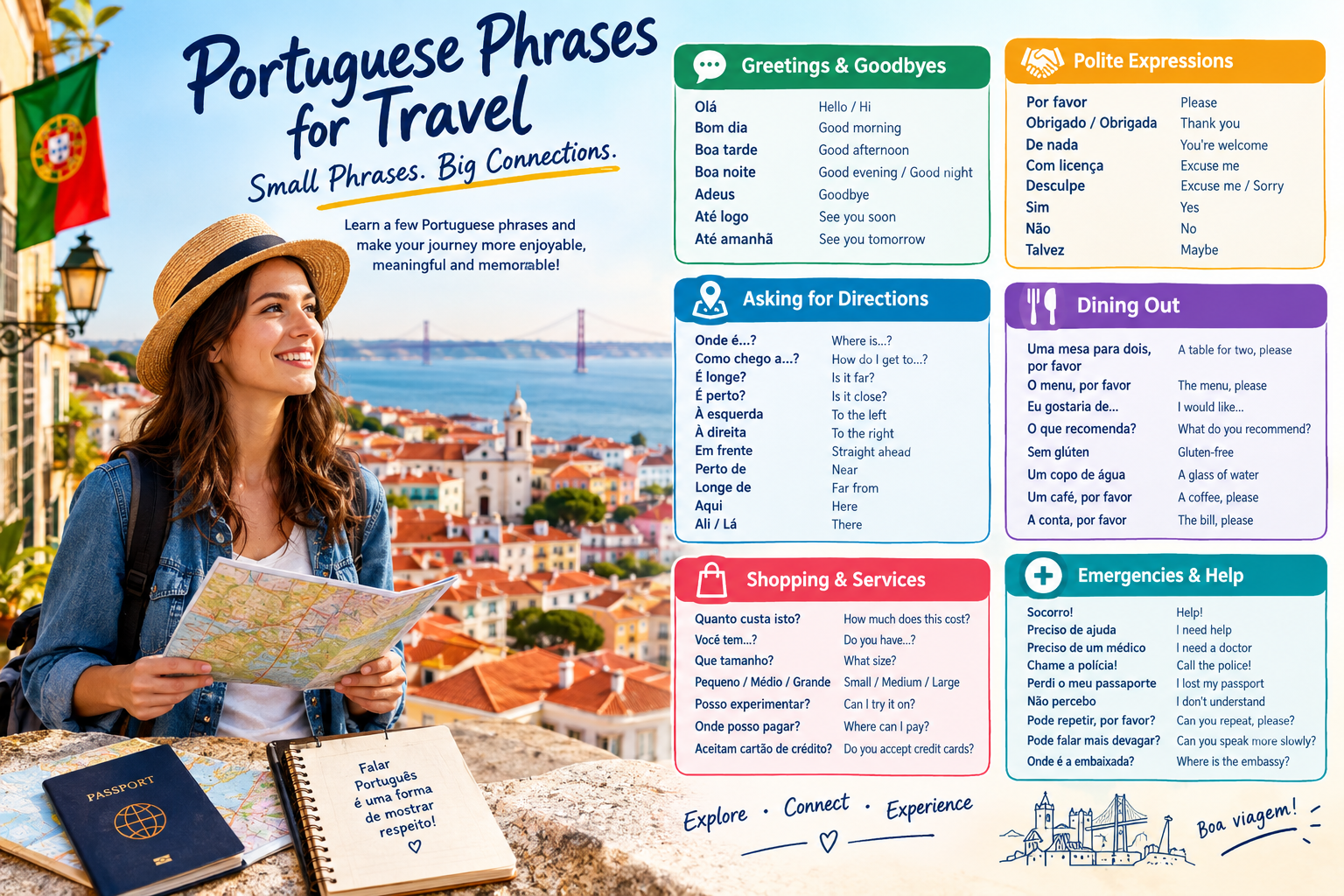


Traveling to a Portuguese-speaking country offers rich cultural experiences, from the vibrant streets of Lisbon to the Amazon rainforest. While English is spoken in many tourist areas, making an effort to communicate in the local language can significantly enhance your journey. Learning even a few portuguese phrases for travel demonstrates respect for the culture and often leads to warmer interactions with locals. This guide provides a collection of basic portuguese phrases for tourists, designed to help you navigate common situations, connect with people, and make your trip more enjoyable.
European Portuguese vs. Brazilian Portuguese: What Travelers Should Know
Portuguese is spoken across several countries, and everyday vocabulary and pronunciation can vary by region. This distinction is especially useful when traveling between Portugal and Brazil. For example, comboio is commonly used for “train” in Portugal, while trem is commonly used in Brazil. Similarly, autocarro is widely used in Portugal, whereas ônibus is common in Brazil.
Travelers should therefore expect some differences in vocabulary, pronunciation, and informal expressions depending on their destination. The phrases in this guide include several expressions commonly encountered in Portugal, so visitors heading to Brazil or another Portuguese-speaking country may want to check local usage before traveling.
A simple approach is to learn the standard phrase first and then familiarize yourself with a few regional alternatives. This helps you communicate confidently without assuming that Portuguese is spoken exactly the same way everywhere.
Getting Started: Portuguese Greetings and Goodbyes
Initiating conversations and showing courtesy are fundamental aspects of travel. Mastering some basic portuguese greetings and goodbyes is an excellent starting point for any traveler. These are truly essential portuguese phrases for travel that will serve you well from the moment you arrive.
Saying Hello and Goodbye
Simple greetings can open doors and create positive first impressions. Here are some common ways to greet people and bid farewell:
- Olá: Hello / Hi
- Bom dia: Good morning (used until midday)
- Boa tarde: Good afternoon (used from midday until evening)
- Boa noite: Good evening / Good night (used from evening onwards)
- Adeus: Goodbye (more formal or for longer separations)
- Até logo: See you soon / See you later (more common for temporary goodbyes)
- Até amanhã: See you tomorrow
Essential Courtesy Phrases
Politeness goes a long way. Incorporating these basic portuguese phrases for tourists into your vocabulary will show appreciation and facilitate smoother interactions.
- Por favor: Please
- Obrigado / Obrigada: Thank you (use ‘Obrigado’ if you are male, ‘Obrigada’ if you are female)
- De nada: You’re welcome
- Com licença: Excuse me (to pass by someone or get attention)
- Desculpe: Excuse me / Sorry (to apologize)
- Sim: Yes
- Não: No
- Talvez: Maybe
A Simple Pronunciation Tip for Travelers
You do not need perfect pronunciation to make yourself understood. However, Portuguese includes sounds that may be unfamiliar to English speakers, including nasal vowel sounds. Words containing ão, for example, can take practice. Listening to native speakers before your trip can help you recognize these sounds more naturally.
One useful strategy is to learn each phrase as a complete expression rather than trying to pronounce every word individually. Practice phrases such as Bom dia, Por favor, and Pode repetir, por favor? aloud several times before traveling.
Navigating Your Journey: Asking for Directions in Portuguese
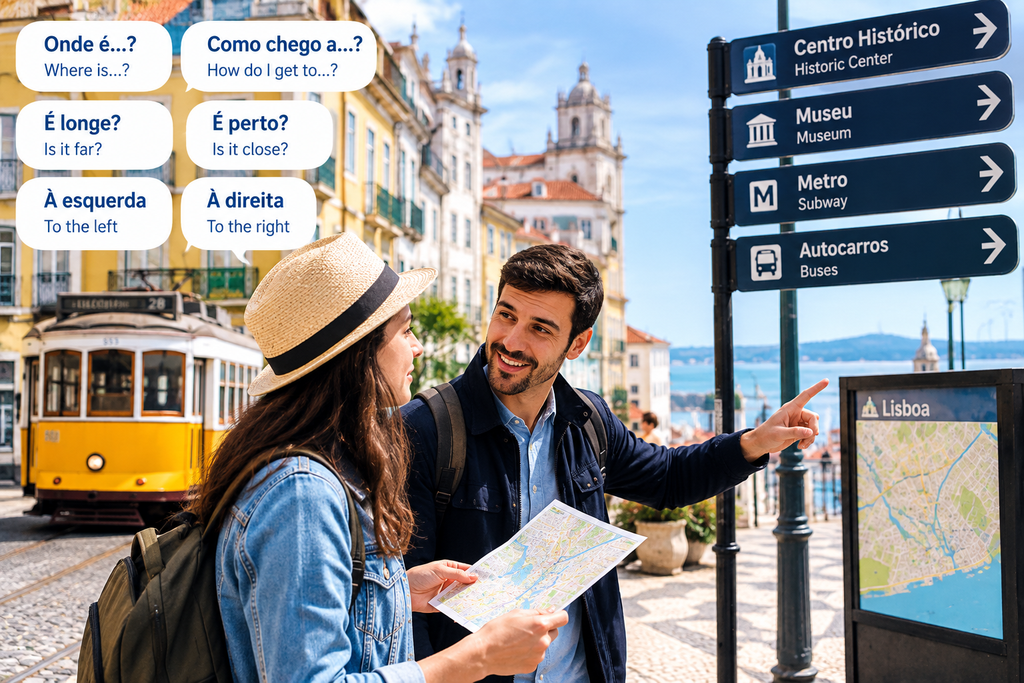
Finding your way around a new city can be challenging, but knowing how to ask for help makes it much easier. These common portuguese phrases for travelers will assist you when you need to understand your surroundings or reach a specific destination. Learning to ask for directions in Portuguese is a practical skill for any trip.
Finding Your Way: Key Directional Phrases
When you need to know where to go, these phrases for asking for directions in portuguese will be invaluable:
- Onde é…?: Where is…?
- Como chego a…?: How do I get to…?
- É longe?: Is it far?
- É perto?: Is it close?
- À esquerda: To the left
- À direita: To the right
- Em frente: Straight ahead
- Perto de: Near
- Longe de: Far from
- Aqui: Here
- Ali / Lá: There
Transportation and General Inquiries
Whether you’re using public transport or need general travel information, these useful portuguese phrases for vacation will help you get around efficiently.
- Um bilhete para…, por favor: A ticket to…, please
- Onde fica a estação de comboios/autocarros?: Where is the train/bus station?
- Quanto tempo demora?: How long does it take?
- Pode chamar um táxi, por favor?: Can you call a taxi, please?
- Paragem seguinte, por favor: Next stop, please (on a bus)
Useful Follow-Up Questions When Getting Directions
Understanding the answer is just as important as asking the question. If someone gives directions too quickly, these phrases can help:
- Pode mostrar no mapa?: Can you show me on the map?
- É a pé?: Is it walkable?
- Quanto tempo a pé?: How long on foot?
- Qual é a melhor maneira de chegar lá?: What is the best way to get there?
- Tenho de virar à esquerda?: Do I have to turn left?
- É esta a estação?: Is this the station?
These short follow-up questions are particularly useful when navigating unfamiliar streets, public transportation networks, or large stations.
Dining Out: Portuguese Phrases for Restaurants
Food is a central part of every travel experience. Using portuguese phrases for restaurants will allow you to order confidently, understand the menu, and enjoy local cuisine. Knowing how to order food in portuguese can transform a simple meal into a memorable cultural exchange.
Making Reservations and Ordering
From securing a table to selecting your meal, these phrases will guide you through the dining process:
- Uma mesa para dois, por favor: A table for two, please
- Eu tenho uma reserva: I have a reservation
- O menu, por favor: The menu, please
- Eu gostaria de…: I would like…
- O que recomenda?: What do you recommend?
- Sem glúten: Gluten-free
- Sem lactose: Lactose-free
- Um copo de água: A glass of water
- Um café, por favor: A coffee, please
Discussing Dietary Needs and Preferences
Communicating dietary restrictions is crucial. These common portuguese phrases for travelers ensure your needs are understood:
- Eu sou vegetariano/vegetariana: I am vegetarian (male/female speaker)
- Eu sou vegano/vegana: I am vegan (male/female speaker)
- Eu tenho alergia a…: I have an allergy to…
- Contém nozes/amendoins?: Does it contain nuts/peanuts?
- Posso ter isto sem…?: Can I have this without…?
Paying the Bill
Concluding your meal politely involves knowing how to ask for the bill and clarify payment details. These portuguese phrases for restaurants are essential for a smooth departure.
- A conta, por favor: The bill, please
- Posso pagar com cartão?: Can I pay by card?
- O serviço está incluído?: Is the service included?
- Está tudo incluído?: Is everything included?
Practical Restaurant Conversation Example
A short conversation can be easier to remember than isolated vocabulary. A traveler might say:
- Uma mesa para dois, por favor. — A table for two, please.
- O menu, por favor. — The menu, please.
- O que recomenda? — What do you recommend?
- Eu gostaria de… — I would like…
- A conta, por favor. — The bill, please.
Learning this sequence gives travelers a practical framework for moving from being seated to ordering and paying without needing to memorize a large vocabulary.
Shopping and Services: Survival Portuguese Phrases
Whether you’re browsing local markets or seeking assistance, a few survival portuguese phrases can make these interactions much easier. These are truly useful portuguese phrases for vacation shopping and general services.
Asking About Prices and Sizes
When shopping, these phrases will help you inquire about items and make purchases:
- Quanto custa isto?: How much does this cost?
- Você tem…?: Do you have…?
- Que tamanho?: What size?
- Pequeno: Small
- Médio: Medium
- Grande: Large
- Posso experimentar?: Can I try it on?
General Shopping Interactions
For general interactions in shops, these common portuguese phrases for travelers will be helpful:
- Estou só a ver: I’m just looking
- Vou levar isto: I’ll take this
- Onde posso pagar?: Where can I pay?
- Aceitam cartão de crédito?: Do you accept credit cards?
Useful Phrases for Hotels and Accommodation
Accommodation is another situation where a few carefully chosen phrases can make communication easier. Travelers can use these expressions when checking in, requesting assistance, or asking about hotel facilities:
- Tenho uma reserva em nome de…: I have a reservation under the name…
- A que horas é o pequeno-almoço?: What time is breakfast?
- Onde fica o meu quarto?: Where is my room?
- Pode ajudar-me, por favor?: Can you help me, please?
- Tenho um problema com o quarto.: I have a problem with the room.
- Qual é a palavra-passe do Wi-Fi?: What is the Wi-Fi password?
- A que horas é o check-out?: What time is check-out?
Travelers visiting Brazil may hear different vocabulary or pronunciation in some situations, so it is useful to check whether a phrase is more typical of Brazilian or European Portuguese.
Handling Unexpected Situations: Essential Portuguese Phrases for Travel
Even with careful planning, unexpected situations can arise. Knowing some essential portuguese phrases for travel for emergencies or difficulties can provide peace of mind. These survival portuguese phrases are crucial for your safety and well-being.
Asking for Help and Expressing Needs
In moments of need, these phrases can make a significant difference:
- Socorro!: Help!
- Preciso de ajuda: I need help
- Preciso de um médico: I need a doctor
- Chame a polícia!: Call the police!
- Perdi o meu passaporte: I lost my passport
- Não percebo: I don’t understand
- Pode repetir, por favor?: Can you repeat, please?
- Pode falar mais devagar, por favor?: Can you speak more slowly, please?
- Onde é a embaixada?: Where is the embassy?
Extra Phrases for Emergencies and Important Situations
A few additional phrases can help travelers communicate clearly when they need urgent assistance:
- Preciso de uma ambulância.: I need an ambulance.
- Onde fica o hospital?: Where is the hospital?
- Perdi a minha carteira.: I lost my wallet.
- Perdi o meu telemóvel.: I lost my phone.
- Pode ajudar-me?: Can you help me?
- Não falo português.: I don’t speak Portuguese.
- Fala inglês?: Do you speak English?
- Pode escrever, por favor?: Can you write it down, please?
If a situation is urgent, travelers should not rely solely on language skills. Contact the appropriate local emergency service, medical provider, police authority, embassy or consular service, depending on the circumstances.
A Quick Travel Phrase Checklist
Before leaving for a Portuguese-speaking destination, travelers can prioritize these phrases:
- Olá — Hello
- Bom dia — Good morning
- Por favor — Please
- Obrigado / Obrigada — Thank you
- Desculpe — Sorry / Excuse me
- Onde fica…? — Where is…?
- Quanto custa? — How much does it cost?
- Eu gostaria de… — I would like…
- A conta, por favor — The bill, please
- Não percebo — I don’t understand
- Pode repetir, por favor? — Can you repeat, please?
- Pode falar mais devagar, por favor? — Can you speak more slowly, please?
- Preciso de ajuda — I need help
These phrases cover the most common travel situations without requiring visitors to memorize an extensive vocabulary.
FAQ: Your Questions About Portuguese Phrases for Travel Answered
Many travelers have similar questions about using portuguese phrases for travel. Here, we address some common concerns to help you feel more prepared and confident.
What are the most important Portuguese phrases for tourists?
For any tourist, prioritizing greetings (Olá, Bom dia/tarde/noite), courtesy phrases (Por favor, Obrigado/a, Desculpe), and basic transactional phrases (Quanto custa?, A conta, por favor) is key. These basic portuguese phrases for tourists cover the majority of daily interactions and show goodwill.
Is it difficult to learn basic Portuguese phrases for travel?
Learning fundamental essential portuguese phrases for travel is generally not difficult. Portuguese pronunciation can be a bit tricky for English speakers due to nasal vowels and specific consonant sounds, but locals appreciate any effort. Focus on a few key phrases and practice them regularly. Many apps and online resources can assist with pronunciation.
Will people understand me if I only speak a few Portuguese phrases?
Absolutely. Even a limited vocabulary of common portuguese phrases for travelers can significantly improve your interactions. Locals often respond positively to visitors who attempt to speak their language, even if imperfectly. It bridges communication gaps and fosters a more authentic connection, often leading them to be more patient or switch to English if they know it.
How can I practice Portuguese phrases before my trip?
There are several effective ways to practice useful portuguese phrases for vacation. Language learning apps like Duolingo or Babbel offer structured lessons. Watching Portuguese films or TV shows with subtitles can help with listening comprehension and pronunciation. Practicing with a language exchange partner or simply repeating phrases aloud can build confidence before your journey.
Are Portuguese phrases the same in Portugal and Brazil?
Not always. Portugal and Brazil share the Portuguese language, but vocabulary, pronunciation, grammar preferences, and everyday expressions can differ. Transportation terms are a particularly easy example: comboio is commonly used for train in Portugal, while trem is common in Brazil; autocarro is common in Portugal, while ônibus is common in Brazil.
If your destination is Brazil, it is worth learning Brazilian Portuguese equivalents for the phrases you expect to use most. If you are visiting Portugal, the European Portuguese forms in this guide will be particularly relevant.
What is the easiest way to remember Portuguese travel phrases?
Group phrases according to situations instead of memorizing a long vocabulary list. For example, learn a small set for greetings, another for transportation, another for restaurants, and another for emergencies. Practicing complete sentences aloud also helps you recall them more quickly during real conversations.
It can also help to save a short phrase list on your phone before departure. Keep essential expressions available offline so you can refer to them even when mobile data or Wi-Fi is unavailable.
Conclusion: Enhance Your Journey with Portuguese Phrases
Incorporating a few portuguese phrases for travel into your vocabulary can profoundly enrich your experience abroad. Beyond mere communication, it opens doors to deeper cultural immersion, fosters genuine connections with locals, and demonstrates a respectful engagement with your destination. From ordering a meal to asking for directions, these essential portuguese phrases for travel are tools for a more confident, enjoyable, and authentic adventure. Start practicing today, and prepare to experience the warmth and hospitality that awaits you.
A little preparation can make these phrases much easier to use when you arrive. Focus first on greetings, courtesy expressions, directions, food, transportation, and emergency communication, then adapt your vocabulary to the country you are visiting. Most importantly, remember that Portuguese varies across regions, so checking local usage can help you communicate more naturally. With a small collection of practical expressions and regular pronunciation practice, travelers can approach everyday conversations with greater confidence.