



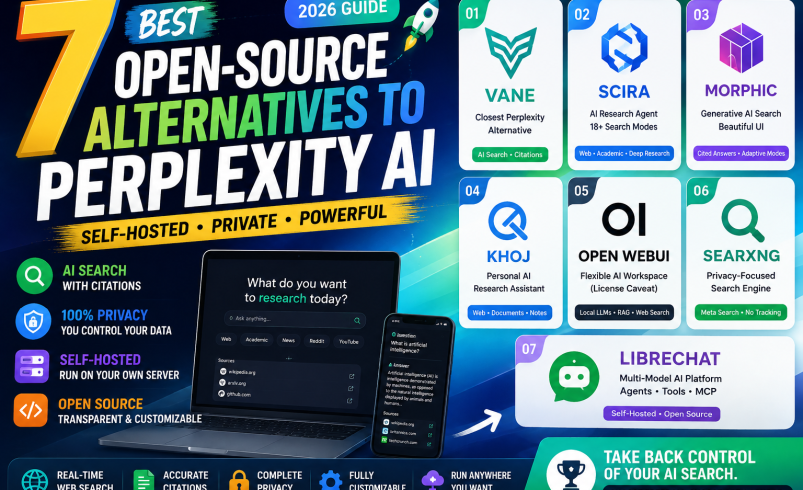

Compare the best open source alternatives to Perplexity AI in 2026, including Vane, Scira, Morphic, Khoj, SearXNG, and LibreChat.
Looking for the best perplexity ai alternatives? Several self-hosted AI search tools can give you cited answers, web research, local LLM support, and more control over your data.
Perplexity AI is popular because it combines web search, AI-generated answers, and source citations in one interface. But some users want more control over their data, the ability to self-host an AI search engine, local LLM support, or freedom to customize the search and model stack.
That is where open-source and self-hostable alternatives become useful.
After reviewing the current project repositories, licensing, search capabilities, deployment options, local-model support, and intended use cases, seven projects stand out for different reasons: Vane (formerly Perplexica), Scira, Morphic, Khoj, Open WebUI, SearXNG, and LibreChat.
The important caveat is that they are not identical products. Vane, Scira, and Morphic are the closest matches for Perplexity-style AI search. Khoj focuses more on personal research and private knowledge. SearXNG is a privacy-focused metasearch layer rather than an AI answer engine. Open WebUI and LibreChat are broader self-hosted AI platforms.
Tool Name Self-Hosted Support Web Search Capability Best For Vane (Perplexica) Yes (Docker / Ollama) Live Web, Academic, Discussion Direct Perplexity Replacement Scira Yes (Docker) Multi-step Agentic Search Deep Research & Analysis Morphic Yes (Docker) Quick & Adaptive Generative Search Customizable UI & Quick Answers Khoj Yes (Local Models) Web & Private Documents Personal AI Knowledge Base Open WebUI Yes (Native Ollama) Web Search & Document RAG General Self-Hosted AI Workspace SearXNG Yes (Docker) Privacy Metasearch Backend Private Search Infrastructure LibreChat Yes (Custom Endpoints) Web Search Tools & Agents Multi-Model AI Workflows
What Is an Open-Source Perplexity AI Alternative?
An open-source Perplexity alternative is software that provides some combination of AI-powered web search, conversational answers, source retrieval, citations, research tools, or document-grounded answers while allowing users to inspect, modify, or self-host the software under its applicable license.
The terms free, open source, and self-hosted are not interchangeable.
- Free describes price, not licensing freedom.
- Open source refers to software distributed under an open-source license.
- Self-hosted means you run the software on infrastructure you control.
- Local LLM means the model runs on your own machine or server instead of being accessed entirely through a cloud API.
- RAG (Retrieval-Augmented Generation) means the model answers using retrieved information, such as documents or search results, alongside the user’s question.
Another important distinction: not every tool in a roundup like this is a one-for-one replacement for Perplexity. The strongest direct matches are the projects whose primary workflow is AI-powered web search and sourced answers. Other AI tools can support adjacent content workflows too, including AI-assisted SEO audits, while the tools below are focused on search, research, or self-hosted AI infrastructure.
How We Evaluated These Tools
This editorial comparison is based on each project’s current official repository or documentation, its stated licensing, documented search and self-hosting capabilities, and how closely its primary workflow matches the Perplexity search intent. We have not treated every feature as universally available: some capabilities depend on the model, search provider, API credentials, or deployment configuration.
| Evaluation Criterion | Focus Area |
| Search & Retrieval | AI Web search accuracy, live source fetching, and citations |
| Model & Hosting | Local LLM support (Ollama), cloud APIs, and Docker deployment |
This comparison uses a practical set of criteria rather than keyword popularity alone:
Because this category changes quickly, licensing and feature claims should always be checked against the current official repository or documentation before commercial deployment.
7 Best Open-Source Perplexity AI Alternatives: Comparison Table
| Tool | Search Capabilities | Local LLM Support | Target Use Case |
| Vane | Web, Academic, Discussion | Yes (Ollama) | Direct Perplexity replacement |
| Scira | Multi-step agentic search | API / Local via provider | Advanced deep research |
| Morphic | Quick & Adaptive search UI | Yes (Ollama / Vercel AI) | Customizable generative UI |
| Khoj | Web & Local Documents | Yes (Local models) | Personal knowledge & RAG |
| Open WebUI | Web Search & RAG | Native Ollama focus | General self-hosted AI workspace |
| SearXNG | Privacy metasearch | N/A (Search backend) | Private search layer |
| LibreChat | Web search tools & Agents | Yes (Custom endpoints) | Multi-model workspace |
Current Open WebUI releases from v0.6.6 onward use the project’s own license with a branding-protection clause; the project itself says this license is not OSI-approved. Earlier code through v0.6.5 remains BSD-3-Clause. Official license documentation.
1. Vane (Formerly Perplexica) — Best Direct Perplexity Alternative
Official project: Vane on GitHub
For instance, Vane is the strongest match for users seeking perplexity ai alternatives. The project was formerly known as Perplexica and is now presented as a privacy-focused AI answering engine that can run on your own hardware.
The current repository documents AI-powered web search with cited sources, local models through Ollama, cloud model providers, multiple search modes, academic and discussion sources, file uploads, domain-specific search, and self-hosting. The repository is MIT licensed.
One practical advantage is the project’s Docker-based setup, which bundles a SearXNG search component so the basic self-hosted stack is easier to assemble.
Why Vane is the closest Perplexity replacement
Perplexity’s core value proposition is the combination of search + synthesis + citations. Vane is built around essentially that same workflow rather than treating web search as a secondary feature in a general-purpose chatbot.
Pros
- ✓ Closest workflow to Perplexity-style AI search
- ✓ Web search with cited sources
- ✓ Local LLM support through Ollama
- ✓ Cloud-model support
- ✓ Self-hosting
- ✓ Research-oriented search modes
- ✓ MIT license
Cons
- ✗ Self-hosting requires technical setup
- ✗ Answer quality depends on the model and search configuration
- ✗ You are responsible for updates and infrastructure
Best for
Users who want “Perplexity, but self-hosted.”
Verdict
Vane is the best direct open-source Perplexity alternative in this comparison. It is the first project I would test if your primary workflow is current web research with AI-generated answers and inspectable citations.
GitHub Repository: Vane on GitHub
Quick Docker Setup:
git clone https://github.com/ItzCrazyKetan/Perplexica.git
cd Perplexica
docker compose up -d
2. Scira — Best for Agentic Research
Official project: Scira on GitHub
Furthermore, Scira stands out among perplexity ai alternatives as an agentic research platform rather than a simple search box. Its current repository describes a workflow in which the system plans a question, retrieves live sources, cross-checks evidence, and returns an answer with inline citations.
Scira also offers multiple specialized search modes, including web, academic, Reddit, GitHub, code, and other research-oriented modes. The project is AGPL-3.0 licensed and includes Docker-based self-hosting instructions.
Why Scira stands out
The key differentiator is research planning. Instead of treating a complex question as a single search request, Scira can break it into subtasks and gather evidence across multiple sources.
Pros
- ✓ Agentic research workflow
- ✓ Inline source citations
- ✓ Multiple specialized search modes
- ✓Academic and technical research support
- ✓ Self-hostable
- ✓AGPL-3.0 license
Cons
- ✗ Full functionality can depend on external AI/search providers
- ✗ More configuration than a simple hosted search service
- ✗ Running the complete stack may involve API costs
Best for
Researchers, developers, analysts, and power users who want multi-step AI research rather than a single generated answer.
Verdict
Scira is one of the most relevant choices for advanced Perplexity-style research. If Vane is the closest direct replacement, Scira is the stronger choice when research depth and agentic planning matter more.
GitHub Repository: Scira on GitHub
Quick Docker Setup:
git clone https://github.com/scira-ai/scira.git
cd scira
docker compose up -d
3. Morphic — Best for a Generative AI Search Experience
Official project: Morphic on GitHub
In addition, Morphic is one of the most visual perplexity ai alternatives, built around a generative user interface.Its current repository documents grounded, cited answers, Quick and Adaptive search modes, multiple model providers, multiple search providers, file uploads, authentication, and Docker deployment.
Morphic supports providers such as OpenAI, Anthropic, Google, Ollama, Vercel AI Gateway, and OpenAI-compatible endpoints. It can also use SearXNG, Tavily, Brave, or Exa depending on configuration.
Why Morphic stands out
Morphic’s main advantage is the search experience itself. Instead of returning plain chat responses, it uses a richer generative interface to present research results.
Pros
- ✓ Grounded, cited answers
- ✓ Generative search UI
- ✓ Quick and Adaptive search modes
- ✓ Multiple search providers
- ✓ Ollama/local-model support
- ✓ Docker deployment
- ✓ Apache-2.0 license
Cons
- ✗ Requires configuration and provider credentials for many setups
- ✗ More of a customizable application than a zero-setup service
- ✗ Quality depends on chosen models and search providers
Best for
Developers and teams who want a modern AI search interface they can self-host and customize.
Verdict
Morphic is a strong Perplexity alternative when interface quality, search customization, and open deployment matter.
GitHub Repository: Morphic on GitHub
Quick Docker Setup:
git clone url?id=18.git
cd morphic
cp .env.example .env
docker compose up -d
4. Khoj — Best for Personal Research and Private Knowledge
Official project: Khoj on GitHub
On the other hand, Khoj differs from standard perplexity ai alternatives by acting as an AI second brain. It can answer questions from the web and from a user’s own documents, and it supports local and online LLMs.
The current project lists support for documents such as PDFs, Markdown, Word files, and Notion content. It also supports custom agents, semantic search, research workflows, and multiple interfaces including browser, desktop, and phone. The repository is AGPL-3.0 licensed.
Why Khoj stands out
If your definition of a Perplexity alternative includes research across the web plus your own private knowledge, Khoj is a better fit than a simple search engine.
Pros
- ✓ Web and document research
- ✓ Local and cloud LLM support
- ✓ Personal knowledge management
- ✓ Custom agents
- ✓ Semantic search
- ✓ Self-hosting
- ✓ AGPL-3.0 license
Cons
- ✗ Not primarily a one-to-one Perplexity clone
- ✗ Its value increases when you have documents or a personal knowledge base
- ✗AGPL licensing may need review for some commercial modifications
Best for
Researchers, writers, students, and professionals building a personal AI knowledge system.
Verdict
Khoj is the strongest research-and-knowledge option in this list.
GitHub Repository: Khoj on GitHub
Quick Setup:
pip install khoj-assistant
khoj
5. Open WebUI — Best for a Flexible Self-Hosted AI Workspace
Official project: Open WebUI on GitHub · Current license
Open WebUI remains one of the most capable self-hosted AI interfaces for users working with local models, Ollama, RAG, documents, and web search. But its current licensing needs to be stated carefully.
According to the project’s own documentation, releases through v0.6.5 used BSD-3-Clause. Starting with v0.6.6 in April 2025, Open WebUI introduced a custom license with a branding-protection clause. The project says the newer license is not OSI-approved, while personal and small-team use remains covered under its documented conditions.
Why Open WebUI belongs in this article
It is not a dedicated Perplexity clone. Instead, it can become a self-hosted AI workspace where web search, local models, RAG, and other workflows live in one place.
Pros
- ✓ Strong local-model ecosystem
- ✓ Ollama support
- ✓ Web search
- ✓ RAG and document workflows
- ✓ Broad provider support
- ✓ Self-hosting
- ✓ Highly customizable
Cons
- ✗ Not a direct Perplexity-style search product
- ✗ More configuration than a dedicated search engine
- ✗ Current licensing and branding rules matter for commercial or white-label deployments
Best for
Users who want a broad self-hosted AI workspace, not just a search engine.
Verdict
Open WebUI is highly capable, but describe it as a self-hosted AI workspace rather than an unrestricted open-source Perplexity clone. The license distinction is important and should not be hidden in a footnote.
GitHub Repository: Open WebUI on GitHub
Quick Docker Setup:
docker run -d -p 3000:8080 --gpus=all -v open-webui:/app/backend/data --name open-webui --restart always ghcr.io/open-webui/open-webui:cuda6. SearXNG — Best for Private Search Infrastructure
Official project: SearXNG on GitHub · Documentation
However, SearXNG can be paired with LLMs to build privacy-focused perplexity ai alternatives.
The official project describes SearXNG as a free, open-source metasearch engine that aggregates results from multiple search services and states that users are neither tracked nor profiled. It is AGPL-3.0 licensed.
Important distinction
SearXNG is not a Perplexity-style AI answer engine by itself. It returns and aggregates search results. You can pair it with an AI application to create a broader AI-search stack.
Pros
- ✓ Privacy-focused search
- ✓ Self-hosting
- ✓ Aggregates multiple search services
- ✓ Highly configurable
- ✓ AGPL-3.0 license
- ✓ Useful as an AI-search backend
Cons
- ✗ No built-in Perplexity-style answer synthesis by itself
- ✗ More technical to deploy
- ✗ Works best as part of a broader search/AI stack
Best for
Privacy-conscious users and developers who want control over the search layer.
Verdict
SearXNG is the best privacy-focused search layer here, not the best direct Perplexity replacement. That distinction is important for accurate comparison.
GitHub Repository: SearXNG on GitHub
Quick Docker Setup:
git clone url?id=21-docker.git
cd searxng-docker
docker compose up -d
7. LibreChat — Best for Multi-Model AI Workflows
Official project: LibreChat on GitHub
LibreChat is a self-hosted AI platform that brings multiple model providers and advanced AI tools into one interface. The current project supports many providers and documents features such as agents, MCP, file search, code execution, custom endpoints, multi-user authentication, and web-search integrations.
The project is MIT licensed.
Why LibreChat belongs in the list
LibreChat is broader than Perplexity. Its real strength is the ability to create a self-hosted AI workspace around multiple models and tools.
Pros
- ✓ Multiple AI providers
- ✓ Self-hosting
- ✓ Local/custom model endpoints
- ✓ Agents and MCP
- ✓ File search
- ✓ Web-search integrations
- ✓ Multi-user support
- ✓ MIT license
Cons
- ✗ Not search-first by design
- ✗ Web-search capabilities can require configuration and provider credentials
- ✗ More complex than a dedicated AI search application
Best for
Developers and power users who want one self-hosted interface for multiple AI models and tools.
Verdict
LibreChat is a better multi-model AI platform than a direct Perplexity clone. Include it when flexibility is more important than reproducing Perplexity’s exact workflow.
GitHub Repository: LibreChat on GitHub
Quick Docker Setup:
git clone https://github.com/danny-avila/LibreChat.git
cd LibreChat
cp .env.example .env
docker compose up -d
Licensing: What “Open Source” Actually Means
| License Type | Key Feature & Commercial Consideration |
| Permissive (MIT / Apache 2.0) | Highly flexible, easy for commercial and private deployment |
| Copyleft (AGPL-3.0 / Custom) | Requires source disclosure or has strict branding clauses |
One of the easiest mistakes in an AI-tool comparison is treating every free or self-hostable application as equally open source.
For Onyx, the current Community Edition is MIT licensed while Enterprise functionality is separately licensed. It is a useful option for enterprise knowledge search, but it is not one of the strongest direct Perplexity matches.
Always read the current LICENSE file before using, modifying, redistributing, or white-labeling software commercially.
Open-Source Alternatives vs Perplexity
| Feature / Aspect | Open-Source Alternatives | Perplexity AI (Hosted) |
| Data Privacy & Control | High (Self-hosted / Local LLMs) | Managed by third party |
| Setup & Maintenance | Technical setup (Docker/APIs) | Zero setup / Subscription |
The real trade-off is convenience versus control.
Perplexity is easier for most casual users. Self-hosted tools become more attractive when privacy, local models, customization, or infrastructure ownership are important.
Which Tool Is Closest to Perplexity?
Vane
Closest overall. Its core workflow is AI web search with generated answers and citations.
Scira
Best for advanced research. It adds planning and multiple research-oriented search modes.
Morphic
Best for a polished generative-search interface.
Khoj
Best for web research plus your own private knowledge.
SearXNG
Best privacy/search layer, not a full answer engine.
Open WebUI
Best flexible AI workspace, with the licensing caveat.
LibreChat
Best multi-model platform for users who want a broad AI stack.
How to Choose the Right Alternative
Choose based on your actual workflow rather than the word “open source” alone.
Opt for Vane if your goal is to recreate the Perplexity experience as closely as possible.
Meanwhile, select Scira if you want deeper multi-step research and specialized search modes.
Go with Morphic if you care about a modern generative search interface and provider flexibility.
In addition, pick Khoj if your research spans both the public web and your private documents.
Consider Open WebUI if you want a general-purpose self-hosted AI workspace.
Alternatively, use SearXNG if your priority is private, controllable web search infrastructure.
Finally, try LibreChat if you want multiple AI providers, agents, tools, and local endpoints in one interface.
Are Open-Source Perplexity Alternatives Really Free?
The software may be free, but the complete system may not be.
Potential costs include:
- VPS or server hosting
- Search APIs
- Cloud LLM APIs
- GPU hardware
- Electricity
- Storage and backups
- Maintenance and monitoring
A local model can reduce recurring API usage, but it does not make hardware and operations free.
A better description is “free/open-source software with optional infrastructure costs” rather than “100% free AI search.”
How to Self-Host a Perplexity Alternative
The installation flow varies, but most projects follow the same pattern:
- Pick one project that matches your workflow.
- Install it using the project’s documented deployment method, often Docker.
- Connect a cloud model or a supported local model.
- Configure web search and search providers.
- Run several real queries that you normally ask Perplexity.
- Verify the citations rather than judging the answer only by its writing quality.
- Secure the deployment before exposing it to other users.
For example, Morphic’s official repository documents Docker deployment and can start PostgreSQL, Redis, SearXNG, and Morphic together. Scira also documents Docker deployment but requires provider credentials for the full feature set. Vane likewise documents self-hosting through its repository.
Self-Hosting and Security
Self-hosting improves control, but it does not automatically make a deployment secure.
At minimum:
- Put internet-facing deployments behind HTTPS and authentication.
- Do not expose administrative endpoints unnecessarily.
- Keep API keys out of public repositories.
- Restrict access to private documents.
- Keep containers and dependencies updated.
- Review telemetry and external-service settings.
- Back up important data.
- Read the software license before white-labeling or redistributing it commercially.
If the system is running inside Docker, remember that localhost inside a container may refer to the container rather than the host machine. This is a common source of local-model connection errors documented in self-hosting guides such as AnythingLLM’s Docker documentation.
Other Tools Worth Considering
Onyx
Onyx Community Edition is stronger for enterprise knowledge search, RAG, agents, and internal company information than for replacing Perplexity’s consumer web-research workflow. The Community Edition is MIT licensed; Enterprise adds organization-focused features.
AnythingLLM
AnythingLLM is especially useful for private documents, RAG, local-first AI, and agents. Its official Docker documentation supports self-hosting and local or remote LLM connections. It is better viewed as a private knowledge/document platform than a direct Perplexity clone.
These tools are worth including in a broader “best self-hosted AI platforms” guide, but keeping them out of the primary seven makes this article more tightly aligned with the target keyword.
Frequently Asked Questions
Is there an official open-source version of Perplexity AI?
No. Perplexity itself is not distributed as an official open-source project. Independent projects such as Vane, Scira, and Morphic attempt to reproduce parts of the AI-search experience.
What is the best option among open-source perplexity ai alternatives?
Vane is the strongest direct match in this comparison because its core purpose is AI-powered web search with generated answers and citations.
What happened to Perplexica?
The project formerly known as Perplexica is now presented as Vane. The current Vane repository is the authoritative place to check its current code, license, and deployment documentation.
Is Scira really open source?
Yes. The current Scira repository is publicly available under AGPL-3.0 and provides instructions for self-hosting. Its hosted service can still depend on external AI/search providers, so open-source software does not automatically mean zero operating cost.
Is Morphic open source?
Yes. The current Morphic repository is licensed under Apache License 2.0 and documents a self-hostable AI-powered search engine with cited answers, multiple search providers, and local-model/provider support.
Is Open WebUI still open source?
Current releases from v0.6.6 onward use Open WebUI’s own license with a branding-protection clause. The project’s documentation explicitly says that license is not OSI-approved open source. Code through v0.6.5 remains BSD-3-Clause.
Can I run an open-source Perplexity alternative locally?
Yes. Vane, Scira, Morphic, Khoj, SearXNG, Open WebUI, and LibreChat can all be self-hosted, although the exact model, search provider, and hardware requirements differ.
Can I use Ollama with a Perplexity alternative?
Yes. Vane explicitly documents Ollama support, and Morphic, Khoj, Open WebUI, and LibreChat support local-model workflows depending on their configured endpoints and current documentation.
What is the best private alternative to Perplexity?
If you mean the search layer, SearXNG is the strongest choice in this article because its official project says users are neither tracked nor profiled. If you also want generated answers, combine the search layer with an AI application that can consume those results.
Are open-source AI search engines free?
The software may be free to use or self-host, but model APIs, search APIs, hosting, GPU hardware, storage, and maintenance can still cost money.
Is self-hosting cheaper than Perplexity?
Sometimes, but not automatically. A local-model setup can reduce recurring API costs, while a hosted setup can be simpler and cheaper than maintaining your own infrastructure for a small casual workflow.
Final Verdict
Overall, choosing from these perplexity ai alternatives depends on your specific self-hosting needs.
Vane is the strongest direct replacement because it focuses on AI-powered web search, synthesized answers, citations, and self-hosting.
Scira is the better choice for agentic, multi-step research. Morphic is compelling for a polished generative-search interface. Khoj is stronger when the web and your private knowledge need to work together. SearXNG is the privacy-focused search layer to choose when search control is the priority. LibreChat is better when you want a broad multi-model AI workspace, while Open WebUI is another powerful option if its current license and branding conditions fit your deployment.
The key advantage of self-hosted/open-source tools is not simply that they can be free. It is the ability to gain more control, customization, model choice, and infrastructure ownership.
The trade-off is that you also become responsible for the system.
Quick picks
- Best direct Perplexity replacement: Vane
- Best for agentic research: Scira
- Best generative AI search UI: Morphic
- Best personal research assistant: Khoj
- Best flexible AI workspace: Open WebUI
- Best private search layer: SearXNG
- Best multi-model platform: LibreChat
Source and freshness note: Licensing and feature statements in this article should be checked against each project’s current official repository or documentation before commercial deployment. AI projects change quickly, and licensing or capabilities can change between releases.

3 Comments
-
[…] system in-house in 2025 on Vespa, an open-source engine, and crawls the web directly through PerplexityBot, maintaining a proprietary index described as covering hundreds of billions of pages with […]
-
[…] 🚫 Never Rely Solely on AI For: • Payment Gateways & Stripe APIs • Authentication & JWT Logic • Database Schema Migrations • Patient / Healthcare Data (HIPAA) 💡 Recommended Reading 7 Best Open Source Perplexity AI Alternatives in 2026 → […]
-
[…] plan. For instance, if you are also exploring broader search options, checking out our guide on open source Perplexity AI alternatives can give you a better perspective on open-source […]