






Effective business finance is the backbone of any successful enterprise, regardless of its size or industry. It dictates a company’s ability to operate, expand, and withstand economic fluctuations. Sound financial management ensures not only day-to-day solvency but also lays the groundwork for long-term profitability and strategic growth. This article explores the fundamental principles, practical strategies, funding avenues, and analytical tools necessary for entrepreneurs and business owners to navigate their financial landscape with confidence and precision.
Understanding the Fundamentals of Business Finance
A solid grasp of financial concepts is non-negotiable for anyone running a business. Establishing a strong foundation in business finance basics empowers decision-makers to interpret financial data, assess performance, and plan for the future.
Core Concepts of Business Finance
At its heart, business finance basics involve understanding how money flows into, through, and out of a company. Key elements include:
- **Revenue:** The total income generated from sales of goods or services before any expenses are deducted.
- **Expenses:** The costs incurred in the process of generating revenue, such as salaries, rent, utilities, and raw materials.
- **Profit:** The amount remaining after all expenses are subtracted from revenue. This can be gross profit (revenue minus cost of goods sold) or net profit (revenue minus all expenses, including taxes).
- **Assets:** Resources owned by the business that have economic value and are expected to provide future benefit. Examples include cash, accounts receivable, inventory, property, and equipment.
- **Liabilities:** Obligations or debts owed to other entities. These can be current (due within one year, like accounts payable) or long-term (due beyond one year, like bank loans).
- **Equity:** The residual value of assets after all liabilities are deducted. It represents the owners’ stake in the business.
Understanding these foundational elements is crucial for interpreting financial health.
Understanding the Difference Between Profit and Cash Flow
Profit and cash flow are related but are not interchangeable. A business can report a profit while still experiencing a cash shortage. For example, a company may record a sale when a customer is invoiced, while the actual payment arrives weeks or months later. At the same time, the business may need to pay employees, suppliers, rent, and other obligations before collecting that business finance receivable.
This distinction is particularly important for businesses that sell on credit or maintain significant inventory. Entrepreneurs should therefore monitor both profitability and available cash rather than relying on a single financial metric.
The U.S. Small Business Administration recommends using financial information such as balance sheets and cash-flow projections to help manage business finances.
Building Financial Literacy for Entrepreneurs
While professional accountants and financial advisors offer invaluable support, developing strong financial literacy for entrepreneurs is paramount. This means more than just knowing the definitions; it involves understanding how these concepts interrelate and impact business operations. Entrepreneurs who are financially literate can:
- Make informed decisions about pricing, investments, and expenditures.
- Communicate effectively with financial professionals and investors.
- Identify potential financial risks and opportunities.
- Set realistic financial goals and track progress towards them.
Even with external expertise, the ultimate responsibility for a company’s financial direction rests with its leadership, making personal financial acumen indispensable.
Cash, Accrual Accounting, and Why Timing Matters
One important concept that business owners should understand is the difference between cash-basis and accrual accounting. Under cash accounting, transactions are generally recorded when money is received or paid. Under accrual accounting, revenue and expenses are generally recognized when the underlying transaction occurs, even if the cash changes hands at a different time.
The accounting method can therefore affect how business performance appears in financial reports. A business owner reviewing profitability should understand which method is being used and avoid assuming that reported profit is the same as cash available in the bank.
The SBA explains that cash and accrual methods present financial activity differently and that understanding the chosen accounting method is part of effective financial management.
Practical Strategies for Managing Business Finances Effectively
Effective managing business finances requires a proactive approach to budgeting, cash flow, and day-to-day financial operations. Implementing robust strategies can significantly improve a company’s financial stability and growth potential.
Implementing Robust Business Budgeting Strategies
A well-constructed budget is a roadmap for financial success. Effective business budgeting strategies involve forecasting income and expenses over a specific period, typically a quarter or a year. Common approaches include:
- **Incremental Budgeting:** Adjusting the previous period’s budget based on expected changes.
- **Zero-Based Budgeting:** Justifying every expense from scratch for each new period, regardless of past spending.
- **Activity-Based Budgeting:** Aligning budgets with specific activities and their associated costs.
Creating a realistic budget involves:
- Analyzing historical financial data.
- Forecasting future sales and expenses based on market conditions and business plans.
- Allocating resources strategically to support operational goals.
- Regularly reviewing and adjusting the budget to reflect actual performance and changing circumstances.
A strong budget helps control costs, identify inefficiencies, and ensure resources are directed where they yield the most value.
Using Budget Variance Analysis to Improve Decisions
Creating a budget is only the first step. Businesses should also compare actual results with budgeted results and investigate significant differences. This process, commonly called variance analysis, can reveal whether revenue is below expectations, whether a particular expense category is increasing faster than planned, or whether a change in customer demand is affecting margins.
A practical monthly review can ask:
- Which revenue assumptions were higher or lower than actual results?
- Which expenses exceeded the budget and why?
- Were the differences temporary or likely to continue?
- Does the forecast need to be updated?
- What specific management action should follow?
This turns the budget from a static document into an active decision-making tool.
Build a Base Case, Downside Case, and Growth Case
A single forecast can create a false sense of certainty. A more resilient approach is to prepare at least three scenarios:
- **Base case:** The most realistic expectation based on current information.
- **Downside case:** Lower sales, delayed customer payments, higher costs, or other adverse conditions.
- **Growth case:** Stronger-than-expected sales or an expansion opportunity requiring additional working capital.
Scenario planning helps management understand how much cash may be required if conditions change and can make funding and spending decisions more deliberate.
Optimizing Business Cash Flow Management
Cash flow is the lifeblood of any business. Positive business cash flow management ensures a company has enough liquid funds to cover its short-term obligations. Strategies for optimizing cash flow include:
- **Accelerating Receivables:** Implementing clear invoicing terms, offering early payment discounts, and promptly following up on overdue invoices.
- **Managing Payables:** Negotiating favorable payment terms with suppliers, taking advantage of credit periods without incurring penalties.
- **Controlling Inventory:** Minimizing excess inventory to reduce holding costs and free up capital.
- **Monitoring Expenses:** Regularly reviewing and cutting unnecessary expenditures.
- **Establishing a Cash Reserve:** Maintaining an emergency fund to cover unexpected costs or periods of low revenue.
Proactive cash flow management prevents liquidity crises and supports operational continuity.
Monitor the Cash Conversion Cycle
For businesses that purchase inventory, sell products, and collect customer payments over time, the cash conversion cycle (CCC) provides another useful way to think about working capital. It focuses on how long cash remains tied up in the operating cycle.
Cash Conversion Cycle = Days Inventory Outstanding + Days Sales Outstanding − Days Payables Outstanding
A rising cycle can indicate that more cash is being tied up in inventory or unpaid customer invoices. A falling cycle may indicate that the business is converting working capital into cash more efficiently.
The appropriate target varies significantly by industry and business model, so owners should compare trends over time and, where reliable data is available, against relevant industry benchmarks rather than treating one number as universally optimal.
Actionable Small Business Finance Tips
For smaller enterprises, specific small business finance tips can make a significant difference:
- **Separate Business and Personal Finances:** Maintain distinct bank accounts and credit cards to simplify accounting and tax preparation.
- **Track Every Expense:** Utilize accounting software or spreadsheets to meticulously record all income and outgoings. This aids budgeting and tax deductions.
- **Understand Your Break-Even Point:** Calculate the sales volume needed to cover all costs, providing a clear target for profitability.
- **Manage Debt Wisely:** Prioritize paying down high-interest debt and avoid taking on excessive liabilities.
- **Regularly Review Pricing Strategies:** Ensure your pricing covers costs, reflects market value, and generates a healthy profit margin.
- **Build Strong Relationships with Financial Professionals:** A good accountant or bookkeeper can provide invaluable guidance and ensure compliance.
These tips contribute to a healthier financial foundation for small businesses.
Small Business Finance Monthly Checklist
A simple recurring review can help business owners identify problems before they become larger financial issues:
- Reconcile business bank and credit accounts.
- Review accounts receivable and overdue invoices.
- Review accounts payable and upcoming obligations.
- Compare actual revenue and expenses with the budget.
- Check gross and net profit margins.
- Review inventory levels and slow-moving stock where applicable.
- Update the short-term cash-flow forecast.
- Set aside appropriate amounts for taxes and other known obligations.
- Review debt balances, interest costs, and upcoming repayments.
- Investigate unusual changes in expenses or revenue.
Maintaining accurate records also supports financial reporting and tax preparation.
Navigating Funding Options for Business Growth
Bilkul. Agar aap “business funding” keyword ek baar naturally add karna chahte hain, to sentence is tarah ho jayega:
Growth often requires capital, and understanding the various avenues for securing funds is a critical aspect of business finance. Different stages of a business and its specific needs will dictate the most appropriate business funding sources.
Exploring Types of Business Financing
There are numerous types of business financing available, each with its own characteristics and suitability:
- **Traditional Bank Loans:** Term loans or lines of credit from commercial banks, often requiring collateral and a strong credit history.
- **SBA Loans:** Government-backed loans (e.g., Small Business Administration in the US) that offer more flexible terms and lower down payments, often through partner banks.
- **Venture Capital:** Equity financing provided by investors to high-growth potential startups in exchange for ownership stakes.
- **Angel Investors:** Wealthy individuals who provide capital for startups, usually in exchange for convertible debt or equity.
- **Crowdfunding:** Raising small amounts of capital from a large number of individuals, often through online platforms (e.g., equity, reward, or debt-based).
- **Grants:** Non-repayable funds provided by government agencies, foundations, or corporations, often for specific purposes or industries.
- **Invoice Factoring/Financing:** Selling or borrowing against accounts receivable to improve immediate cash flow.
- **Merchant Cash Advances:** A lump sum payment in exchange for a percentage of future credit card sales.
The choice depends on factors like the amount needed, repayment capacity, and willingness to give up equity.
How to Choose the Right Business Funding Option
The cheapest source of capital is not automatically the best option. Business owners should evaluate funding based on the purpose of the money, repayment requirements, total financing cost, effect on ownership, speed of access, collateral requirements, and the risk created by the repayment structure.
| Funding option | Potential advantage | Important consideration |
| Bank loan | Predictable debt structure | Requires repayment and may require strong financials or collateral |
| Business line of credit | Flexible access to working capital | Interest and fees can vary |
| Equity investment | No scheduled loan repayment | Reduces the owners’ percentage of ownership |
| Crowdfunding | Can combine funding with market exposure | Platform rules, fees, and obligations vary |
| Grant | May not require repayment | Eligibility and permitted uses can be restrictive |
| Invoice financing | Can accelerate access to receivables | Financing costs can reduce margins |
The U.S. Small Business Administration notes that funding choices can affect how a business is structured and operated, and recommends determining the amount needed and evaluating available funding sources before proceeding.
Preparing for Funding for Small Businesses
Securing funding for small businesses requires thorough preparation. Lenders and investors look for specific indicators of a business’s viability and potential. Key preparation steps include:
- **Develop a Comprehensive Business Plan:** Outline your business model, market analysis, management team, and growth strategy.
- **Create Detailed Financial Projections:** Provide realistic forecasts for revenue, expenses, and cash flow for at least the next 3-5 years.
- **Maintain Accurate Financial Records:** Present clean, up-to-date financial statements (income statements, balance sheets, cash flow statements).
- **Build a Strong Credit Profile:** Both personal and business credit scores are often scrutinized.
- **Clearly Articulate Your Use of Funds:** Explain precisely how the capital will be utilized and how it will contribute to growth and repayment.
- **Prepare a Compelling Pitch:** Be ready to present your business case clearly and confidently.
Diligent preparation significantly increases the likelihood of securing necessary capital.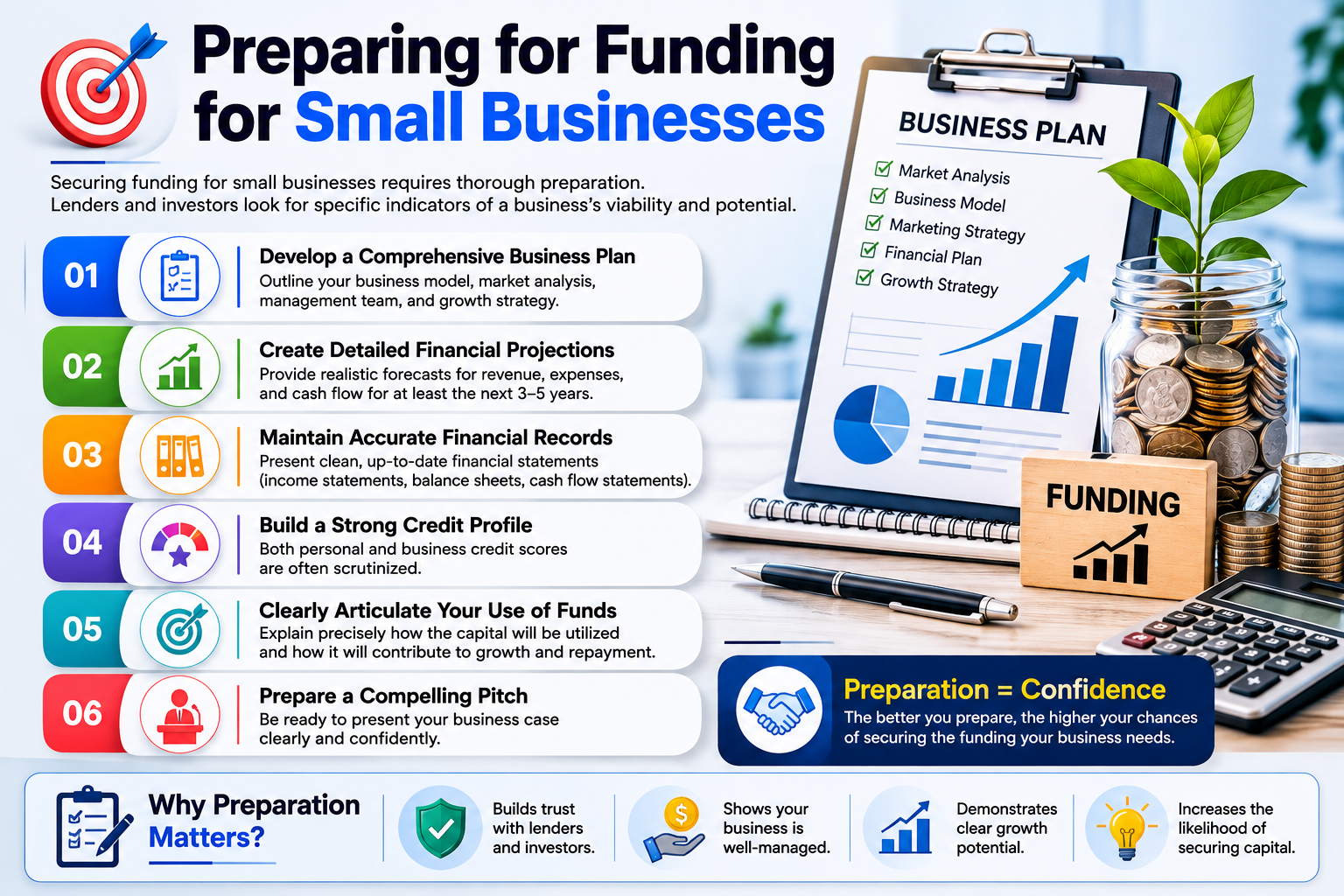
What Lenders and Investors May Want to Understand
A funding request becomes stronger when the business can clearly connect the requested capital to a specific business need and a credible financial plan. Depending on the funding source, useful supporting information may include:
- Historical revenue, expenses, and profitability.
- Current assets, liabilities, and available cash.
- Existing debt and repayment obligations.
- A clear explanation of how the requested funds will be used.
- Financial projections and the assumptions behind them.
- Relevant information about the management team and business model.
- Evidence supporting major revenue or expense assumptions.
For U.S. small businesses, the SBA specifically recommends preparing a business case, financial statements, forecasts, and information about the intended use of funds when seeking additional funding.
Funding Readiness: Questions to Answer Before Applying
Before submitting a financing application, a business owner should be able to answer:
- How much capital is actually required?
- What specific business problem or opportunity will the money address?
- What will the funds purchase or finance?
- How will the investment generate additional revenue, reduce costs, or strengthen operations?
- How will repayments be made under a conservative revenue scenario?
- What happens if sales are lower than forecast?
- What documents can support the financial assumptions?
Answering these questions in advance helps prevent a business from borrowing more than it can reasonably support.
Deciphering Business Financial Statements for Insight
Financial statements are more than just compliance documents; they are powerful tools for understanding a business’s past performance and guiding future decisions. Effective understanding business financial statements is crucial for strategic planning.
Key Business Financial Statements and Their Purpose
Three primary statements provide a comprehensive view of a company’s financial health:
- **Income Statement (Profit and Loss Statement):** Shows a company’s revenues, expenses, and profit or loss over a period (e.g., a quarter or year). It reveals profitability.
- **Balance Sheet:** Presents a snapshot of a company’s assets, liabilities, and equity at a specific point in time. It indicates financial position.
- **Cash Flow Statement:** Details the cash generated and used by a company over a period, categorized into operating, investing, and financing activities. It highlights liquidity.
Understanding business financial statements allows stakeholders to assess profitability, solvency, and operational efficiency.
How the Three Financial Statements Work Together
The three statements should not be analyzed in isolation.
For example, an increase in sales on the income statement may look positive, but if those sales are mostly made on credit, accounts receivable can increase on the balance sheet while operating cash flow remains under pressure. Similarly, purchasing additional inventory may increase assets while reducing available cash.
This is why an experienced financial review looks for relationships between statements rather than focusing on a single figure.
Leveraging Statements for Financial Planning for Businesses
Analyzing financial statements goes beyond simply reading the numbers. It involves identifying trends, calculating ratios, and benchmarking against industry standards to inform financial planning for businesses. For example:
- **Profitability Ratios:** Gross profit margin, net profit margin, return on assets – indicate how efficiently a company generates profit.
- **Liquidity Ratios:** Current ratio, quick ratio – assess a company’s ability to meet short-term obligations.
- **Solvency Ratios:** Debt-to-equity ratio – measure a company’s ability to meet its long-term debts.
- **Efficiency Ratios:** Inventory turnover, accounts receivable turnover – show how effectively assets are being used.
By regularly reviewing these metrics, businesses can identify areas for improvement, forecast future performance, and develop robust strategies for growth and risk mitigation. This analytical approach is central to effective financial planning for businesses.
A Practical Financial Ratio Review
Financial ratios become more useful when they are viewed as trends rather than isolated numbers. For example, a declining gross profit margin may indicate changes in product costs, pricing, discounts, or sales mix. A rising accounts-receivable balance may warrant closer examination of collection timing. An increasing debt-to-equity ratio may indicate greater financial leverage and therefore greater exposure to debt obligations.
A useful review should therefore compare:
- Current results with previous periods.
- Actual results with the business budget.
- Results across major products, services, or locations where meaningful.
- Ratios against appropriate industry benchmarks when reliable benchmark data is available.
The objective is not to pursue a particular ratio in isolation, but to understand what changed, why it changed, and what management action may be appropriate.
Break-Even Analysis for Better Financial Decisions
Break-even analysis helps a business estimate the sales level at which total revenue covers total costs.
Break-Even Units = Fixed Costs ÷ (Selling Price per Unit − Variable Cost per Unit)
For example, if monthly fixed costs are $10,000, a product sells for $50, and its variable cost is $30 per unit:
$10,000 ÷ ($50 − $30) = 500 units
The business would need to sell approximately 500 units to cover those specified fixed and variable costs under the assumptions used in the example. Actual decisions should also consider taxes, financing costs, changes in pricing, product mix, and other relevant expenses.
Financial Red Flags Business Owners Should Investigate
No single metric automatically indicates financial failure, but several changes deserve closer examination:
- Revenue is increasing while operating cash flow repeatedly weakens.
- Accounts receivable grows faster than sales.
- Inventory continues increasing without a corresponding improvement in sales.
- Gross margins decline over several reporting periods.
- Debt repayments consume an increasing share of available cash.
- The business repeatedly relies on short-term borrowing to fund ordinary operating expenses.
- Financial records are consistently delayed or unreconciled.
These indicators should be investigated in context rather than treated as automatic diagnoses. A qualified accountant or financial advisor can help determine whether a particular trend reflects a temporary issue or a deeper structural problem.
Common Questions on Business Finance
Entrepreneurs frequently encounter specific questions when managing their business finance. Here are answers to some common inquiries:
Q: When should a small business hire a professional bookkeeper or accountant?
A: It’s advisable to engage a professional as soon as your transactions become too complex or time-consuming for you to manage accurately. This often occurs when you start hiring employees, dealing with inventory, or generating significant revenue. A professional ensures compliance, provides strategic advice, and frees up your time.
Q: What are common financial pitfalls for new businesses?
A: Common pitfalls include underestimating startup costs, poor cash flow management, inadequate pricing, failing to separate business and personal finances, neglecting to track expenses, and not setting aside funds for taxes.
Q: How important is a business credit score?
A: Extremely important. A strong business credit score can unlock better terms for loans, lines of credit, and supplier agreements. It demonstrates financial reliability and can be crucial for securing future funding or partnerships.
Q: What accounting software is recommended for small businesses?
A: Popular options include QuickBooks, Xero, and FreshBooks. The best choice depends on your specific needs, budget, and desired features, such as invoicing, payroll integration, or inventory management.
Q: What is the most important financial metric for a small business?
A: There is no single metric that is appropriate for every business. Owners should generally monitor profitability, cash position, operating cash flow, working capital, debt obligations, and key operating metrics relevant to their industry. The most useful dashboard is one that connects financial results with the business decisions that drive them.
Q: How often should a business review its finances?
A: A basic financial review should generally occur regularly rather than only at tax time. Many businesses benefit from monthly financial statement reviews, while cash-intensive or rapidly changing businesses may need more frequent cash-flow monitoring. The appropriate frequency depends on transaction volume, business size, seasonality, and financial risk.
Q: What is working capital in business finance?
A: Working capital generally refers to the resources available to support short-term operations, often evaluated using current assets and current liabilities. Monitoring receivables, inventory, payables, and available cash helps owners understand whether day-to-day operations can be funded without unnecessary financial strain.
Q: Should business owners manage finances themselves or hire an accountant?
A: Many owners can handle basic financial monitoring with appropriate systems and software, but professional assistance becomes increasingly valuable as transactions, employees, inventory, taxes, financing, or reporting requirements become more complex. A bookkeeper, accountant, CPA, or financial advisor can provide different types of support, so the appropriate professional depends on the business’s needs and jurisdiction.
Conclusion
Effective business finance is not merely about tracking numbers; it’s about strategic decision-making that drives sustainable growth and ensures long-term viability. From understanding the fundamental concepts and implementing sound budgeting and cash flow strategies to intelligently navigating funding options and interpreting financial statements, every aspect plays a crucial role. Proactive financial management, coupled with continuous learning and adaptation, empowers businesses to overcome challenges, seize opportunities, and build a resilient foundation for enduring success.
Expert Perspective: Turning Financial Data Into Business Decisions
The most valuable financial-management practice is not simply collecting more numbers; it is consistently connecting financial information to business decisions. Revenue, margins, cash flow, working capital, debt, and operating costs should help answer practical questions such as whether to hire, raise prices, purchase inventory, reduce expenses, invest in equipment, or seek external funding.
Business owners should also document the assumptions behind forecasts and revisit them as actual results become available. When financial information is incomplete, inconsistent, or difficult to interpret, consulting a qualified accounting or finance professional can help reduce the risk of making decisions based on inaccurate information.
For U.S. businesses, authoritative guidance on bookkeeping, financial management, business planning, and funding is available through the U.S. Small Business Administration and Internal Revenue Service small-business resources. Requirements and financial practices can differ by country, business structure, and industry, so readers should verify applicable local rules before making tax, accounting, or financing decisions.