





Computer Information Technology
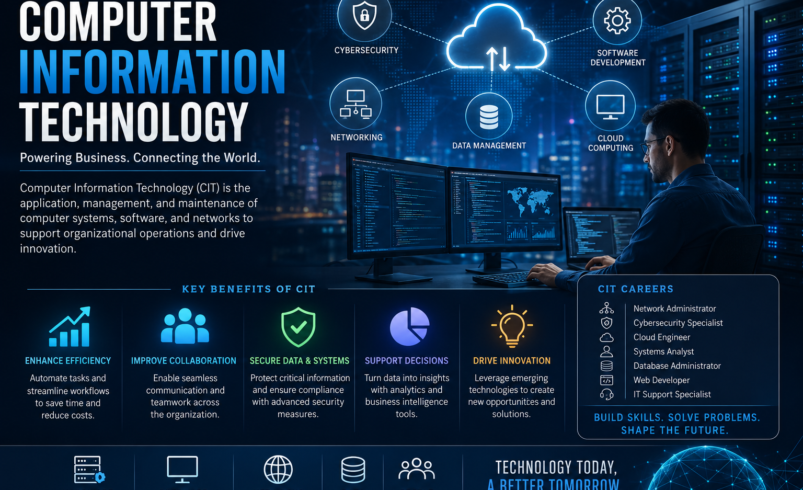
Computer information technology (CIT) is a field that focuses on the application, management, and maintenance of computer systems and software to support organizational operations. It encompasses the entire ecosystem of digital infrastructure, from hardware and software to networks and data, ensuring that information flows efficiently and securely within businesses and institutions. This article explores the fundamental aspects of computer information technology, its critical function in modern operations, the diverse career paths it offers, and its future trajectory.
Understanding Computer Information Technology
At its core, computer information technology involves the study and application of computers and telecommunications equipment to store, retrieve, transmit, and manipulate data. It’s a broad discipline that ensures technology serves practical business needs. Key components include:
- Hardware: Physical components like servers, workstations, mobile devices, and networking equipment.
- Software: Operating systems, applications, and utilities that enable hardware to perform tasks.
- Networks: Systems that connect computers and devices, allowing for communication and resource sharing, whether local (LAN) or global (WAN).
- Data Management: The processes and systems for collecting, storing, organizing, and retrieving data efficiently and securely.
So, how computer information technology works is by integrating these components to create robust systems that support an organization’s goals. For instance, IT professionals configure servers, install operating systems, manage databases, and secure networks to ensure employees can access the tools and information they need to perform their jobs effectively. This practical application of technology is what defines CIT.
A Practical Example of Computer Information Technology in Action
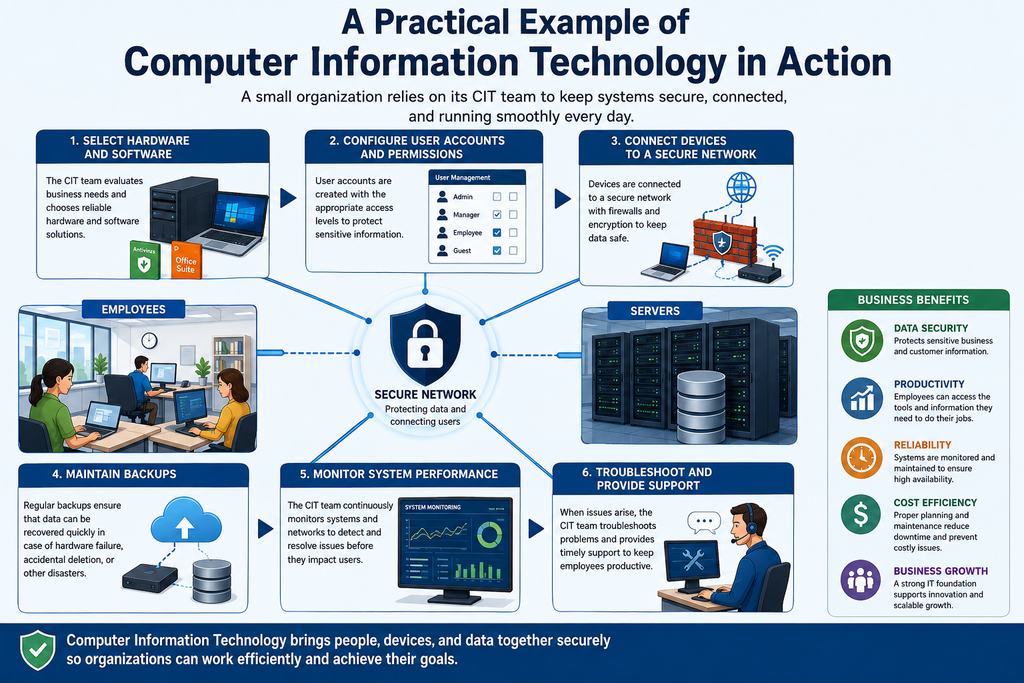
Consider a small organization that needs employees to securely access shared files, business applications, email, and customer information. A CIT team may help select appropriate hardware and software, configure user accounts and permissions, connect devices to a secure network, maintain backups, monitor system performance, and troubleshoot problems when users encounter technical issues.
This example shows why computer information technology is broader than simply using computers. IT professionals must consider how different technologies interact, how users access those systems, how information is protected, and how the technology supports the organization’s operational requirements. In practice, successful IT work combines technical knowledge with documentation, communication, troubleshooting, risk management, and an understanding of business priorities.
The Strategic Role of IT in Business
The role of IT in business has evolved from a support function to a strategic imperative. Modern organizations rely heavily on computer information technology to drive efficiency, foster innovation, and maintain a competitive edge. Here’s how:
- Enhancing Efficiency: Automation of routine tasks, streamlined workflows, and integrated systems reduce manual effort and accelerate processes.
- Enabling Communication and Collaboration: Email, instant messaging, video conferencing, and shared document platforms facilitate seamless internal and external communication.
- Securing Data and Systems: Cybersecurity measures protect sensitive information from breaches, ensuring compliance with regulations and maintaining customer trust.
- Supporting Decision-Making: Business intelligence tools and data analytics provide insights from vast datasets, empowering leaders to make informed strategic decisions.
- Driving Innovation: IT departments often spearhead the adoption of new technologies, enabling businesses to develop new products, services, and operational models.
From managing supply chains with enterprise resource planning (ERP) systems to powering e-commerce platforms and customer relationship management (CRM) tools, IT is the backbone of nearly every business function.
IT Governance, Risk Management, and Business Continuity
As organizations become more dependent on technology, effective IT management also involves governance and risk management. IT teams may establish policies for access control, software updates, data protection, system availability, vendor management, and incident response.
Business continuity is another important consideration. Organizations need plans for maintaining or restoring essential technology services when systems become unavailable because of technical failures, security incidents, infrastructure problems, or other disruptions. Regular backups, documented recovery procedures, redundancy, monitoring, and testing can help organizations prepare for these situations.
Cybersecurity should also be treated as an ongoing risk-management process rather than a one-time technical installation. The National Institute of Standards and Technology (NIST) Cybersecurity Framework 2.0 provides a flexible framework for organizations to manage and reduce cybersecurity risk.
Computer Information Technology Careers and In-Demand Skills
The field of CIT offers a wide array of rewarding computer information technology careers. These roles are essential across all industries, leading to strong demand for skilled professionals. Some common computer information technology jobs include:
- Network Administrator: Manages and maintains an organization’s computer networks.
- Systems Analyst: Bridges the gap between business needs and IT solutions, designing and implementing systems.
- Cybersecurity Specialist: Protects systems and data from cyber threats.
- Database Administrator: Manages and maintains databases, ensuring data integrity and accessibility.
- IT Support Specialist: Provides technical assistance and troubleshooting for users.
- Cloud Engineer: Designs, implements, and manages cloud-based infrastructure and services.
- Web Developer: Creates and maintains websites and web applications.
To succeed in these roles, certain IT skills in demand are crucial. These include proficiency in cloud computing (e.g., AWS, Azure, Google Cloud), data analytics, project management, network security, operating systems (Windows, Linux), programming languages (Python, Java, SQL), and strong problem-solving abilities. Soft skills like communication, teamwork, and adaptability are also highly valued.
Practical Skills That Help Build a Computer Information Technology Career
A strong CIT career usually requires more than theoretical knowledge. Hands-on practice helps learners understand how systems behave in real-world situations and provides opportunities to demonstrate technical ability to employers.
Useful projects can include:
- Setting up a small virtualized network and documenting its configuration.
- Creating a basic SQL database and practicing queries, backups, and data organization.
- Building a simple website and testing it across different devices.
- Installing and administering a Linux-based environment.
- Creating a basic cloud-hosted application or service while documenting its configuration.
- Developing a troubleshooting guide for common hardware, software, or connectivity problems.
- Creating a small cybersecurity lab focused on defensive monitoring, account management, and secure configuration.
A practical portfolio can be especially useful because it demonstrates what a learner can actually build, configure, troubleshoot, or document. Keeping project notes, screenshots, diagrams, configuration records, and explanations of technical decisions can also make the learning process easier to evaluate.
Computer Information Technology Career Outlook
Career prospects vary considerably by occupation, so readers should evaluate individual job categories instead of assuming that every IT role will grow at the same rate. The U.S. Bureau of Labor Statistics publishes occupation-specific employment projections, wage information, and education requirements for computer and information technology careers.
These differences highlight an important career-planning lesson: learning foundational IT concepts is valuable, but professionals should also monitor how automation, cloud services, cybersecurity requirements, software development practices, and changing business needs are affecting individual occupations.
Navigating a Computer Information Technology Degree
Pursuing a computer information technology degree provides a structured pathway into the field. Educational options range from associate to master’s degrees, each offering different levels of depth and specialization:
- Associate’s Degree: Often focuses on foundational IT skills, preparing students for entry-level support or technician roles.
- Bachelor’s Degree: A comprehensive program covering core IT concepts, including networking, database management, programming, and information security. This is a common entry point for many professional IT roles.
- Master’s Degree: Designed for professionals seeking advanced specialization in areas like cybersecurity, IT management, or data science, often leading to leadership positions.
Typical curriculum components for a computer information technology degree include courses in networking fundamentals, operating systems, database systems, programming logic, information security, web development, and IT project management. Many programs also incorporate practical labs and internships to provide real-world experience.
How to Evaluate a Computer Information Technology Degree Program
Students comparing CIT programs should look beyond the degree title. Program quality can depend on curriculum depth, practical learning opportunities, faculty expertise, available technology, accreditation where applicable, and career-support services.
Before choosing a program, consider:
- Does the curriculum include current networking, cloud, database, cybersecurity, and systems topics?
- Are students given access to practical labs or project-based assignments?
- Does the program provide internship, cooperative education, or other work-experience opportunities?
- Are courses regularly updated as technology and industry practices change?
- Does the institution clearly explain admission requirements, total costs, and expected program outcomes?
- Are graduates given access to career services and professional development resources?
The right choice depends on the student’s career objective. Someone interested in infrastructure may prioritize networking and cloud courses, while someone interested in cybersecurity may look for security operations, risk management, digital forensics, and secure systems content.
CIT vs. Computer Science: Choosing Your Path
While often confused, there are distinct differences between computer information technology vs computer science. Understanding these can help individuals choose the right educational and career path:
- Computer Information Technology (CIT): Focuses on the application, implementation, and management of technology within an organizational context. CIT professionals are often concerned with how existing technology can solve business problems, optimize systems, and support users. Their work is more hands-on with hardware, software, networks, and data management in a practical setting.
- Computer Science (CS): Emphasizes the theoretical foundations of computation, algorithms, and software development. CS professionals are typically involved in designing new software, developing complex algorithms, and exploring the fundamental principles behind computing. Their work is often more abstract and focused on creating new technologies.
In essence, CIT is about applying technology, while CS is about creating technology. Both fields are vital and often intersect, but their primary focuses differ significantly.
CIT vs. Information Systems vs. Computer Science
Another useful distinction is between CIT, information systems, and computer science. These disciplines overlap, but they tend to emphasize different questions.
Field | Primary emphasis | Common areas of study
Computer Information Technology | Applying and managing technology in practical environments | Networking, systems administration, cybersecurity, databases, cloud computing
Information Systems | Using technology and information to support organizational and business objectives | Business analysis, databases, enterprise systems, project management
Computer Science | Computing theory, algorithms, programming, and software development | Algorithms, data structures, programming, artificial intelligence, computational theory
The boundaries are not absolute. Universities may define programs differently, and employers often evaluate candidates based on their actual skills and experience rather than the degree title alone. Reviewing the specific curriculum and intended career outcomes is therefore more useful than relying only on the name of a program.
The Future and Benefits of Computer Information Technology
The future of computer information technology is characterized by rapid innovation and increasing integration into every aspect of life and business. Key trends shaping this future include:
- Artificial Intelligence (AI) and Machine Learning (ML): Automating tasks, enhancing data analysis, and enabling predictive capabilities across industries.
- Cloud Computing: Continued migration of infrastructure and applications to cloud platforms, offering scalability, flexibility, and cost efficiency.
- Internet of Things (IoT): The proliferation of connected devices generating vast amounts of data, requiring robust IT infrastructure for management and analysis.
- Advanced Cybersecurity: Evolving threats necessitate sophisticated defenses, making cybersecurity an even more critical component of IT.
- Edge Computing: Processing data closer to its source to reduce latency and improve real-time decision-making.
The benefits of computer information technology are profound. For organizations, it translates into enhanced operational efficiency, improved decision-making through data insights, stronger security postures, and the ability to innovate rapidly. For individuals, it offers diverse and high-demand career opportunities, continuous learning, and the chance to contribute to technological advancements that shape the world.
How AI Is Changing Computer Information Technology
Artificial intelligence is increasingly becoming part of everyday IT operations. Rather than replacing every IT function, AI can change how professionals perform tasks such as monitoring systems, analyzing large volumes of information, assisting with troubleshooting, detecting unusual activity, and automating repetitive workflows.
This makes foundational IT knowledge increasingly important. Professionals need to understand the systems being automated so they can evaluate outputs, identify errors, protect sensitive information, and make appropriate decisions when automated tools produce unreliable or incomplete results.
For CIT professionals, an important long-term skill is therefore the ability to combine technical fundamentals with responsible use of automation. Understanding limitations, security implications, data quality, privacy considerations, and human oversight can be as important as knowing how to operate a particular AI-enabled tool.
Cybersecurity as a Core Computer Information Technology Skill
Cybersecurity is relevant to almost every area of CIT because networks, endpoints, applications, databases, and cloud environments all require appropriate protection. Basic security practices include strong identity and access management, timely software updates, secure configurations, appropriate backups, monitoring, employee awareness, and documented incident-response procedures.
For organizations seeking a structured approach, NIST’s Cybersecurity Framework 2.0 provides guidance for managing and reducing cybersecurity risk. NIST also emphasizes that organizations should adapt cybersecurity practices to their own missions, risks, and circumstances rather than applying a single identical approach to every environment.
This is an important distinction for students and professionals: cybersecurity is not limited to specialized security jobs. A network administrator, database professional, cloud engineer, software developer, or IT support specialist may all have responsibilities that affect an organization’s security posture.
Frequently Asked Questions About Computer Information Technology
What is computer information technology?
Computer information technology (CIT) is the field that deals with the application, management, and maintenance of computer systems, software, and networks to support organizational operations and achieve business objectives.
How computer information technology works?
How computer information technology works involves integrating hardware, software, networks, and data management systems to process, store, and transmit information. IT professionals design, implement, and manage these systems to ensure efficient and secure operations for users and organizations.
What are typical computer information technology jobs?
Typical computer information technology jobs include network administrator, systems analyst, cybersecurity specialist, database administrator, IT support specialist, cloud engineer, and web developer, among others.
Is a computer information technology degree worth it?
Yes, a computer information technology degree is generally considered valuable. It provides foundational knowledge and practical skills for a wide range of in-demand careers, offering strong job prospects and competitive salaries in a continuously growing field.
What skills should a computer information technology student learn first?
Students can begin with foundational concepts such as computer hardware, operating systems, networking, databases, troubleshooting, cybersecurity fundamentals, and technical communication. After developing these basics, they can specialize in areas such as cloud computing, cybersecurity, data management, systems administration, or web development.
Can you work in computer information technology without a degree?
Some IT occupations have flexible education requirements, although requirements vary by role and employer. For example, the U.S. Bureau of Labor Statistics notes that some computer support specialists may qualify with a high school diploma plus relevant IT certifications, while other positions commonly require a bachelor’s degree.
This means prospective IT professionals should evaluate the requirements of the specific occupation they want rather than assuming that either a degree or a certification is universally required.
Is certification useful for a computer information technology career?
Certifications can help demonstrate knowledge in a specific technical area, particularly when they align with an individual’s target occupation. However, certification should complement rather than replace practical skills. Employers may also evaluate projects, internships, troubleshooting ability, communication skills, education, and previous work experience.
What is the difference between IT and cybersecurity?
IT is a broad field covering the implementation, management, maintenance, and support of technology systems. Cybersecurity is a specialized area focused on protecting systems, networks, applications, data, and users from security risks. The two fields overlap because secure technology management is an important part of modern IT.
Conclusion
Computer information technology is an indispensable force driving progress and efficiency across all sectors. From managing daily operations to enabling strategic growth and innovation, its impact is pervasive. The field offers a dynamic environment for professionals, with a constant need for new skills and adaptability to emerging technologies. As technology continues to advance, the importance and breadth of computer information technology will only expand, presenting continuous opportunities for those who engage with this vital discipline.
Sources and Further Reading
- U.S. Bureau of Labor Statistics, Occupational Outlook Handbook — employment, education, wage, and job-outlook information for computer and information technology occupations.
- National Institute of Standards and Technology (NIST), Cybersecurity Framework 2.0 — guidance for managing and reducing cybersecurity risk.
- NIST, Cybersecurity, Enterprise Risk Management, and Workforce Management Quick-Start Guide — guidance connecting cybersecurity risk management with workforce planning and evolving technology needs.