






Cheap Fitness Franchises: A Guide to Affordable Fitness Business Opportunities
The health and wellness sector continues its robust growth, attracting entrepreneurs seeking opportunities. For many, the prospect of owning a fitness business is appealing, but the initial capital required can be a significant barrier. This is where cheap fitness franchises present a compelling solution. They offer a viable path to entrepreneurship in a thriving industry without the prohibitive startup costs often associated with traditional gyms. This article will guide you through understanding low cost gym franchises and identifying truly affordable fitness business opportunities, providing insights into how to enter this market strategically.
What to Check Before Choosing a Cheap Fitness Franchise
Affordability should not be judged by the franchise fee alone. A franchise with a low entry fee can still require substantial spending on equipment, rent, renovations, payroll, insurance, technology, marketing, and working capital. Prospective franchisees should therefore calculate the estimated total investment rather than comparing brands solely by their advertised franchise fee.
- Initial franchise fee
- Real estate and security deposits
- Construction or leasehold improvements
- Fitness equipment and supplies
- Technology and software
- Insurance and professional fees
- Licenses and permits
- Initial advertising and promotional expenses
- Employee recruitment and training
- Inventory, if applicable
- Working capital for the first several months
- Ongoing royalties and advertising contributions
This approach helps distinguish genuinely affordable fitness business opportunities from franchises that simply advertise a low initial fee.
The Appeal of Low-Cost Fitness Franchises
Entrepreneurs are increasingly drawn to low investment gym business models for several reasons. These models often provide a more accessible entry point into the fitness industry, reducing the financial risk associated with launching a new venture. The inherent benefits of franchising—such as established brand recognition and operational blueprints—are amplified when combined with a lower initial investment, making them particularly attractive.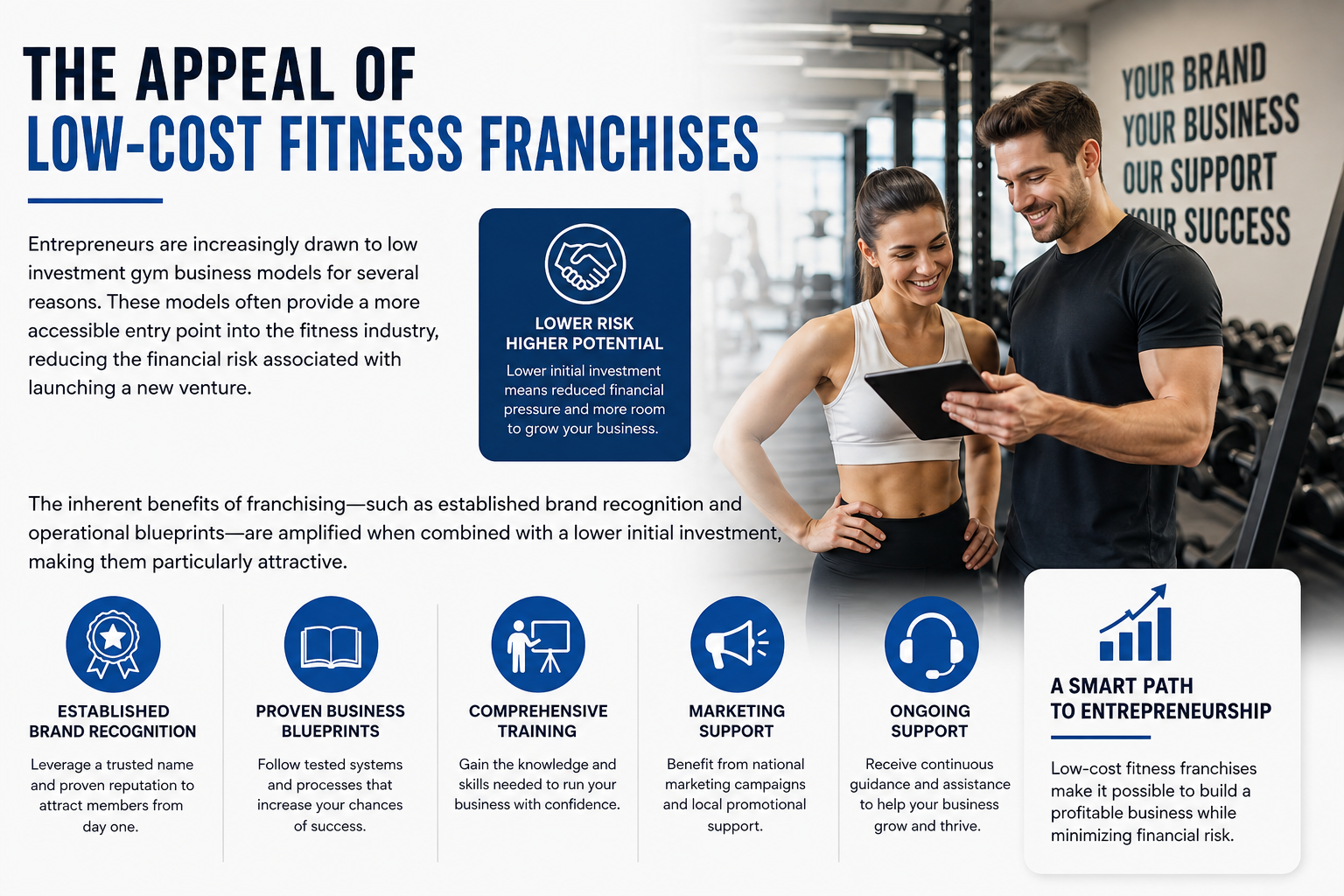
Reduced Financial Barrier to Entry
One of the primary advantages of these models is their ability to make starting a fitness franchise with little money a realistic goal. Unlike large, full-service gyms that demand substantial real estate, extensive equipment, and a large staff, many low-cost franchises focus on specialized services, smaller footprints, or mobile operations. This significantly lowers the capital needed for initial setup, allowing a broader range of individuals to pursue their entrepreneurial aspirations in fitness.
Leveraging an Established Brand and Support System
Even a budget fitness franchise option provides the invaluable benefit of an established brand. Franchisees gain immediate access to a recognized name, proven business strategies, comprehensive training programs, and ongoing marketing support. This infrastructure reduces the learning curve and mitigates many of the risks associated with independent startups. From site selection assistance to operational manuals and marketing campaigns, the franchisor’s support system is designed to help franchisees succeed.
Understanding the Difference Between Low Cost and Low Risk
A low-cost fitness franchise is not automatically a low-risk business. Lower startup costs can reduce the amount of capital required, but they do not eliminate common business risks such as weak local demand, high customer acquisition costs, poor retention, unfavorable lease terms, staffing challenges, or unexpected operating expenses.
- How many members are needed to reach monthly break-even?
- What percentage of revenue goes toward rent, payroll, royalties, and advertising?
- How much working capital is recommended after opening?
- What happens if membership growth is slower than projected?
- How dependent is the business on the owner’s personal involvement?
- What additional fees could arise after signing the franchise agreement?
Looking at these questions alongside the advertised investment range gives a more realistic picture of affordability.
Deconstructing Fitness Franchise Investment Costs
Understanding the various financial components is crucial when evaluating any franchise opportunity. For those seeking the cheapest gym franchises to open, a detailed breakdown of the fitness franchise investment cost is essential to identify where savings can be made and what constitutes a truly affordable option.
Initial Franchise Fees and Royalty Structures
Every franchise requires an initial franchise fee, which grants the franchisee the right to use the brand name and business system. These fees can range widely, from a few thousand dollars for smaller, niche concepts to tens of thousands for larger brands. Beyond this, ongoing royalty fees, typically a percentage of gross revenue, are paid to the franchisor. When exploring affordable fitness business opportunities, it’s important to compare these fees across different brands, as they significantly impact the overall financial commitment. Some low-cost models might have lower upfront fees but slightly higher royalties, or vice-versa.
Equipment, Build-Out, and Operational Expenses
Beyond the initial fees, significant fitness franchise startup costs include equipment, leasehold improvements (build-out), and initial operational capital. For low-cost models, these expenses are often minimized. For example:
Equipment: Franchises focusing on bodyweight exercises, small group training, or specialized equipment (e.g., EMS training) require less capital than those needing extensive cardio and strength machines.
Build-Out: Smaller footprints, existing commercial spaces requiring minimal renovation, or even mobile units drastically reduce construction and design costs.
Operational Expenses: Lower rent, fewer staff members, and streamlined operations contribute to reduced initial working capital requirements.
A Practical Fitness Franchise Startup Budget
A useful way to evaluate fitness franchise startup costs is to create a complete startup budget before making a commitment. The exact figures vary by franchise, location, facility size, and business model, so the following framework should be treated as an example rather than a prediction of actual costs.
| Cost Category | What to Consider |
| Franchise fee | Initial payment for the right to operate under the franchise system |
| Real estate | Lease, deposit, utilities, and other occupancy-related costs |
| Build-out | Flooring, lighting, signage, showers, reception area, and required improvements |
| Equipment | Machines, weights, training tools, technology, and replacement costs |
| Insurance | General liability, property, workers’ compensation, and other required coverage |
| Technology | Membership management, payment processing, scheduling, websites, and software |
| Marketing | Grand-opening promotions, local advertising, digital marketing, and ongoing campaigns |
| Payroll | Trainers, managers, reception staff, and employer-related costs |
| Working capital | Cash reserved for operating expenses before the business reaches a stable revenue level |
The most important point is to maintain a working-capital reserve rather than allocating every available dollar to opening the facility. A business can have a successful launch and still face cash-flow pressure if membership revenue takes longer than expected to build.
How to Calculate the Break-Even Point
Break-even analysis can help prospective franchisees determine whether a low-cost gym concept is financially realistic for their market.
Break-even members = Monthly fixed costs ÷ Average monthly contribution per member
The contribution per member should account for costs that vary with each customer rather than simply using the membership price. Depending on the business model, this can include payment processing, trainer compensation, supplies, and other variable expenses.
For example, if a business has $20,000 in monthly fixed costs and generates an average contribution of $100 per member, it would require approximately 200 active members to cover those costs under this simplified model.
This is only an illustrative calculation. Actual break-even requirements should incorporate the franchise’s specific pricing, staffing structure, royalties, advertising fees, occupancy costs, taxes, and other expenses.
Identifying the Best Affordable Fitness Franchises
Selecting the right franchise requires careful research and alignment with personal goals and financial capacity. For those prioritizing affordability, focusing on specific models can help identify the best affordable fitness franchises and viable small fitness franchise opportunities.
Niche and Boutique Models
Many of the most accessible cheap fitness franchises operate within niche or boutique segments. These often focus on a specific type of workout (e.g., barre, Pilates, high-intensity interval training, boxing, yoga) or a particular demographic. Their specialized nature often means:
Smaller Space Requirements: Less square footage translates to lower rent and utility costs.
Targeted Equipment: Investment is concentrated on specific equipment rather than a broad range.
Streamlined Staffing: Fewer employees are needed to deliver specialized services.
These factors collectively contribute to a lower overall investment, making them attractive options for entrepreneurs.
Mobile, Home-Based, and Express Gym Concepts
Another category of low cost gym franchises includes models that inherently reduce real estate and equipment costs.
Mobile Fitness: These franchises bring fitness services directly to clients, eliminating the need for a physical studio. Examples include mobile personal training, boot camps in parks, or fitness classes held at corporate offices.
Home-Based: Some concepts can be operated from a home office, particularly those focused on online coaching, nutrition planning, or virtual classes, significantly cutting overheads.
Express Gyms: These are typically smaller facilities offering limited services, often 24/7 access, and a basic range of equipment. Their lean operational model makes them highly cost-effective to establish and run.
Choosing the Right Fitness Franchise Business Model
Different franchise models can have very different economics, even when their advertised startup investments appear similar.
Boutique studios may benefit from specialized memberships and community-based customer relationships, but they can depend heavily on instructor quality, class schedules, and local demand.
Personal training concepts may require less equipment and space, but revenue can depend heavily on trainer availability, client retention, and the ability to maintain a consistent client pipeline.
Mobile fitness businesses can reduce traditional facility costs, although transportation, scheduling, weather, insurance, and local operating requirements can affect profitability.
Express gyms may offer a simpler facility model, but membership volume and location can be particularly important because lower-priced memberships may require a larger customer base.
The best model is therefore not necessarily the one with the lowest advertised startup cost. It is the model whose operating requirements, customer demand, and owner capabilities best match the local market.
Practical Steps for Starting a Fitness Franchise with Little Money
Even with lower investment requirements, securing funding and conducting thorough research are critical steps for starting a fitness franchise with little money. These actions ensure a solid foundation for your budget fitness franchise option.
Securing Financing and Funding
While the goal is a low investment gym business, some capital will still be necessary. Explore various financing avenues:
SBA Loans: Small Business Administration (SBA) loans are often available for franchises and can offer favorable terms.
Franchisor Financing: Some franchisors offer in-house financing or have relationships with lenders who specialize in their brand.
Rollover for Business Startups (ROBS): This allows you to use retirement funds without incurring early withdrawal penalties.
Personal Savings/Family & Friends: A common source for initial capital, especially for lower-cost ventures.
Crowdfunding: Platforms can help raise smaller amounts of capital from a broad base of investors.
Funding Should Cover More Than the Opening Day
One common mistake when evaluating a low investment gym business is focusing only on the amount needed to open the doors. Financing should also account for the period when the business is building its customer base.
- Expected monthly operating expenses
- Minimum cash reserve
- Debt repayments
- Franchise royalties and advertising fees
- Expected membership ramp-up period
- Emergency or unexpected expenses
Prospective owners should also distinguish between the amount they can technically borrow and the amount they can comfortably repay. A lower-cost franchise may still become financially difficult if debt payments consume too much of the business’s early cash flow.
Due Diligence and Market Analysis
Before committing to any fitness franchise investment cost, comprehensive due diligence is paramount. This involves:
Reviewing the Franchise Disclosure Document (FDD): This legal document provides extensive information about the franchisor, its financial health, fees, and obligations.
Speaking with Existing Franchisees: Gaining insights from current and former franchisees can offer invaluable perspectives on the day-to-day operations, profitability, and franchisor support.
Market Research: Analyze the local demand for the specific fitness concept, competitor landscape, and demographic suitability. Ensure there’s a viable market for your chosen budget fitness franchise option.
How to Use the Franchise Disclosure Document (FDD) as a Decision Tool
The Franchise Disclosure Document should be one of the central documents in the evaluation process. Prospective franchisees should review it carefully and consider having a qualified franchise attorney and financial professional explain provisions they do not understand.
- Item 5: Initial fees and other initial payments.
- Item 6: Other fees and expenses.
- Item 7: Estimated initial investment.
- Item 11: Franchisor’s assistance, advertising, computer systems, and training.
- Item 19: Financial performance representations, if the franchisor provides them.
- Item 20: Information about outlets, franchisee turnover, and franchisee contacts.
Item 19 is especially important when evaluating profitability claims. If a sales representative makes financial claims that are not reflected in the franchisor’s authorized financial performance disclosure, prospective franchisees should request clarification before relying on those claims.
The FDD should also be compared with the actual franchise agreement and other documents provided during the sales process. Fees, territory restrictions, renewal terms, transfer conditions, mandatory purchases, and termination provisions can materially affect the long-term economics of the business.
Questions to Ask Current and Former Franchisees
Speaking directly with franchisees can provide practical insight that promotional materials may not capture. Consider asking several current and former franchisees questions such as:
- Did the actual startup investment match the estimate in the FDD?
- How long did it take to reach break-even?
- Which expenses were higher than expected?
- How much owner involvement is required?
- How effective was the franchisor’s initial training?
- What support is provided after opening?
- How difficult is member acquisition in the local market?
- What is the typical customer retention experience?
- Would you choose the same franchise again?
- What do you wish you had known before signing?
A single franchisee’s experience should not be treated as universal. Speaking with multiple operators in different markets can reveal recurring patterns and help separate individual circumstances from broader franchise-system issues.
Navigating the Challenges and Maximizing Success
While affordable fitness business opportunities offer a lower barrier to entry, success still requires strategic planning and diligent execution. Understanding potential pitfalls and leveraging available resources is key.
Understanding the Franchise Disclosure Document (FDD)
The FDD is a critical resource. It details not only the initial fitness franchise startup costs but also ongoing fees, required purchases, and the franchisor’s financial performance representations (Item 19). Thoroughly reviewing this document, ideally with legal and financial counsel, helps prospective franchisees understand the true financial commitment and potential returns. It outlines the obligations of both the franchisor and franchisee, providing a transparent view of the business relationship.
Evaluating Location, Competition, and Local Demand
Even the cheapest gym franchise can struggle if the surrounding market cannot support the concept. Location analysis should consider population density, household income, nearby employers, parking availability, visibility, accessibility, competitors, and the target customer’s willingness to pay.
Competition should not be evaluated only by counting nearby gyms. A boutique fitness franchise may compete with personal trainers, recreation centers, health clubs, home workouts, digital fitness subscriptions, and other specialized studios.
Before signing a lease, prospective franchisees should understand the territory rules in the franchise agreement and determine whether the proposed location meets the franchisor’s requirements. A strong location can support customer acquisition and retention, while an unsuitable location can increase marketing costs and reduce membership growth.
Key Metrics to Monitor After Opening
Owning a small fitness franchise requires more than tracking total sales. Operators should monitor business metrics that reveal whether the model is actually improving.
- New memberships per month
- Membership cancellations
- Customer retention rate
- Average revenue per member
- Cost to acquire a customer
- Personal training or class utilization
- Payroll as a percentage of revenue
- Rent and occupancy costs
- Royalty and advertising expenses
- Monthly cash flow
- Break-even membership level
Tracking these figures consistently can help identify problems before they become major financial issues. For example, strong membership sales combined with weak retention may indicate that the business is replacing lost customers rather than building a stable member base.
Franchisor Support vs. Independent Effort
A significant advantage of a small fitness franchise opportunity is the support provided by the franchisor. This includes initial training, marketing materials, operational guidelines, and sometimes even technology platforms. However, success is not solely dependent on the franchisor. Franchisees must actively engage with the system, implement strategies, and adapt to local market conditions. While the franchisor provides the blueprint, the franchisee is responsible for the day-to-day execution, local marketing, and building a strong community of clients. A proactive approach, combined with leveraging franchisor resources, maximizes the potential for profitability.
Common Mistakes When Buying a Cheap Fitness Franchise
Low startup cost can be attractive, but rushing into an affordable franchise can create avoidable problems. Common mistakes include:
- Choosing a franchise solely because its initial fee is low.
- Underestimating working-capital requirements.
- Accepting projected revenue without reviewing supporting documentation.
- Failing to speak with current and former franchisees.
- Ignoring local competition.
- Signing a lease before understanding the franchise territory and site requirements.
- Overlooking royalty, advertising, technology, and renewal fees.
- Assuming franchisor support will replace effective local management.
- Using all available capital for the opening instead of maintaining a cash reserve.
- Failing to obtain independent legal and financial advice before signing.
Avoiding these mistakes can be just as important as finding a franchise with a low initial investment.
Affordable Fitness Franchise Due-Diligence Checklist
Before committing to one of the cheap fitness franchises you are considering, use this checklist:
- ☐ Obtain and review the current Franchise Disclosure Document.
- ☐ Confirm the total estimated initial investment.
- ☐ Calculate expected monthly fixed and variable expenses.
- ☐ Determine the approximate break-even membership level.
- ☐ Review all royalty, marketing, technology, and other recurring fees.
- ☐ Investigate the franchise’s territory and location requirements.
- ☐ Analyze local competitors and customer demand.
- ☐ Speak with multiple current franchisees.
- ☐ Contact former franchisees where appropriate.
- ☐ Review the franchisor’s litigation and bankruptcy disclosures.
- ☐ Examine franchisee turnover and outlet growth.
- ☐ Review any available financial performance representation.
- ☐ Build a working-capital reserve.
- ☐ Obtain independent legal and financial advice.
- ☐ Compare at least several franchise opportunities before making a final decision.
FAQ: Your Questions About Cheap Fitness Franchises Answered
Q: What typically defines a “cheap” or “low cost” fitness franchise?
A: Generally, cheap fitness franchises or low cost gym franchises are those with an initial investment (including franchise fee, equipment, and build-out) under $150,000 to $200,000. These often feature smaller footprints, specialized services, or mobile/home-based models that reduce real estate and equipment costs.
Q: Are low-cost fitness franchises less profitable than full-service gyms?
A: Not necessarily. While full-service gyms might have higher revenue potential due to more offerings, cheap fitness franchises can have lower overheads depending on the business model and location. Their focused business model can support profitability when managed effectively and backed by strong customer demand.
Q: What are some common types of low-cost fitness franchises?
A: Common types include boutique studios (e.g., yoga, Pilates, HIIT, boxing), personal training studios, mobile fitness services, express gyms, and specialized wellness concepts like stretching or recovery studios. These models often prioritize efficiency and a targeted service offering, making them potential cheap fitness franchises for entrepreneurs with limited startup capital.
Q: How can I verify the financial viability of a cheap fitness franchise?
A: Review the Franchise Disclosure Document (FDD), particularly Item 19 (Financial Performance Representations), if provided. Speak with multiple existing franchisees to understand their experiences with revenue, expenses, and profitability. Consult with a financial advisor specializing in franchising.
Q: What is the cheapest fitness franchise to open?
A: There is no single franchise that is universally the cheapest to open because total investment depends on the business model, location, equipment requirements, lease costs, staffing, and working capital. Mobile, home-based, and smaller service-based concepts can sometimes require less capital than traditional gyms, but prospective owners should compare the complete estimated investment rather than the franchise fee alone.
Q: Can I start a fitness franchise with little money?
A: It may be possible to enter certain low-cost fitness models with less capital than a traditional full-service gym, but “little money” does not mean no money. Franchisees may still need funds for the franchise fee, equipment, insurance, marketing, professional services, working capital, and other expenses. Financing requirements also vary by franchisor and lender.
Q: What should I look for in a cheap fitness franchise?
A: Look beyond the initial investment. Evaluate the franchise’s business model, recurring fees, territory, training, support, customer demand, staffing requirements, working-capital needs, franchisee turnover, and available financial performance information. When comparing cheap fitness franchises, the goal is to find a sustainable business model rather than simply the lowest entry price.
Q: Do I need fitness industry experience to own a fitness franchise?
A: Requirements vary by franchise. Some concepts provide extensive training and are designed to be operated by owners without a professional fitness background, while others may require qualified trainers or managers. Review the franchisor’s training requirements and staffing expectations before investing.
Q: How much working capital should I have for a fitness franchise?
A: There is no universal amount because operating expenses and ramp-up periods differ significantly. The franchisor’s FDD and Item 7 estimate can provide a starting point, but prospective franchisees should also build their own cash-flow forecast and consider advice from an independent financial professional.
Conclusion: Your Path to a Profitable Fitness Future
The fitness industry offers abundant opportunities for entrepreneurs, and cheap fitness franchises provide an accessible entry point for those with limited capital. By understanding the nuances of affordable fitness business opportunities, from initial investment costs to operational models, aspiring business owners can make informed decisions. Whether through niche studios, mobile services, or express gyms, the path to owning a successful fitness venture is more attainable than ever. With diligent research, strategic planning, and a commitment to execution, a profitable future in fitness is well within reach
Final Expert Tip: Compare Total Investment, Not Just the Franchise Fee
The most affordable fitness franchise is not necessarily the franchise with the smallest upfront fee. A stronger evaluation considers the complete cost of opening and operating the business, the amount of working capital required, the strength of local demand, the franchisor’s support system, and the economics of the business after recurring expenses.
Prospective franchisees should verify financial claims against the current Franchise Disclosure Document, speak with multiple franchisees, conduct independent market research, and seek qualified legal and financial advice before signing a franchise agreement. This process can help turn the search for cheap fitness franchises into a more informed and realistic investment decision.