



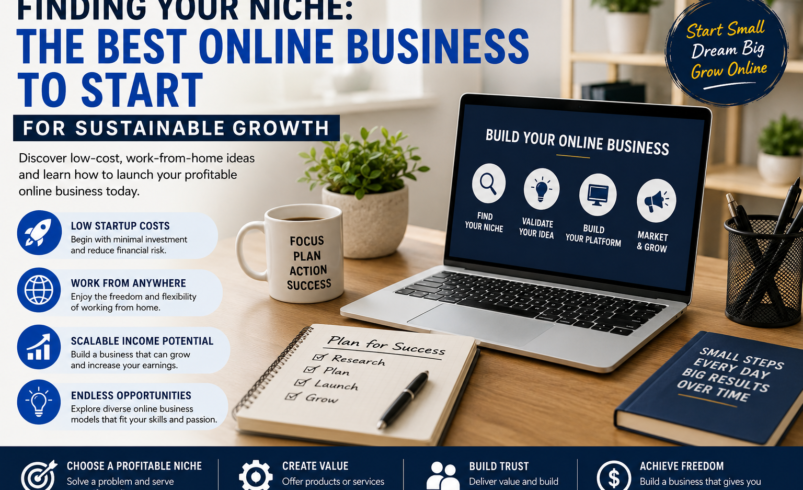

Finding Your Niche: The Best Online Business to Start for Sustainable Growth
The appeal of online entrepreneurship continues to grow, drawing individuals seeking greater autonomy, flexibility, and the potential for significant income. For many, the goal is to discover the best online business to start that aligns with their unique skills, interests, and financial objectives. The digital landscape offers a diverse array of opportunities, from selling physical products to offering specialized services or creating digital content. Understanding these options and how to approach them systematically is key to launching a successful venture.
Why Consider an Online Business Venture?
Operating a business online presents distinct advantages over traditional models. The inherent flexibility and expansive reach make online ventures particularly attractive, especially for those exploring work from home business ideas. Furthermore, the reduced overhead often associated with digital operations positions many as compelling low cost online business ideas.
Flexibility and Global Reach for Your Online Business
One of the primary benefits of an online business is the unparalleled flexibility it offers. Entrepreneurs can often set their own hours, work from any location with an internet connection, and manage their operations around personal commitments. This makes online businesses ideal work from home business ideas, providing a better work-life balance for many. Beyond personal flexibility, online businesses inherently possess global reach. A website or online store can serve customers across different continents, breaking down geographical barriers and opening up vast new markets that would be inaccessible to a local brick-and-mortar establishment.
Lower Startup Costs and Scalability
Compared to traditional businesses that require physical premises, inventory, and extensive staff, many online ventures can be launched with significantly less capital. This makes them excellent low cost online business ideas, accessible to a broader range of aspiring entrepreneurs. For instance, a service-based business might only require a website and marketing tools, while a dropshipping e-commerce store avoids the need for upfront inventory purchases. This reduced financial barrier lowers risk and allows individuals to test concepts without substantial investment. Moreover, online businesses are often highly scalable. Once a system is established, it can frequently handle increased demand with relatively minor adjustments, making them effective small online business ideas with large growth potential.
Identifying Your Ideal Online Business to Start
Pinpointing the best online business to start requires a thoughtful assessment of personal attributes and market realities. It’s about finding the intersection where your strengths and interests meet a genuine market need. This strategic approach is especially beneficial for online business ideas for beginners, providing a clear path forward.
Aligning Passion with Market Demand
Sustainable business success often stems from genuine interest and expertise. When exploring online business ideas for beginners, it’s crucial to identify areas you are passionate about or have significant knowledge in. This passion fuels motivation during challenging times and helps you connect authentically with your audience. However, passion alone is not enough; it must be coupled with market demand. Researching potential niches to understand customer pain points, existing solutions, and market size is vital. A business built on both passion and a proven market need has a stronger foundation for growth.
Assessing Skills and Resources for Your Online Venture
Before committing to a specific venture, evaluate your current skill set, available time, and financial resources. Do you have a knack for writing, design, coding, or teaching? These skills can directly translate into a viable online business. Consider what you already possess that can be leveraged. Understanding your limitations is equally important. If a business idea requires skills you lack, determine if you can acquire them, outsource the tasks, or partner with someone who has them. This realistic assessment is a fundamental step in understanding how to start an online business effectively and efficiently.
Practical Niche Validation Before You Invest
Before committing money or significant time to an online business, validate the problem you intend to solve. Start by defining a specific customer group and the problem they are trying to solve. Review competing products or services, study customer questions and complaints, and look for evidence that people already spend money on solutions. A useful validation process is to test a small offer before building a large product range or complex website.
A Simple Validation Checklist
• Define the target customer and the specific problem you want to solve.
• Review direct and indirect competitors and identify gaps in their offers.
• Estimate likely startup, operating, fulfillment, marketing, and platform costs.
• Test demand with a small offer, pilot service, landing page, pre-launch list, or direct customer conversations.
• Record objections and feedback, then improve the offer before scaling.
• Set a clear go/no-go decision point so enthusiasm does not replace evidence.
Profitable Online Business Models to Explore
The digital economy supports a variety of business models, each with its own structure and potential for revenue. Exploring these options can help you identify the best online business to start that aligns with your capabilities and goals. Many of these represent highly profitable online businesses when executed strategically.
E-commerce Business Ideas: Selling Physical Products Online
E-commerce involves selling physical goods directly to consumers through an online store. This category encompasses various approaches, making it a versatile option for small online business ideas. Common models include:
• Dropshipping: You sell products without holding any inventory. When a customer places an order, you purchase the item from a third-party supplier who then ships it directly to the customer. This significantly reduces upfront costs and logistical complexities.
• Print-on-Demand (POD): Similar to dropshipping, but focused on custom-designed products like t-shirts, mugs, or phone cases. You create designs, and a POD service prints and ships them only when an order is placed.
• Selling Handmade Goods: Platforms like Etsy allow artisans to sell unique, handcrafted items directly to a global audience. This model leverages creative skills and offers a personal touch.
• Private Label/White Label: Sourcing generic products and branding them as your own. This allows for greater control over branding and pricing.
Digital Product Business Ideas: Creating and Selling Information
Digital products are assets that can be delivered electronically, offering high-profit margins and significant potential for passive income online business. Once created, they can be sold repeatedly without needing to replenish inventory. Examples of digital product business ideas include:
• Online Courses: Teaching a skill or subject through video lessons, text, and exercises.
• E-books: Non-fiction guides, fiction novels, or instructional manuals.
• Templates: For websites, social media, resumes, or business documents.
• Software/Apps: Developing and selling tools or applications.
• Stock Photos/Videos/Music: Licensing creative assets for others to use.
Service-Based Online Business: Leveraging Your Expertise
If you have a specialized skill, offering it as a service online can be a straightforward and rewarding path. This category represents excellent work from home business ideas because it often requires minimal startup capital beyond your expertise and a way to connect with clients. Examples of service-based online business ventures include:
• Freelance Writing/Editing: Providing content for websites, blogs, marketing materials, or academic papers.
• Graphic Design: Creating logos, branding materials, website graphics, or marketing visuals.
• Virtual Assistance: Offering administrative, technical, or creative support to businesses remotely.
• Consulting/Coaching: Providing expert advice or guidance in areas like business strategy, fitness, career development, or personal finance.
• Web Development/Design: Building and maintaining websites for clients.
Passive Income Online Business Models: Earn While You Sleep
The concept of a passive income online business involves setting up systems that generate revenue with minimal ongoing effort after the initial setup. While often requiring significant upfront work, the long-term benefits can be substantial. Key models include:
• Affiliate Marketing: Promoting other companies’ products or services and earning a commission on sales made through your unique referral link.
• Advertising on Content Platforms: Monetizing a blog, YouTube channel, or podcast through display ads, sponsorships, or direct advertising sales.
• Licensing Digital Assets: Allowing others to use your photos, music, or software for a fee.
• Creating Membership Sites: Offering exclusive content or community access for a recurring subscription fee.
Choosing the Best Online Business Model: A Practical Comparison
There is no single online business model that is best for everyone. A practical choice depends on the founder’s skills, available capital, preferred work style, customer-acquisition ability, and tolerance for operational complexity. The comparison below provides a starting framework rather than a promise of income or results.
| Business Model | Startup Cost | Skill Level | Time to First Revenue | Scalability | Key Consideration |
| Freelancing | Low | Medium | Often faster | Medium | Client acquisition and time capacity |
| Digital Products | Low–Medium | Medium | Variable | High | Demand validation and marketing |
| E-commerce | Low–High | Medium | Variable | High | Sourcing, fulfillment, returns, and margins |
| Affiliate Marketing | Low | Medium | Often slower | High | Traffic, audience trust, and commissions |
| Online Tutoring | Low | Medium–High | Often faster | Medium | Expertise and available teaching time |
How to Start an Online Business: Essential Steps
Launching an online business involves a structured approach, moving from conceptualization to execution. Understanding these steps is crucial for anyone wondering how to start an online business successfully, especially for those exploring online business ideas for beginners.
Business Planning and Niche Validation
Every successful venture begins with a solid plan. This involves thorough market research to identify your target audience, understand their needs, and analyze competitors. Define your unique selling proposition (USP) – what makes your offering different or better? Create a detailed business plan outlining your goals, strategies, financial projections, and operational procedures. Niche validation is critical; ensure there’s a genuine demand for your product or service before investing significant time and resources. This foundational work is paramount for understanding how to start an online business with a clear direction.
Building Your Online Presence
Your online presence is your digital storefront. This typically involves:
• Website Development: Creating a professional, user-friendly website that reflects your brand and effectively showcases your products or services. Platforms like Shopify, WordPress, or Squarespace offer accessible solutions for various needs.
• Social Media Strategy: Identifying relevant social media platforms where your target audience spends time and developing a content strategy to engage them.
• Brand Identity: Designing a consistent brand image, including logos, color schemes, and messaging, to create a memorable and trustworthy impression.
Even for small online business ideas, a strong online presence builds credibility and reach.
Marketing and Customer Acquisition Strategies
Once your online business is established, attracting customers becomes the focus. Effective marketing is essential for any of the profitable online businesses discussed. Key strategies include:
• Search Engine Optimization (SEO): Optimizing your website content and structure to rank higher in search engine results, driving organic traffic.
• Content Marketing: Creating valuable blog posts, videos, podcasts, or infographics that educate and engage your target audience, establishing your authority.
• Social Media Marketing: Running targeted campaigns on platforms like Facebook, Instagram, or LinkedIn to reach potential customers.
• Email Marketing: Building an email list and sending newsletters, promotions, or updates to nurture leads and retain customers.
• Paid Advertising: Utilizing platforms like Google Ads or social media ads to reach a specific audience quickly.
Building Trust and Authority in an Online Business
A credible online business should make it easy for customers to understand who is behind the offer, what is being sold, what it costs, and what they can reasonably expect. Clear business information, accurate claims, accessible contact details, transparent policies, and genuine customer feedback can strengthen trust. Where recommendations or affiliate links are used, disclose material relationships clearly and place the disclosure close to the recommendation.
Trust-Building Checklist
• Show relevant qualifications, experience, or evidence supporting specialist advice.
• Use accurate product, service, pricing, and performance descriptions.
• Provide clear contact, refund, cancellation, privacy, and terms information where applicable.
• Use genuine testimonials and reviews, and do not present exceptional outcomes as typical.
• Disclose affiliate commissions, sponsorships, or other material relationships when applicable.
• Review important business claims periodically so outdated information does not undermine credibility.
Low Cost Online Business Ideas for Beginners
For those new to entrepreneurship or with limited capital, focusing on low cost online business ideas is a prudent approach. These options often require more time and effort than financial investment, making them ideal online business ideas for beginners and excellent small online business ideas to get started.
Affiliate Marketing: Promoting Products for Commission
Affiliate marketing is a popular choice for a low cost online business idea because it doesn’t require you to create your own product or handle customer service. You partner with companies and promote their products or services through unique affiliate links. When someone makes a purchase through your link, you earn a commission. This model can also evolve into a significant passive income online business as your content and audience grow, generating sales over time.
Social Media Management: Helping Businesses Grow Online
Many small businesses struggle to maintain a consistent and effective social media presence. Offering social media management services is a viable small online business idea. You can help clients create content, schedule posts, engage with their audience, and analyze performance. This service-based online business leverages your organizational and communication skills, requiring minimal startup costs beyond your time and a few social media management tools.
Online Tutoring or Coaching: Sharing Your Knowledge
If you have expertise in a particular subject or skill, online tutoring or coaching can be a rewarding and accessible venture. Whether it’s academic subjects, musical instruments, language learning, or life coaching, you can connect with students or clients globally through video conferencing platforms. This is one of the most straightforward online business ideas for beginners, as it primarily requires your knowledge, a reliable internet connection, and a webcam. It’s also a strong example of a service-based online business that can be scaled.
A Practical 30-Day Launch Roadmap
For beginners, the first month is better treated as a validation period than as a race to build a perfect business. The objective is to learn whether a defined audience has a meaningful problem and whether your proposed solution is worth pursuing.
• Days 1–7: Choose a focused niche, define the target customer, and research competitors and customer problems.
• Days 8–14: Create a simple offer and test the value proposition through conversations, content, a landing page, or a small pilot.
• Days 15–21: Build the minimum online presence needed to explain the offer, establish credibility, and collect inquiries or orders.
• Days 22–30: Start customer acquisition, track responses, review objections, and decide what should be improved before investing further.
Keep records of what you tested, what customers asked, what converted, and what failed. These observations become practical first-hand evidence that can guide future decisions and help prevent repeating the same mistakes.
Frequently Asked Questions About Starting an Online Business
Many common questions arise when considering an online venture. Here are answers to some of the most frequent inquiries:
• What is the easiest online business to start? Generally, service-based businesses like freelance writing, virtual assistance, or online tutoring are considered among the easiest to start due to minimal upfront costs and the ability to leverage existing skills. Affiliate marketing is also a strong contender for a low cost online business idea.
• How much money do I need to start an online business? This varies widely. Some businesses, like dropshipping or digital product creation, can start with under $100-$500 for website hosting, domain, and basic tools. Service-based businesses might require even less, primarily investing in marketing and a professional online presence. More complex e-commerce or software development ventures will naturally require more capital.
• Can I really make a full-time income online? Absolutely. Many individuals generate substantial full-time incomes and even build multi-million dollar enterprises online. Success depends on market demand, the value you provide, effective marketing, consistent effort, and choosing the right best online business to start for your capabilities.
Your Journey to Finding the Best Online Business to Start
Embarking on an online business journey offers immense potential for personal and financial growth. By carefully considering your passions, skills, and market demand, you can identify the best online business to start that resonates with your aspirations. Whether you gravitate towards e-commerce, digital products, or a service-based online business, the digital realm provides a fertile ground for innovation and entrepreneurship. The key is to begin with thorough planning, build a strong online presence, and commit to consistent marketing efforts. With dedication, many of these ventures can evolve into highly profitable online businesses, offering the flexibility and freedom you seek. Take the first step today to explore the possibilities and build your online future.
Editorial Trust & Source Note
For publication, verify current business, advertising, platform, tax, privacy, and consumer-protection requirements for the markets you serve. The U.S. Small Business Administration provides guidance on market research, competitive analysis, business planning, and startup costs, while the Federal Trade Commission provides guidance on truthful advertising, reviews, endorsements, and affiliate disclosures. Requirements can vary by country and business model.