




Starting a business is one of the most exciting ways to build financial independence, but choosing the right idea can feel overwhelming. With countless options available, it helps to focus on ventures that match current market demand, require best business ideas manageable startup costs, and fit your skills or interests.
This guide breaks down the best business ideas across different categories, whether you’re looking for a low investment business idea, a side hustle, or a full-time venture with strong growth potential.
How to Validate a Business Idea Before Investing
Choosing an interesting business idea is only the first step. Before spending significant money, test whether real customers are willing to pay for the product or service.
- Identify your target customer — Define exactly who is most likely to buy from you.
- Research competitors — Look at their pricing, services, customer reviews, and weaknesses.
- Talk to potential customers — Ask about their problems and what they currently use to solve them.
- Test a minimum viable offer — Start with a simple version of your product or service instead of building everything at once.
- Measure real demand — Actual inquiries, pre-orders, bookings, or sales are stronger evidence than likes or positive opinions.
- Review the numbers — Estimate startup costs, ongoing expenses, pricing, and how many customers you need to become profitable.
For example, someone considering a social media management business could first approach a small group of local businesses with a simple monthly service package. If businesses consistently show interest and are willing to pay, the entrepreneur has stronger evidence of demand before investing in software, branding, or a larger team.
What Makes a Business Idea “Good” in 2026
Before jumping into a list, it’s worth understanding what separates a promising business idea from a risky one. The best small business ideas usually share a few common traits:
**Real market demand** — People are already searching for or paying for this product or service.
**Manageable startup costs** — You don’t need massive capital to get started.
**Scalability** — The business can grow without requiring proportional increases in cost or effort.
**Alignment with your skills** — You can execute it well, or learn quickly.
Keeping these factors in mind will help you evaluate any idea on this list, or one you come up with on your own.
Consider Profitability, Not Just Startup Cost
A business with a low startup cost is not automatically a good business. Before choosing an idea, consider how much you can realistically charge, how frequently customers may purchase, and how much it costs to deliver the product or service.
A useful basic calculation is:
Estimated profit = Revenue − operating expenses − marketing costs − taxes and other applicable costs
For service businesses, also consider the value of your time. A business that generates revenue but requires many unpaid hours may be less attractive than a slightly more expensive service with better margins and repeat customers.
Match the Business Model to Your Resources
Your available capital, skills, time, location, and access to customers should influence your decision. Someone with strong writing skills and a laptop may be able to start a freelance service immediately, while someone with access to a commercial workspace or specialized equipment may have different opportunities.
The strongest business idea is not necessarily the one with the highest theoretical earning potential. It is the one where you can realistically reach customers, deliver a useful solution, and maintain positive cash flow.
Low Investment Business Ideas
If you’re working with a limited budget, these low investment business ideas are a smart place to start.
Freelance Services
Freelancing remains one of the most accessible business ideas for beginners. Writing, graphic design, video editing, and virtual assistance all require minimal upfront investment — often just a laptop and an internet connection. Platforms like Upwork and Fiverr make it easier to find your first clients while you build a portfolio.
Social Media Management
Many small businesses need help managing their online presence but don’t have the time or expertise to do it themselves. Offering social media management services, including content planning, scheduling, and basic ad management, is a practical business idea with low startup costs and strong recurring revenue potential.
Print-on-Demand Store
Print-on-demand allows you to sell custom-designed products, such as t-shirts, mugs, and phone cases, without holding inventory. You design the product, a third-party supplier handles printing and shipping, and you focus on marketing. It’s one of the most beginner-friendly online business ideas available today.
How to Make a Low-Investment Business More Sustainable
Low startup costs can make an idea easier to test, but keeping expenses low should not mean ignoring quality. Beginners should prioritize a reliable delivery process, clear pricing, customer communication, and a simple way to collect feedback.
For service businesses, recurring packages can make revenue more predictable. For product businesses, tracking product costs, shipping, returns, advertising, and payment fees is essential before deciding whether a product is actually profitable.
Online Business Ideas
The internet has opened the door to business models that simply weren’t possible a decade ago. These online business ideas are worth serious consideration.
E-commerce and Dropshipping
Running an online store, whether through dropshipping or your own inventory, remains one of the most popular business ideas. Success depends on choosing a focused niche, sourcing reliable suppliers, and investing in customer experience rather than trying to compete on price alone.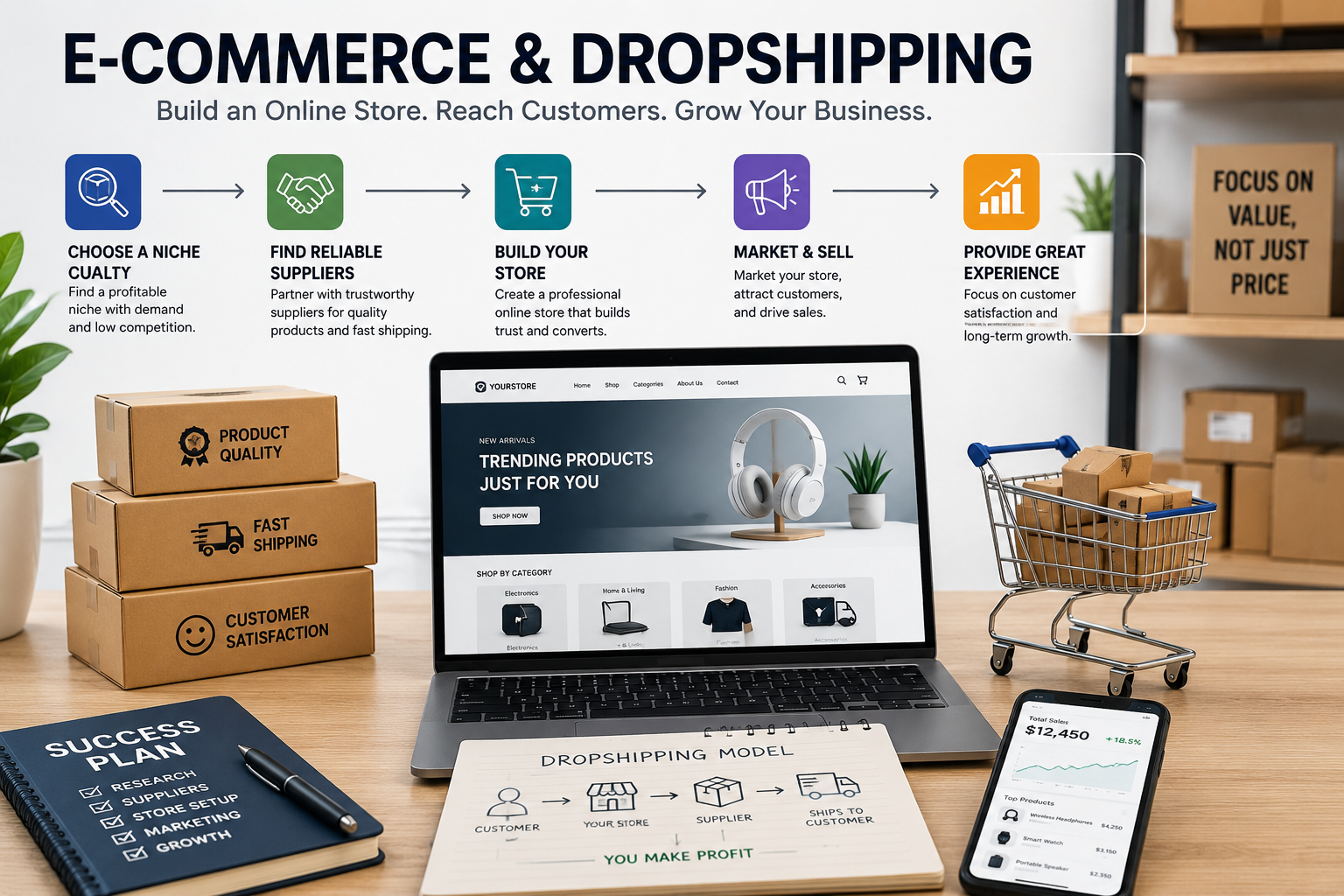
Online Courses and Digital Products
If you have expertise in a particular subject, packaging that knowledge into an online course, ebook, or template pack can generate income with minimal ongoing effort. This is a highly scalable business idea since digital products can be sold repeatedly without additional production costs.
Affiliate Marketing and Content Creation
Building a blog, YouTube channel, or niche website around a topic you understand well allows you to earn through affiliate marketing, sponsorships, and ad revenue. This business idea requires patience and consistency, but it has low overhead and long-term earning potential.
Build Trust Before Trying to Scale an Online Business
Online businesses depend heavily on credibility. Clear product descriptions, transparent pricing, accessible customer support, secure payment processes, and accurate marketing claims can help establish trust.
Content-based businesses should also demonstrate genuine knowledge rather than simply republishing generic information. Original tutorials, practical examples, case studies, demonstrations, and clearly identified expert contributions can make content more useful and credible.
Home Based Business Ideas
For those who prefer working from home, these home based business ideas combine flexibility with real income potential.
Home Bakery or Food Business
If you enjoy cooking or baking, turning that skill into a home-based food business can be highly rewarding. Local delivery apps and social media make it easier than ever to reach customers without renting a commercial kitchen space right away.
Tutoring and Online Coaching
Whether it’s academic tutoring, language lessons, or fitness coaching, sharing your expertise one-on-one or in small groups is a low-cost business idea that can be run entirely from home using video calls.
Pet Sitting and Dog Walking
Pet care services are in consistent demand, especially in urban areas. This is one of the best small business ideas to start with almost no capital, since it mainly requires reliability, a love of animals, and good time management.
Check Local Rules Before Starting a Home-Based Business
Before accepting customers, verify the regulations that apply to your location and business type. Food businesses, tutoring services, pet care, and businesses operating from a residential property can have different licensing, registration, zoning, insurance, tax, and health or safety requirements.
Do not assume that because a business can be operated from home, it is automatically exempt from local requirements. Checking official government or regulatory sources before launching can prevent costly problems later.
Business Ideas for Students and Beginners
Students and first-time entrepreneurs often need business ideas that fit around a busy schedule and limited funds.
Part-Time Business Ideas
Simple options like reselling items online, offering campus-based services, or managing small freelance gigs allow students to earn income while learning the basics of running a business. These part-time business ideas serve as a low-risk way to test entrepreneurial skills.
Skill-Based Micro Businesses
Photography, resume writing, or basic web design are excellent business ideas for students because they turn an existing skill into paid work without requiring a large investment.
A Simple Student Business Validation Test
Students can reduce financial risk by starting with a small service rather than immediately purchasing inventory or expensive equipment. For example, a student with web-design skills could create a small portfolio, contact potential customers, offer one clearly defined service, and use the first few projects to improve pricing and delivery.
This approach also creates something valuable beyond immediate income: testimonials, portfolio work, practical experience, and a better understanding of customer needs.
High Demand Business Ideas Worth Watching
Certain industries consistently show strong demand, making them worth considering if you want a business idea with long-term staying power.
Health and Wellness Services
From personal training to nutrition consulting, the health and wellness space continues to grow. Businesses that offer convenience, such as mobile services or virtual consultations, tend to perform especially well.
Sustainable and Eco-Friendly Products
Consumers are increasingly seeking environmentally responsible options. Businesses built around reusable products, sustainable packaging, or eco-conscious services often attract loyal, values-driven customers.
Cleaning and Home Services
Cleaning services, organizing, and general home maintenance remain reliably profitable small business ideas, largely because demand is steady regardless of economic conditions.
How to Choose Between a Service Business and a Product Business
One of the most important decisions for a new entrepreneur is whether to sell a service, a physical product, or a digital product.
Service businesses can often start with less capital because the entrepreneur sells expertise or labor rather than inventory. However, revenue may initially be limited by the number of clients and hours available.
Physical-product businesses can potentially sell to many customers, but they may require inventory, packaging, fulfillment, returns management, and more working capital.
Digital-product businesses can have low delivery costs and strong scalability, but they usually require expertise, content creation, marketing, and a reliable way to reach an audience.
Understanding these trade-offs can help you choose a business model that matches your financial resources and long-term goals.
Common Mistakes First-Time Entrepreneurs Should Avoid
- Spending too much money before validating demand.
- Trying to serve everyone instead of choosing a specific customer.
- Setting prices without calculating total costs.
- Ignoring taxes, licenses, insurance, or other applicable requirements.
- Depending entirely on one customer or one marketing platform.
- Scaling before establishing a repeatable sales and delivery process.
- Confusing revenue with profit.
- Copying competitors without developing a clear reason for customers to choose the business.
Avoiding these mistakes can be just as important as choosing the right business idea.
How to Choose the Right Business Idea for You
With so many options, narrowing down the best business idea for your situation comes down to three questions:
What skills or resources do you already have? Starting with something familiar reduces your learning curve.
How much time and money can you realistically invest? Be honest about your constraints before committing.
Is there proven demand for this idea in your target market? Validate interest before scaling up.
Business Idea Decision Checklist
- Can I clearly explain the problem this business solves?
- Who is the specific customer?
- Are people already paying for similar solutions?
- What will it cost me to start?
- What will my monthly operating costs be?
- How will I find my first 10 customers?
- How much can I realistically charge?
- What could make this business unprofitable?
- Can I test the idea on a small scale first?
- Do I understand the legal, tax, licensing, and insurance requirements that apply to me?
- What skills do I need to learn before launching?
- What would make customers choose me instead of a competitor?
If you cannot answer several of these questions, more validation may be needed before making a significant financial commitment.
Frequently Asked Questions About Business Ideas
What is the best business idea for a beginner?
The best option depends on your skills, budget, available time, and target market. Service-based businesses such as freelancing, tutoring, social media management, and basic professional services can be relatively simple to test because they may not require substantial inventory.
What is a good low investment business idea?
A good low investment idea is one that can be tested without committing a large amount of money. Freelancing, tutoring, virtual assistance, social media management, and certain digital services can often be tested with existing skills and basic equipment.
How much money should I invest in a new business?
There is no single amount that works for every business. Estimate the minimum cost required to test demand first, including equipment, software, marketing, licenses, inventory, and other necessary expenses. Avoid committing substantial capital until you have evidence that customers want the offer.
How do I know if a business idea will be profitable?
Estimate potential revenue and subtract all relevant costs, including materials, inventory, shipping, software, advertising, payment processing, labor, taxes, and other operating expenses. Then test the assumptions with real customers rather than relying only on forecasts.
Should I start a business while working or studying?
Starting part-time can be a practical way to validate an idea while limiting financial risk. It also gives you an opportunity to learn sales, customer service, marketing, bookkeeping, and operations before deciding whether to move into the business full-time.
What should I do before launching a business?
Define the customer and problem, research competitors, validate demand, estimate startup and operating costs, establish pricing, determine how you will acquire customers, and check the legal and regulatory requirements that apply to your business and location.
Final Thoughts on Finding the Right Business Idea
The strongest business idea is not always the newest or most popular option. A practical opportunity combines a genuine customer problem with a realistic way for you to deliver a solution profitably.
Start small, validate demand, track your numbers, listen to customers, and improve the offer based on real feedback. Once you have a repeatable process and evidence that customers value what you provide, you can decide whether expanding the business makes sense.