






Artificial intelligence (AI) is rapidly transforming how businesses operate, innovate, and compete. What was once considered a futuristic concept is now a practical suite of tools and technologies, collectively known as AI business solutions, that are reshaping industries across the globe. These solutions offer more than just automation; they provide strategic insights, enhance decision-making, and create new avenues for growth. This article explores the fundamental aspects of AI in business, its tangible benefits, practical applications, and a strategic approach to successful implementation.
Understanding AI Business Solutions: What They Are and How They Work
AI business solutions encompass a broad range of technologies designed to automate complex tasks, analyze vast datasets, and improve operational efficiency. At their core, these solutions leverage algorithms and computational power to mimic human intelligence, enabling systems to learn, reason, and adapt. Understanding how AI helps businesses begins with recognizing that it’s not a single technology but a collection of interconnected disciplines working in concert.
Core Components of Modern AI Solutions
The effectiveness of modern AI tools for business stems from several key technological components:
- Machine Learning (ML): This allows systems to learn from data without explicit programming. Supervised, unsupervised, and reinforcement learning models are used for tasks like prediction, classification, and pattern recognition.
- Natural Language Processing (NLP): NLP enables computers to understand, interpret, and generate human language. This is crucial for chatbots, sentiment analysis, and automated content generation.
- Computer Vision: This field allows AI systems to interpret and understand visual information from the world, such as images and videos. Applications include quality control, facial recognition, and autonomous navigation.
- Predictive Analytics: By analyzing historical data, AI can forecast future trends and behaviors, informing strategic planning and risk management.
- Robotic Process Automation (RPA): While not strictly AI, RPA often integrates with AI to automate repetitive, rule-based tasks, freeing human employees for more complex work.
How AI Helps Businesses Across Various Sectors
The versatility of AI means that how AI helps businesses is evident across virtually every sector. In manufacturing, AI optimizes production lines and predicts equipment failures. In healthcare, it assists with diagnostics and drug discovery. Financial services use AI for fraud detection and personalized investment advice. Retail leverages AI for inventory management, personalized recommendations, and customer service. This widespread adoption underscores AI’s role as a foundational technology for modern commerce.
Key Benefits of AI in Business: Driving Growth and Innovation
Adopting AI offers significant advantages, translating into measurable improvements in performance and competitiveness. The benefits of AI in business extend from operational efficiencies to strategic decision-making, providing a robust framework for sustained growth. Many organizations are specifically seeking AI solutions for efficiency to streamline their operations.
Enhancing Operational Efficiency and Productivity with AI
One of the most immediate and impactful benefits of AI in business is its ability to enhance operational efficiency. AI automates repetitive, time-consuming tasks, reducing manual effort and minimizing human error. This includes everything from data entry and report generation to customer support inquiries. For instance, AI automation for business processes like invoice processing or supply chain logistics can significantly cut operational costs and accelerate workflows, leading directly to improved AI solutions for efficiency.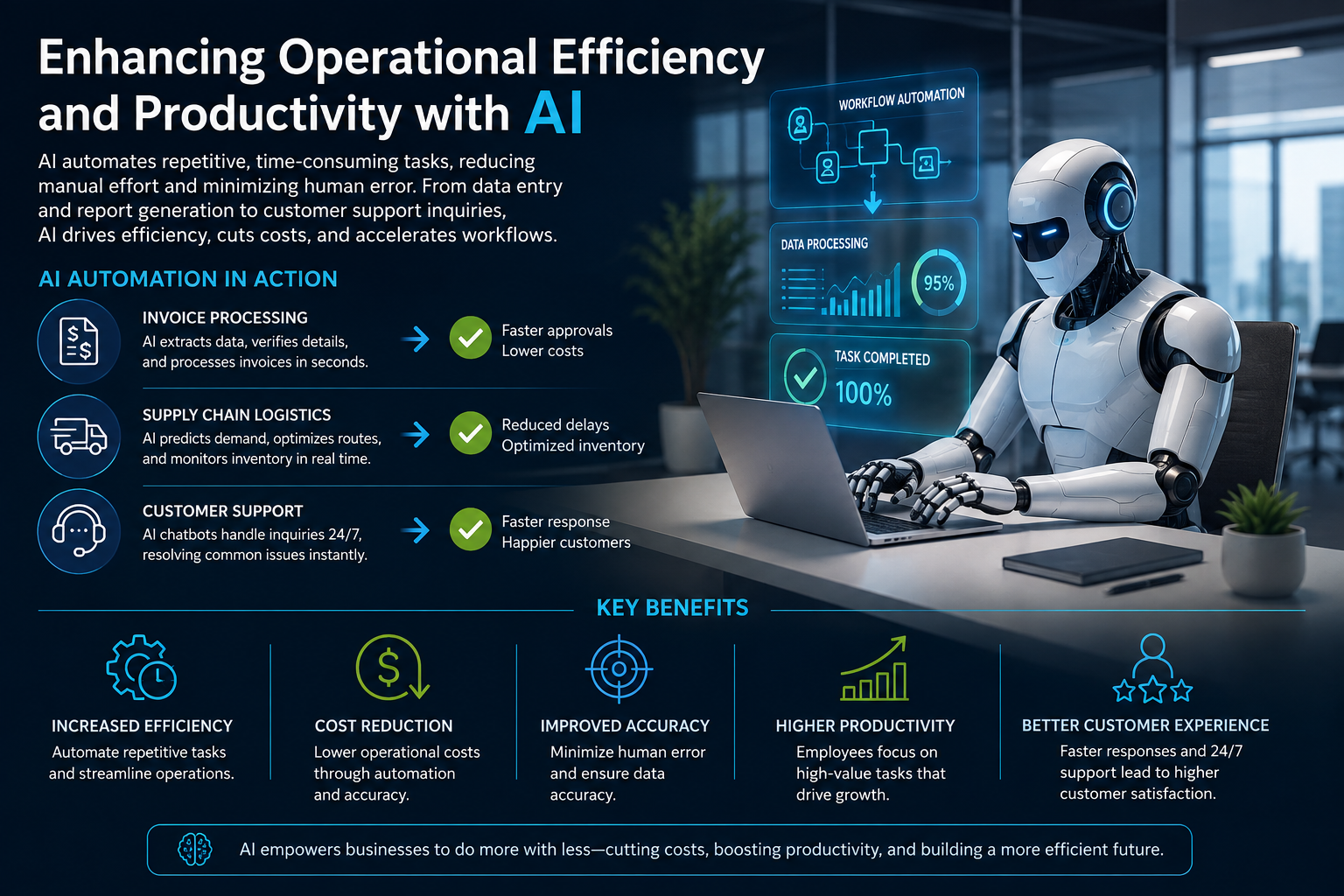
Improving Decision-Making and Business Strategy
AI provides businesses with unparalleled capabilities for data analysis, transforming raw data into actionable insights. Through advanced analytics and machine learning, AI can identify patterns, predict market trends, and model various scenarios, empowering leaders to make more informed and strategic decisions. Developing an effective AI strategy for business involves leveraging these insights to optimize resource allocation, identify new market opportunities, and mitigate risks, ultimately shaping a more resilient and forward-thinking organization.
Boosting Customer Experience and Engagement
AI applications in business are revolutionizing customer interactions. AI-powered chatbots and virtual assistants provide instant, 24/7 support, resolving common queries and improving response times. Personalization engines analyze customer data to offer tailored product recommendations, content, and marketing messages, creating more engaging and relevant experiences. This level of personalized service fosters stronger customer relationships and drives loyalty.
Practical AI Applications in Business: Real-World Examples
The theoretical advantages of AI become tangible through its diverse applications. From optimizing internal processes to transforming customer interactions, AI applications in business are varied and impactful. These solutions are not exclusive to large corporations; many are accessible even for smaller entities, making AI for small business a growing reality.
AI for Small Business: Leveling the Competitive Field
Small businesses often operate with limited resources, making efficiency and strategic advantage critical. Fortunately, AI for small business is becoming increasingly accessible. Cloud-based AI tools for business can automate marketing campaigns, manage customer relationships (CRM), optimize website content for search engines, and even provide sophisticated data analytics without requiring a dedicated IT department. This allows small businesses to compete more effectively with larger enterprises by leveraging advanced capabilities previously out of reach.
AI Automation for Business: Streamlining Operations
AI automation for business extends beyond simple task repetition. Examples include:
- Robotic Process Automation (RPA): Software robots handle structured, rule-based tasks like data migration, report generation, and form filling.
- Supply Chain Optimization: AI predicts demand fluctuations, optimizes inventory levels, and identifies potential disruptions, leading to more resilient and cost-effective supply chains.
- Fraud Detection: AI algorithms analyze transaction patterns in real-time to identify and flag suspicious activities, protecting businesses and customers.
Data Analysis and Predictive Insights
One of the most powerful aspects of AI business solutions is their capacity to process and interpret massive datasets. AI can uncover hidden correlations, predict future outcomes, and provide deep insights into market dynamics, customer behavior, and operational performance. This capability is invaluable for strategic planning, product development, and identifying emerging trends.
Personalized Marketing and Sales with AI Tools
AI tools for business have transformed marketing and sales. AI algorithms analyze customer demographics, browsing history, and purchase patterns to deliver highly personalized advertisements and product recommendations. This precision marketing increases conversion rates and improves the return on investment for marketing spend. Sales teams use AI to prioritize leads, predict customer churn, and optimize pricing strategies.
Developing and Implementing AI in Business: A Strategic Approach
Successfully integrating AI requires more than just purchasing software; it demands a clear strategy and careful execution. Implementing AI in business effectively means aligning AI initiatives with overarching organizational goals and preparing for the necessary changes. A well-defined AI strategy for business is paramount.
Assessing Business Needs and Defining an AI Strategy
The first step in implementing AI in business is to identify specific pain points or opportunities where AI can deliver the most value. This involves a thorough assessment of current processes, data availability, and desired outcomes. Developing an AI strategy for business should clearly articulate objectives, define key performance indicators (KPIs), and outline the resources required. Starting with pilot projects that address specific, high-impact problems can demonstrate value and build internal support.
Choosing the Right AI Tools for Business and Platforms
With a multitude of AI tools for business available, selecting the appropriate ones is crucial. Considerations include:
- Scalability: Can the solution grow with your business needs?
- Integration: How well does it integrate with existing systems and data infrastructure?
- Ease of Use: Is it user-friendly for your team?
- Vendor Support: What level of technical support and ongoing development does the vendor provide?
- Cost-Effectiveness: Does the potential return on investment justify the expenditure?
Whether opting for off-the-shelf solutions or custom development, a careful evaluation ensures the chosen tools align with your strategic goals.
Best Practices for Implementing AI in Business
Successful implementing AI in business involves several best practices:
- Data Preparation: High-quality, clean, and relevant data is the foundation of effective AI. Invest time in data collection, cleansing, and organization.
- Start Small, Scale Up: Begin with pilot projects to test hypotheses and refine approaches before a full-scale rollout.
- Change Management: Prepare your workforce for AI adoption through training and clear communication about how AI will augment, not replace, human roles.
- Continuous Monitoring and Iteration: AI models require ongoing monitoring, evaluation, and retraining to maintain accuracy and adapt to changing conditions.
- Ethical Considerations: Address biases in data, ensure transparency, and adhere to privacy regulations from the outset.
Frequently Asked Questions About AI Business Solutions
As businesses explore the potential of AI, several common questions arise regarding its accessibility, cost, and implementation.
Is AI only for large enterprises?
No, AI is increasingly accessible and beneficial for businesses of all sizes. While large enterprises may have the resources for custom-built AI systems, the proliferation of cloud-based platforms and specialized AI tools for business means that AI for small business is a growing reality. Many solutions are designed to be user-friendly and cost-effective, allowing smaller organizations to leverage AI’s power without extensive in-house expertise.
What are the typical costs associated with AI solutions?
The costs associated with AI business solutions vary widely. They can range from subscription fees for off-the-shelf AI tools for business (which might be hundreds to thousands of dollars per month) to significant investments for custom-developed AI systems, data infrastructure, and specialized talent (potentially hundreds of thousands to millions of dollars). Factors influencing cost include complexity, data volume, integration requirements, and the need for specialized AI expertise.
How long does it take to implement AI?
The timeline for implementing AI in business varies significantly. Simple AI tools for specific tasks might be integrated within weeks. More complex projects involving custom model development, extensive data integration, and significant process changes can take several months to over a year. Pilot projects typically range from 3 to 6 months, providing valuable insights before broader deployment.
What data privacy concerns should businesses consider?
Data privacy is a critical consideration for any business adopting AI. Organizations must ensure compliance with regulations like GDPR, CCPA, and other industry-specific standards. This involves securing data, obtaining proper consent for data usage, anonymizing sensitive information, and implementing robust data governance policies. Ethical considerations regarding data bias and algorithmic transparency are also paramount when deploying AI business solutions.
Conclusion: The Future is Now with AI Business Solutions
The integration of AI business solutions is no longer an option but a strategic imperative for organizations aiming for sustained competitiveness and growth. From enhancing operational efficiency and driving innovation to personalizing customer experiences and informing strategic decisions, AI offers transformative capabilities. By carefully assessing needs, choosing appropriate AI tools for business, and adopting a structured approach to implementing AI in business, companies can harness the full potential of this technology. Embracing AI is about building a more intelligent, agile, and future-ready enterprise.