




A well-designed business card is more than just a piece of paper; it’s a tangible representation of your brand and a crucial tool for professional networking. The effectiveness of this small but mighty marketing asset often hinges on its physical attributes, particularly its buisness card size. Incorrect or poorly considered dimensions can lead to awkward handling, difficulty storing, or even a perception of unprofessionalism. Understanding the various standard and custom business card dimensions, along with critical print specifications like bleed and safety margins, ensures your card makes the intended impact. This article will explore the global standards, digital considerations, and creative possibilities surrounding business card sizes, equipping you with the knowledge to make informed design decisions.
Understanding Standard Business Card Size Across Regions
While the concept of a “standard” business card exists, its precise measurements can vary significantly depending on geographic location. These regional differences reflect historical printing practices and cultural preferences. Knowing the prevalent standard business card size for your target audience is essential for ensuring your card is easily accepted and stored.
Standard Business Card Size in Inches (North America)
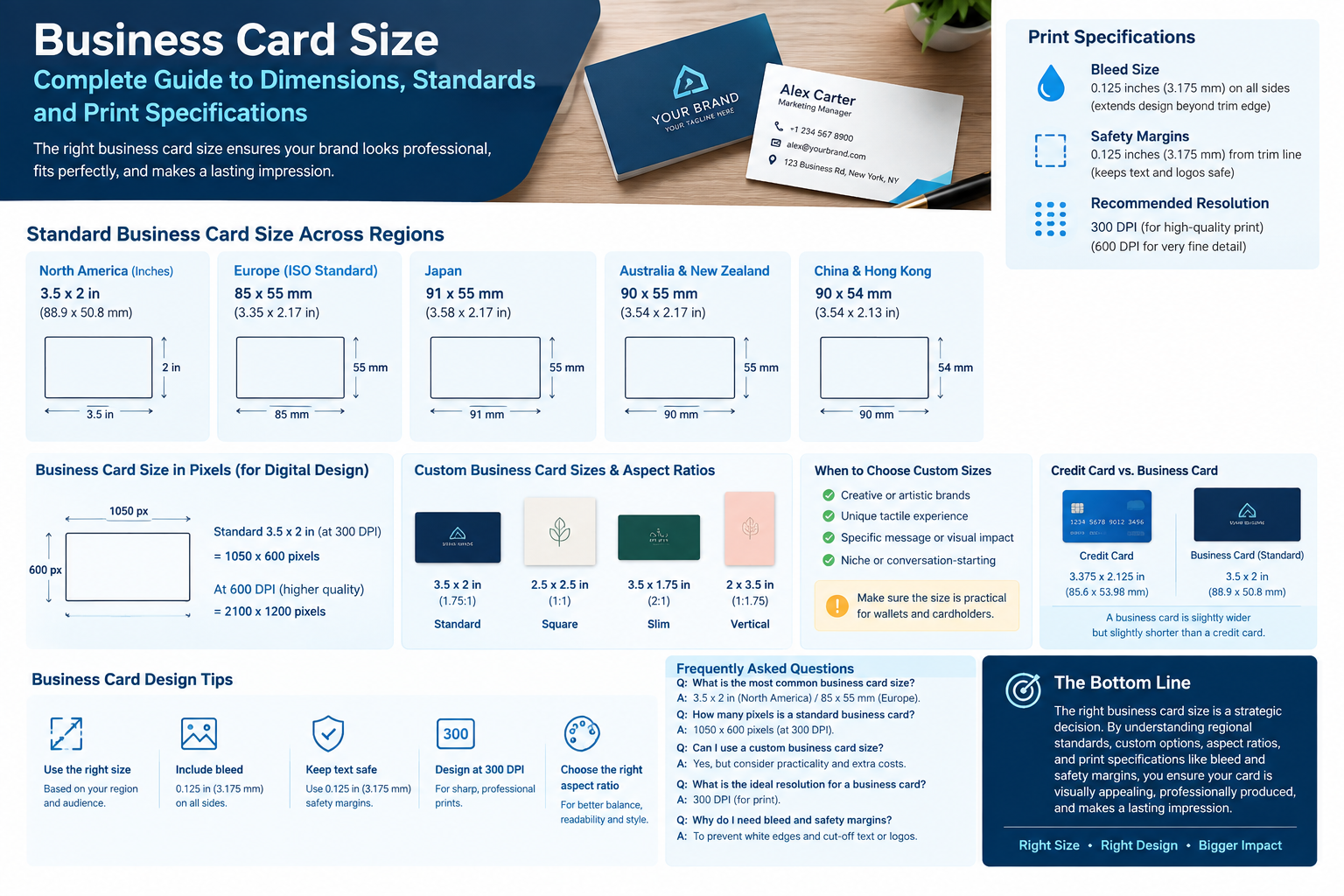
In North America, encompassing the United States and Canada, the most widely accepted business card size in inches is 3.5 x 2 inches. This dimension has become the de facto standard, fitting comfortably into wallets, cardholders, and Rolodex systems. When designing for this market, adhering to these dimensions ensures compatibility and familiarity for recipients.
Standard Business Card Size in Millimeters (mm) (Europe & Asia)
Outside of North America, measurements are typically expressed in millimeters. The business card size in mm varies by region:
- Europe (ISO Standard): The most common size is 85 x 55 mm. This aligns with the ISO 7810 ID-1 format, which is also used for credit cards, making it convenient for storage.
- Japan: Often uses a slightly larger card at 91 x 55 mm.
- Australia & New Zealand: Typically use 90 x 55 mm.
- China & Hong Kong: Commonly use 90 x 54 mm.
These variations highlight the importance of specifying the intended region when ordering or designing business cards internationally.
Business Card Size in Pixels for Digital Design and Print Readiness
When preparing digital files for printing, understanding the appropriate business card size in pixels is crucial for achieving high-quality results. Pixel dimensions are directly tied to the desired print resolution, measured in Dots Per Inch (DPI).
For professional printing, a resolution of 300 DPI (dots per inch) is generally recommended to ensure sharp text and clear images. To calculate the pixel dimensions for a standard 3.5 x 2 inch business card at 300 DPI:
- Width: 3.5 inches \* 300 DPI = 1050 pixels
- Height: 2 inches \* 300 DPI = 600 pixels
Therefore, a standard buisness card size for print-ready files at 300 DPI would be 1050 x 600 pixels. If a higher resolution like 600 DPI is required for extremely fine detail, the pixel dimensions would double to 2100 x 1200 pixels. Always confirm the printer’s specific DPI requirements before finalizing your design.
Exploring Custom Business Card Sizes and Aspect Ratios
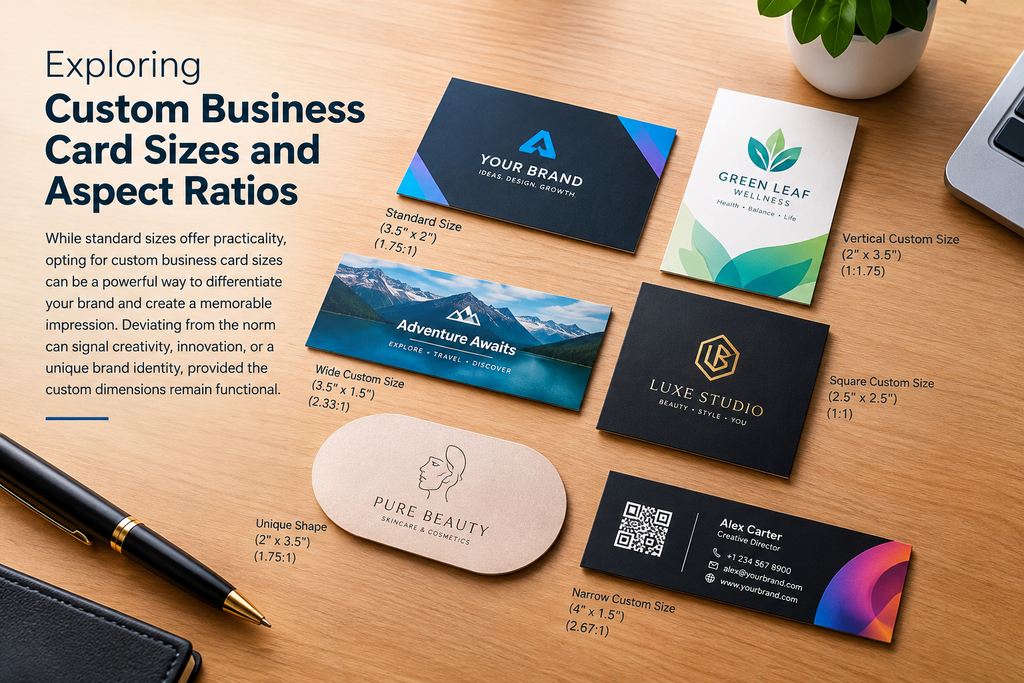
While standard sizes offer practicality, opting for custom business card sizes can be a powerful way to differentiate your brand and create a memorable impression. Deviating from the norm can signal creativity, innovation, or a unique brand identity, provided the custom dimensions remain functional.
When to Opt for Custom Business Card Sizes
Custom sizes are particularly effective for businesses or individuals looking to stand out in crowded markets. Consider custom dimensions if:
- Your brand is highly creative: Designers, artists, photographers, or event planners might use square, mini, or even die-cut cards to reflect their artistic flair.
- You want a specific tactile experience: A thicker, smaller card might feel more premium, while a longer, thinner card could convey sleekness.
- You need to convey a specific message: A vertical card can draw attention differently than a horizontal one, subtly influencing how the information is perceived.
- Your industry benefits from novelty: Certain niche markets might appreciate a unique card that serves as a conversation starter.
However, remember that highly unusual buisness card size options might not fit standard wallets or cardholders, which could lead to them being misplaced or discarded. Balance uniqueness with practicality.
Understanding Business Card Aspect Ratio and Its Impact on Design
The business card aspect ratio refers to the proportional relationship between its width and height. For a standard 3.5 x 2 inch card, the aspect ratio is 1.75:1 (3.5 divided by 2). This ratio dictates the overall shape and how design elements are composed.
- Standard (1.75:1): Offers a familiar canvas, suitable for most layouts.
- Square (1:1): A 2.5 x 2.5 inch card, for example, provides a modern, balanced look, ideal for minimalist designs or brands emphasizing equality and precision.
- Slim (e.g., 2:1 or 3:1): A 3.5 x 1.75 inch or 3.5 x 1.25 inch card can appear elegant and sophisticated, though it offers less vertical space for content.
- Vertical (e.g., 1:1.75): Flipping the standard orientation (2 x 3.5 inches) creates a vertical card, which can make a bold statement and allow for different visual hierarchies in your business card dimensions.
The chosen aspect ratio significantly influences the visual balance, readability, and overall aesthetic of your card. Experimenting with different ratios can unlock unique design possibilities.
Critical Design Elements: Business Card Bleed Size and Safety Margins
Beyond the overall buisness card size, two technical specifications are paramount for professional printing: bleed and safety margins. Neglecting these can result in unsightly white edges or cut-off text and logos.
What is Business Card Bleed Size and Why It’s Necessary
Business card bleed size refers to the extra area of your design that extends beyond the trim edge of the finished card. When cards are printed in large sheets and then cut, slight variations in the cutting process can occur. If your design doesn’t extend past the trim line, these variations can result in thin, unwanted white lines along the edges of your card.
To prevent this, designers extend background colors, images, and patterns beyond the final cut line. The typical bleed allowance is 0.125 inches (3.175 mm) on all four sides. So, for a standard 3.5 x 2 inch card, your design file should be 3.75 x 2.25 inches, with the extra 0.125 inches on each side serving as the bleed.
Implementing Safety Margins for Text and Graphics
Just as bleed protects the edges from white lines, safety margins protect critical design elements from being accidentally trimmed. The safety margin is an inner boundary within your design where all essential text, logos, and important graphics should be placed.
A common safety margin is also 0.125 inches (3.175 mm) from the trim line. This means that for a 3.5 x 2 inch card, all vital information should be contained within a 3.25 x 1.75 inch area. Adhering to these business card dimensions ensures that no part of your contact information or branding is cut off during the finishing process, maintaining the integrity of your design.
Credit Card Size vs. Business Card: A Common Comparison
Many people assume that a business card is the same size as a credit card due to their similar function of being carried in a wallet. While they are close, there are subtle differences in credit card size vs business card dimensions.
A standard credit card adheres to the ISO/IEC 7810 ID-1 standard, measuring 3.375 x 2.125 inches (85.6 x 53.98 mm). In contrast, the standard North American business card is 3.5 x 2 inches (88.9 x 50.8 mm). This means a standard business card is slightly wider but slightly shorter than a credit card. European business cards (85 x 55 mm) are very close to credit card dimensions, being slightly shorter but a bit wider.
These minor differences generally mean that most business cards will fit comfortably in wallet slots designed for credit cards, though some may be a snugger fit or protrude slightly. Understanding this comparison can be helpful when considering the practicality of your chosen buisness card size for recipients.
Frequently Asked Questions About Business Card Sizes
What is the most common business card size?
In North America, the most common standard business card size is 3.5 x 2 inches. In Europe, it’s typically 85 x 55 mm.
How many pixels is a standard business card?
For a standard 3.5 x 2 inch business card intended for professional printing at 300 DPI, the recommended business card size in pixels is 1050 x 600 pixels.
Can I use a custom business card size?
Yes, you can use custom business card sizes. However, consider the practicality for recipients (will it fit in a wallet?) and potential additional printing costs. Custom sizes can help your card stand out.
What is the ideal resolution for a business card design?
For print, 300 DPI (dots per inch) is the industry standard to ensure sharp, high-quality images and text. Lower resolutions can result in pixelated or blurry prints.
Why do I need bleed and safety margins?
Bleed prevents white edges from appearing after the card is trimmed, by extending the background design past the cut line. Safety margins ensure that important text and graphics are not accidentally cut off during the trimming process, keeping them a safe distance from the edge of the finished card.
Choosing the Right Business Card Size for Your Professional Needs
The choice of buisness card size is a strategic decision that impacts how your brand is perceived and remembered. Whether you opt for the universally recognized standard business card size or venture into custom business card sizes, careful consideration of business card dimensions, regional norms, and technical print specifications is paramount. By understanding bleed, safety margins, and the implications of different aspect ratios, you ensure your card is not only visually appealing but also professionally produced and highly functional. A well-executed business card, thoughtfully designed down to its precise measurements, reinforces your professionalism and leaves a lasting, positive impression.