



Navigating the financial markets can be complex, whether you’re planning for retirement, saving for a major purchase, or looking to grow your wealth. Many individuals seek professional guidance to make informed decisions. This article will help you understand how to locate qualified traders near me and other local financial professionals who can provide tailored support for your investment journey. Connecting with local expertise offers the advantage of personalized service and a deeper understanding of regional economic factors that might influence your portfolio.
Why Choosing the Right Financial Professional Matters
Choosing a financial professional should involve more than simply selecting the first result that appears when searching for traders near me. Different professionals can provide different services, operate under different regulatory frameworks, and use different compensation structures.
Before sharing personal financial information or transferring money, confirm exactly what services the professional provides, how they are compensated, where they are registered, and what type of relationship they are offering. The U.S. Securities and Exchange Commission (SEC) specifically recommends checking registration information and reviewing available disclosures before working with an investment professional.
A useful approach is to compare several qualified professionals rather than making a decision based solely on proximity, online reviews, or marketing claims. Local availability can be convenient, but credentials, regulatory status, transparency, experience, and suitability for your financial goals should carry greater weight.
Defining Your Financial Goals: What Kind of Trader Do You Need?
Before you begin searching for financial professionals, it’s beneficial to clarify your own financial objectives. Are you interested in active trading, long-term wealth accumulation, or comprehensive financial planning? Understanding your needs will guide you toward the right type of expert, ensuring you receive the most relevant personal investment advice near me.
Trader, Broker, Investment Adviser, and Financial Planner: Know the Difference
The word “trader” can describe several different types of market participants, so it is important to understand what you are actually hiring. A person who trades securities for their own account is different from a registered broker, an investment adviser, or a financial planner providing advice to clients.
A broker-dealer and an investment adviser can both interact with retail investors, but they operate under different regulatory frameworks and can have different obligations depending on the services they provide. The SEC notes that investors can sometimes be confused about whether they are working with a broker-dealer, an investment adviser, or a professional who provides both types of services.
If your primary need is executing securities transactions, a broker may be appropriate. If you need ongoing portfolio management or investment advice, an investment adviser may be more relevant. If your needs extend to budgeting, retirement, tax considerations, insurance, and broader financial goals, you may want to consider a qualified financial planner.
The important point is to identify the professional’s actual role rather than relying on titles such as “wealth advisor,” “financial consultant,” or “trader.”
Stock Brokers Near Me vs. Investment Advisors Local: Understanding the Differences
The terms “stock broker” and “investment advisor” are often used interchangeably, but they represent distinct roles. A stock broker near me primarily executes trades on your behalf, buying and selling securities as directed. Their compensation often comes from commissions per trade. An investment advisor local, on the other hand, provides broader financial advice, helps develop investment strategies, and often manages portfolios on a discretionary basis. They typically operate under a fiduciary duty, meaning they are legally obligated to act in your best interest. Their fees are often asset-based or a flat fee. Deciding between these depends on whether you need transactional support or comprehensive strategic guidance.
The distinction is important when evaluating potential professionals because titles alone do not determine the legal standard that applies to a relationship. Under the federal Investment Advisers Act, investment advisers owe fiduciary duties to their advisory clients. Broker-dealers are subject to their own regulatory requirements, including Regulation Best Interest when making covered recommendations to retail customers.
When interviewing a professional, ask directly: “Are you acting as an investment adviser, a broker-dealer representative, or both?” Also ask which services are covered by the relationship and request the applicable disclosures in writing. This can help prevent misunderstandings about fees, conflicts of interest, monitoring, and the scope of advice.
Exploring Specialized Markets: Forex Trading Near Me and Crypto Trading Services Local
For those interested in more specialized and often higher-risk markets, finding professionals with specific expertise is crucial. If you’re considering foreign exchange, searching for forex trading near me can connect you with individuals or firms specializing in currency markets. Similarly, the burgeoning digital asset space requires specific knowledge; look for crypto trading services local if you intend to invest in cryptocurrencies. These markets demand a deep understanding of unique dynamics, regulatory landscapes, and risk management strategies. Ensure any professional you consider has verifiable experience and a clear track record in these niche areas.
When evaluating specialized services, do not assume that a business advertising forex or cryptocurrency services is regulated in the same way as a traditional securities broker or investment adviser. Regulatory requirements can depend on the specific product, service, entity, and jurisdiction.
Ask prospective providers which regulator oversees the service they are offering, what entity will hold your assets, and what protections or disclosures apply. Be especially cautious of professionals who promise guaranteed returns, minimize the possibility of losses, or pressure you to deposit funds quickly.
Comprehensive Financial Planning: Wealth Management Near Me
Beyond specific investment types, many individuals seek holistic financial guidance. Wealth management near me typically encompasses a broader range of services, including investment management, retirement planning, estate planning, tax strategies, and even philanthropic advice. Wealth managers often work with high-net-worth individuals or families, providing integrated solutions to complex financial situations. These professionals aim to preserve and grow wealth across generations, offering a comprehensive approach to your financial well-being.
What to Check Before Hiring a Local Financial Professional
A practical vetting process can help you narrow down the professionals you find through searches for traders near me or local investment services:
- Verify registration: Check whether the individual and firm are appropriately registered for the services they provide.
- Review professional history: Look at employment history, qualifications, disclosures, and regulatory information.
- Understand compensation: Ask exactly how the professional and firm are paid and whether other fees may apply.
- Identify conflicts of interest: Ask whether the professional receives commissions, referral payments, incentives, or other compensation related to recommendations.
- Review documents: Ask for relevant disclosure documents before committing your money.
- Evaluate communication: A reputable professional should be willing to explain strategies, risks, fees, and limitations in understandable language.
- Avoid pressure: Be cautious if someone insists that you invest immediately or discourages you from independently verifying their credentials.
FINRA’s BrokerCheck is a free resource for researching the background and experience of financial professionals and firms. The SEC also provides access to investment adviser registration and disclosure information through its Investment Adviser Public Disclosure system.
How to Find a Financial Trader: Practical Search Strategies
Once you have a clearer idea of your financial needs, the next step is to actively search for qualified professionals. Knowing how to find a financial trader involves a combination of online research, credential verification, and personal referrals.
Leveraging Online Resources for Local Trading Firms
Start your search by utilizing online tools. Search engines are a primary resource for finding local trading firms and individual traders near me. Use specific search terms like “financial advisor [your city]” or “investment management [your state]”. Professional directories such as the Financial Industry Regulatory Authority (FINRA) BrokerCheck, the Securities and Exchange Commission (SEC) Investment Adviser Public Disclosure (IAPD) database, and the Certified Financial Planner Board of Standards website are invaluable. These platforms allow you to verify licenses, check for disciplinary actions, and review professional backgrounds.
How to Verify a Trader or Investment Adviser Step by Step
After finding potential professionals, perform your own verification before arranging an investment relationship.
- Get the professional’s exact name and firm name. Ask for the individual’s full professional name and the legal name of the firm they work for. If available, obtain their CRD number or other registration identifier.
- Search FINRA BrokerCheck. BrokerCheck allows investors to research brokers and brokerage firms and provides information about registration and professional background.
- Check the SEC’s IAPD database when appropriate. For investment advisers, review their Form ADV and related disclosures. The SEC explains that Form ADV contains important information about an adviser’s business, services, and conflicts.
- Review disclosures and disciplinary information. Do not automatically treat a disclosure as proof that a professional is unsuitable. Instead, understand what was reported, when it occurred, how it was resolved, and whether the explanation is consistent with what the professional tells you.
- Compare the results with the professional’s claims. If a website says someone has extensive experience or a particular registration, confirm that information through the relevant regulatory or credentialing source.
This verification process is one of the most important steps a consumer can take before hiring someone found through a local search.
Evaluating Credentials and Regulatory Compliance
When identifying potential candidates, thoroughly evaluate their credentials. Look for certifications such as Certified Financial Planner (CFP®), Chartered Financial Analyst (CFA), or Series 7 and Series 65 licenses. These indicate a professional commitment to ethical standards and ongoing education. Crucially, verify that any professional or firm is properly registered with the appropriate regulatory bodies (FINRA, SEC, or state securities regulators). This step is fundamental to finding reputable traders near me and protecting your investments.
It is also useful to distinguish between professional designations and regulatory qualifications. For example, CFP® certification has education, examination, experience, and ethics components established by CFP Board, while securities-industry qualification exams such as Series 7 and Series 65 serve different purposes.
A credential should therefore be treated as one part of your evaluation rather than proof that a professional is automatically the right fit. Confirm the person’s current registration, the services they are authorized to provide, and whether their experience matches your specific financial needs.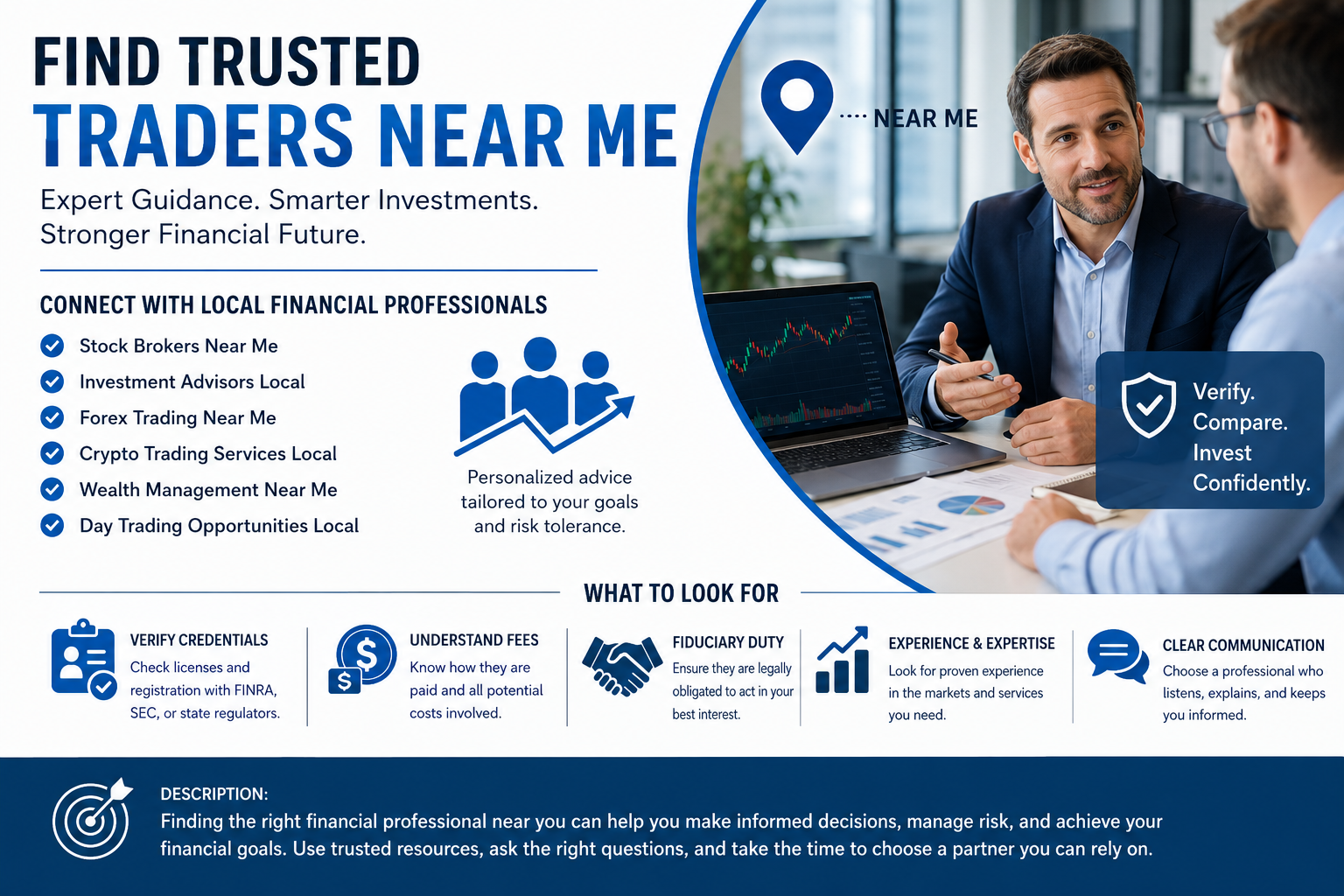
Seeking Referrals and Professional Networks
Personal recommendations can be a powerful tool. Ask trusted friends, family members, or colleagues if they have positive experiences with investment advisors local to your area. Additionally, engage with local business communities or professional organizations. Networking events can provide opportunities to meet financial professionals and gain insights into their services and reputations. A referral from a trusted source often comes with an implicit level of vetting.
A referral should still be independently verified. Someone who had a positive experience with a professional may have different financial goals, risk tolerance, investment time horizons, and service requirements than you do. Treat referrals as a starting point for research rather than a substitute for checking credentials and regulatory records.
What to Expect from Local Trading Professionals
Understanding the scope of services and the nature of the client-advisor relationship is key to a successful partnership.
Personalized Investment Strategies and Advice
A significant benefit of working with local professionals is the ability to receive personal investment advice near me. They should take the time to understand your unique financial situation, including your income, expenses, assets, liabilities, risk tolerance, and long-term goals. Based on this comprehensive assessment, they will develop a customized investment strategy designed to align with your objectives. This personalized approach ensures that recommendations are relevant and suitable for your individual circumstances.
Understanding Fees, Conflicts of Interest, and Account Costs
Cost should be evaluated beyond the headline advisory fee or trading commission. Depending on the relationship and investments involved, an investor may encounter advisory fees, transaction costs, account fees, fund expenses, spreads, or other charges.
Ask the professional to provide a clear explanation of all expected costs and identify who receives each fee. Also ask whether the professional or firm has financial incentives connected to particular products or services.
The SEC emphasizes the importance of understanding conflicts of interest and the standards of conduct applicable to investment advisers and broker-dealers.
A useful comparison is to request the same fee information from several professionals and place their services, costs, and responsibilities side by side before making a decision.
Exploring Day Trading Opportunities Local to You
While many financial professionals focus on long-term investment strategies, some firms or individual traders may offer guidance or platforms for more active trading styles. If you are interested in day trading opportunities local to your area, searching for reputable traders near me can help you identify professionals who understand active trading and its associated risks. It’s important to approach this with caution. Day trading involves frequent buying and selling of securities within the same trading day, aiming to profit from small price fluctuations. This strategy carries significant risk and is not suitable for all investors. Any professional offering day trading services should clearly explain the risks involved, provide robust educational resources, and ensure you understand the capital requirements and potential for substantial losses.
Before pursuing day trading, separate education from personalized investment advice and be skeptical of claims that consistently profitable short-term trading is easy or guaranteed. When evaluating traders near me, a professional should explain the possibility of losing money as well as the costs and risks associated with frequent transactions.
If someone markets a day-trading strategy using unusually high or guaranteed returns as the primary selling point, treat that as a warning sign and independently verify the person and firm before providing funds or personal information. Taking time to research traders near me and verify their credentials can help you make a more informed decision.
Key Questions to Ask Potential Traders Near You
Before committing to a financial professional, conduct thorough interviews. Here are essential questions to ask to ensure you find the right fit among the traders near me:
- What is your experience and what certifications do you hold?
- How do you structure your fees (e.g., commission-based, fee-only, asset-based)?
- What is your investment philosophy and approach to risk management?
- How often will we communicate, and what reporting can I expect?
- Are you a fiduciary, and how do you manage potential conflicts of interest?
- Can you provide references from current clients?
- What is your typical client profile?
- Have you ever had any disciplinary actions or complaints filed against you? (This can often be verified through regulatory databases).
Asking these questions will help you assess transparency, expertise, and whether a professional is truly a reputable trader near me.
Local Financial Professional Interview Checklist
Before making your final choice, consider asking these additional questions:
- What specific services are included in your fee?
- Will I receive a written investment or financial plan?
- Who has custody of my assets?
- What benchmark or method do you use to evaluate portfolio performance?
- How frequently will my portfolio or financial plan be reviewed?
- What happens if my financial circumstances change?
- Do you receive compensation from third parties or investment-product providers?
- What types of clients do you normally serve?
- What investment risks should I understand before proceeding?
- Can I review your applicable regulatory disclosures before signing an agreement?
A professional who answers these questions clearly and provides documentation can make it easier to compare candidates objectively.
Frequently Asked Questions About Finding Local Financial Traders
• How do I know if a financial advisor is legitimate?
Verify their registration and licenses through FINRA BrokerCheck or the SEC IAPD database. Check for any disciplinary history.
• What’s the difference between a broker and an advisor regarding fees?
Stock brokers near me typically earn commissions per trade, while investment advisors local often charge a percentage of assets under management (AUM) or a flat fee.
• Can I find specialized services like forex or crypto trading locally?
Yes, but it requires specific searching for professionals advertising forex trading near me or crypto trading services local. Always verify their expertise and regulatory compliance in these niche areas.
• Is it better to work with a large firm or an independent trader?
Both have advantages. Large firms may offer more resources and diverse services, while independent traders near me might provide more personalized attention. Your choice depends on your preferences and needs.
• What should I do if I have a complaint about a financial trader?
Contact the appropriate regulatory body (FINRA, SEC, or your state’s securities regulator) to file a formal complaint.
• How can I compare several traders near me?
Create a simple comparison based on registration status, services, experience, fees, conflicts of interest, communication practices, and investment approach. Avoid selecting a professional solely because they are geographically close.
• Should I choose a professional who guarantees investment returns?
Be extremely cautious. Investment markets involve risk, and claims of guaranteed or unusually high returns should be independently investigated before you provide money or personal information.
• Why should I check both the professional and the firm?
The individual and the firm can have separate registration histories and disclosures. Checking both can provide a more complete picture of the relationship you are considering.
Making an Informed Choice for Your Financial Future
Finding the right financial professional is a critical step toward achieving your financial goals. By clearly defining your needs, utilizing effective search strategies, thoroughly vetting credentials, and asking pertinent questions, you can confidently select a partner. Whether you’re seeking a stock broker near me, an investment advisor local, or specialized forex trading near me expertise, taking a proactive and informed approach will help you connect with the most suitable traders near me to guide your financial journey.
Final Verification Before You Invest
Before entering into a relationship with any professional you found through a search for traders near me, complete a final review:
- Confirm the professional’s identity and firm.
- Verify applicable registration and credentials.
- Review available regulatory disclosures.
- Understand every major fee and expense.
- Ask how conflicts of interest are handled.
- Confirm who will hold or have custody of your assets.
- Make sure you understand the proposed investment strategy and its risks.
- Take time to review agreements and disclosures before signing.
- Never feel pressured to invest immediately.
The goal is not simply to find a financial professional who is nearby. The goal is to find someone whose qualifications, regulatory status, services, communication style, costs, and approach to risk are appropriate for your individual circumstances. Using authoritative regulatory databases and asking detailed questions can help you make a more informed decision. FINRA’s BrokerCheck and the SEC’s investment adviser disclosure resources are useful starting points for this verification process.