



Starting Conversations: Portuguese Greetings and Goodbyes
portuguese phrases for travel Initiating conversations with appropriate portuguese greetings and goodbyes is a sign of respect and a great way to start any interaction. These simple exchanges are fundamental basic portuguese phrases that will serve you well.
Essential Welcomes and Farewells
Here are some common ways to say hello and goodbye, depending on the time of day:
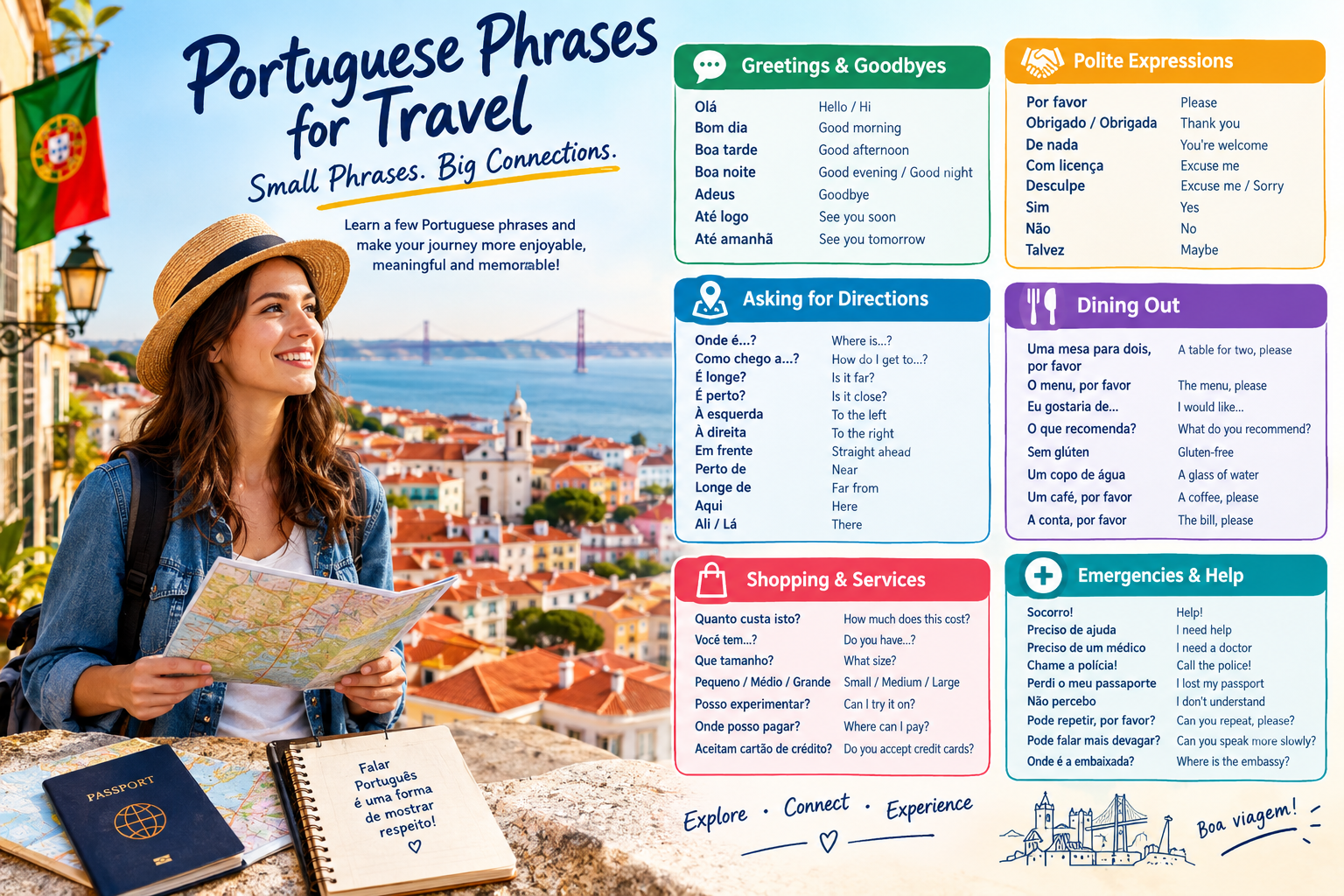
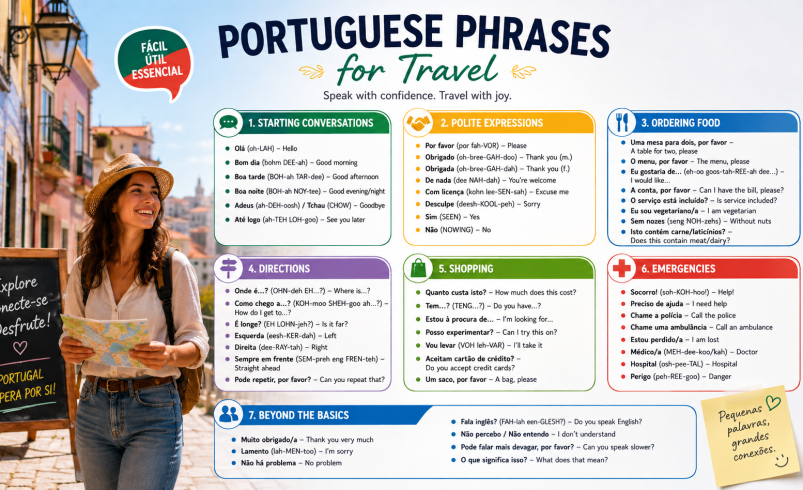
- Hello: Olá (oh-LAH)
- Good morning: Bom dia (bohm DEE-ah)
- Good afternoon: Boa tarde (BOH-ah TAR-dee)
- Good evening/night: Boa noite (BOH-ah NOY-tee)
- Goodbye: Adeus (ah-DEH-oosh) or Tchau (CHOW – more informal)
- See you later: Até logo (ah-TEH LOH-goo)
Polite Everyday Expressions
Politeness goes a long way. Incorporate these phrases into your daily interactions:
- Please: Por favor (por fah-VOR)
- Thank you: Obrigado (oh-bree-GAH-doo) for males, Obrigada (oh-bree-GAH-dah) for females. This is how you say thank you in portuguese.
- You’re welcome: De nada (dee NAH-dah)
- Excuse me / Sorry: Com licença (kohn lee-SEN-sah) for getting attention or passing through; Desculpe (deesh-KOOL-peh) for apologizing.
- Yes: Sim (SEEN)
- No: Não (NOWNG)
Practical Greeting Tip for Travelers
A simple greeting before asking a question can make an interaction feel more natural. For example, instead of immediately asking for directions, a traveler can say Bom dia or Boa tarde, followed by Com licença and then their question. This small combination is especially useful when approaching hotel staff, restaurant employees, shopkeepers, or someone on the street.
Culinary Adventures: How to Order Food in Portuguese
Exploring local cuisine is a highlight of any trip. Knowing how to order food in portuguese ensures you get exactly what you want and can navigate restaurant experiences with ease. These are essential portuguese phrases for tourists looking to savor local flavors.
Restaurant Navigation Phrases
From finding a table to paying the bill, these phrases are indispensable:
- A table for two, please: Uma mesa para dois, por favor (OO-mah MEH-zah PAH-rah DOYSH, por fah-VOR)
- The menu, please: O menu, por favor (oo meh-NOO, por fah-VOR)
- I would like…: Eu gostaria de… (eh-oo goos-tah-REE-ah dee…)
- Can I have the bill, please?: A conta, por favor (ah KOHN-tah, por fah-VOR)
- Is service included?: O serviço está incluído? (oo ser-VEE-soo esh-TAH een-kloo-EE-doo?)
Discussing Dietary Needs
Communicating dietary restrictions is crucial for a safe and enjoyable meal:
- I am vegetarian: Eu sou vegetariano/a (eh-oo soh veh-jeh-tah-ree-AH-noo/nah)
- I am vegan: Eu sou vegano/a (eh-oo soh veh-GAH-noo/nah)
- I am allergic to…: Eu sou alérgico/a a… (eh-oo soh ah-LER-jee-koo/kah ah…)
- Without nuts: Sem nozes (seng NOH-zehs)
- Does this contain meat/dairy?: Isto contém carne/laticínios? (EESH-too kohn-TENG KAR-nee/lah-tee-SEE-nee-osh?)
Useful Restaurant Follow-Up Phrases
Travelers may need more than a basic order when communicating with restaurant staff. These additional expressions can help clarify ingredients, preferences, and available options:
- Is this spicy?: É picante?
- Does this contain…? Isto contém…?
- I don’t eat…: Eu não como…
- Can I have water, please?: Água, por favor.
- Can I have this without…? Pode ser sem…?
When communicating an allergy, it is better to state the specific ingredient clearly rather than relying only on a general dietary label. If the allergy is serious, make sure the restaurant staff clearly understands the ingredient that must be avoided.
Brazilian and European Portuguese: What Travelers Should Know
Portuguese is spoken in several countries, but travelers are most likely to encounter Brazilian Portuguese in Brazil and European Portuguese in Portugal. The two varieties share the same language but differ in pronunciation, vocabulary, rhythm, and some everyday expressions.
For example, transportation vocabulary can vary noticeably. Trem is commonly used in Brazil, while comboio is commonly used in Portugal. Similarly, ônibus is widely used in Brazil, whereas autocarro is common in Portugal.
The core travel phrases in this guide will generally be useful across both varieties. When a regional difference is particularly important for travelers, learning the local version can make everyday communication easier.
Navigating Your Way: Portuguese Phrases for Directions
Getting around a new place is part of the adventure. These portuguese phrases for directions are vital survival portuguese phrases for independent exploration, whether you’re walking, using public transport, or taking a taxi.
Asking for Locations and Landmarks
Don’t hesitate to ask for help finding your way:
- Where is…?: Onde é…? (OHN-deh EH…?)
- How do I get to…?: Como chego a…? (KOH-moo SHEH-goo ah…?)
- Is it far?: É longe? (EH LOHN-jeh?)
- Street: Rua (ROO-ah)
- Square: Praça (PRAH-sah)
- Train station: Estação de comboios (esh-tah-SAH-oong dee kohn-BOY-osh – European Portuguese) / Estação de trem (es-tah-SAH-oong jee TRENG – Brazilian Portuguese)
- Bus stop: Paragem de autocarro (pah-RAH-jeng dee ow-toh-KAH-hoo – European Portuguese) / Ponto de ônibus (POHN-too jee OH-nee-boos – Brazilian Portuguese)
Understanding and Responding to Directions
Knowing common directional terms will help you follow instructions:
- Left: Esquerda (eesh-KER-dah)
- Right: Direita (dee-RAY-tah)
- Straight ahead: Sempre em frente (SEM-preh eng FREN-teh)
- Here: Aqui (ah-KEE)
- There: Ali (ah-LEE)
- Can you repeat that, please?: Pode repetir, por favor? (POH-deh reh-peh-TEER, por fah-VOR?)
A Simple Formula for Asking Directions
A useful pattern is to combine a greeting, a polite request, the destination, and a clarification question. For example:
Bom dia. Com licença. Como chego à estação, por favor? É longe?
This approach is easier to remember than trying to memorize a long conversation. If the response is too fast, Pode repetir, por favor? gives you a polite way to ask for repetition.
Smart Shopping: Portuguese Phrases for Shopping
Whether you’re browsing local markets or looking for souvenirs, having some portuguese phrases for shopping at your disposal makes the experience more enjoyable and efficient. These are common portuguese phrases for travel that facilitate transactions and interactions with vendors.
Price and Product Inquiries
Ask about items and prices with confidence:
- How much does this cost?: Quanto custa isto? (KWAN-too KOOS-tah EESH-too?)
- Do you have…?: Tem…? (TENG…?)
- I’m looking for…: Estou à procura de… (esh-TOH ah proh-KOO-rah dee…)
- What size is this?: Que tamanho é este? (keh tah-MAH-nyoo eh ESH-tee?)
- Can I try this on?: Posso experimentar? (POH-soo esh-peh-ree-men-TAR?)
Transactional Language
Completing your purchase smoothly:
- I’ll take it: Vou levar (VOH leh-VAR)
- Do you accept credit cards?: Aceitam cartão de crédito? (ah-SAY-tahm kar-TOWNG dee KREH-dee-too?)
- Cash: Dinheiro (dee-NYEH-roo)
- A bag, please: Um saco, por favor (oong SAH-koo, por fah-VOR – European Portuguese) / Uma sacola, por favor (OO-mah sah-KOH-lah, por fah-VOR – Brazilian Portuguese)
Shopping Etiquette and Useful Follow-Ups
In a market or shop, travelers may also need to ask whether another size or color is available. These short phrases can make the interaction easier:
- Do you have another one?: Tem outro?
- Do you have another size?: Tem outro tamanho?
- Do you have another color?: Tem outra cor?
- Can I pay by card?: Posso pagar com cartão?
- Thank you, I’m just looking: Obrigado/a, estou só a ver.
Learning these expressions can help travelers communicate without needing to translate every sentence individually.
Handling the Unexpected: Portuguese Phrases for Emergencies
While we hope for smooth travels, being prepared for unforeseen circumstances is always wise. These critical portuguese phrases for emergencies are indispensable survival portuguese phrases that can make a significant difference in difficult situations.
Urgent Assistance Phrases
Knowing how to call for help is paramount:
- Help!: Socorro! (soh-KOH-hoo!)
- I need help: Preciso de ajuda (preh-SEE-zoo dee ah-JOO-dah)
- Call the police: Chame a polícia (SHAH-meh ah poh-LEE-see-ah)
- Call an ambulance: Chame uma ambulância (SHAH-meh OO-mah am-boo-LAN-see-ah)
- I am lost: Estou perdido/a (esh-TOH per-DEE-doo/dah)
- I am sick: Estou doente (esh-TOH doo-EN-tee)
Medical and Safety Vocabulary
Key terms for communicating specific needs:
- Doctor: Médico/a (MEH-dee-koo/kah)
- Hospital: Hospital (osh-pee-TAL)
- Pharmacy: Farmácia (far-MAH-see-ah)
- Pain: Dor (DOR)
- Fire: Fogo (FOH-goo)
- Danger: Perigo (peh-REE-goo)
Expert Safety Tip: Keep Emergency Language Simple
In a stressful situation, short and direct sentences are easier to remember and communicate than complicated explanations. Travelers can combine a basic request with the specific problem, such as Preciso de ajuda followed by the location or type of assistance needed.
Language should not replace contacting the appropriate local emergency service. Travelers should also keep important accommodation details and emergency information accessible during their trip.
Beyond the Basics: Key Phrases for Deeper Connections
Beyond transactional needs, some essential portuguese phrases for tourists can foster better interactions and show genuine interest in the local culture. These phrases help bridge communication gaps and build rapport.
Expressing Gratitude and Apologies
Mastering expressions of politeness:
- Thank you very much: Muito obrigado/a (MOOYN-too oh-bree-GAH-doo/dah)
- I’m sorry: Lamento (lah-MEN-too) or Peço desculpa (PEH-soo deesh-KOOL-pah)
- No problem: Não há problema (NOWNG ah proh-BLEH-mah)
Clarification and Understanding
When you need a little extra help:
- Do you speak English?: Fala inglês? (FAH-lah een-GLESH?)
- I don’t understand: Não percebo (NOWNG per-SEH-boo – European Portuguese) / Não entendo (NOWNG en-TEN-doo – Brazilian Portuguese)
- Can you speak slower, please?: Pode falar mais devagar, por favor? (POH-deh fah-LAR MAYS deh-vah-GAR, por fah-VOR?)
- What does that mean?: O que significa isso? (oo keh see-gnee-fee-KAH EE-soo?)
Portuguese Pronunciation Tips for Travelers
Pronunciation does not need to be perfect for a traveler to communicate effectively, but a few habits can make familiar phrases easier to understand.
Pay particular attention to nasal sounds, especially in words containing combinations such as ão. Portuguese pronunciation also differs between Brazil and Portugal, so the same written word may sound noticeably different depending on where you are traveling.
Rather than trying to master every pronunciation rule before a trip, focus on practicing the phrases you are most likely to use. Saying Bom dia, Por favor, Obrigado/a, Onde é…?, and Pode repetir, por favor? aloud several times can build confidence before departure.
Portuguese Travel Etiquette: Small Details That Matter
Using Portuguese is not only about choosing the correct words. The way a phrase is introduced can also affect how natural and polite the interaction feels.
A greeting such as Bom dia or Boa tarde is useful before making a request, while Por favor and Obrigado/a can help maintain a courteous tone. When you do not understand someone, asking them to repeat or speak more slowly is generally more useful than pretending to understand.
Travelers should also remember that language habits vary between individuals and regions. A phrase that sounds natural in one setting may be less common in another, so listening to how local speakers communicate can be just as valuable as memorizing vocabulary.
Quick Practice Dialogues for Common Travel Situations
Practicing complete exchanges can make individual phrases easier to recall when you are actually traveling.
At a restaurant
Traveler: Bom dia. Uma mesa para dois, por favor.
Staff: Claro.
Traveler: O menu, por favor.
Asking for directions
Traveler: Com licença. Onde é a estação, por favor?
Local: É ali.
Traveler: Obrigado/a.
In a shop
Traveler: Quanto custa isto?
Shopkeeper: Cinquenta euros.
Traveler: Posso pagar com cartão?
Frequently Asked Questions About Portuguese Phrases for Travel
How much Portuguese do I really need for a trip?
Even a handful of basic portuguese phrases can significantly enhance your travel experience. While you don’t need to be fluent, knowing how to greet people, order food, and ask for directions shows respect for the local culture and can lead to more positive interactions. It often encourages locals to be more helpful and patient with you.
Are there significant differences between Brazilian and European Portuguese for travelers?
Yes, there are noticeable differences in pronunciation, intonation, and some vocabulary between Brazilian Portuguese and European Portuguese. However, for most portuguese phrases for travel, the core meaning will be understood in both regions. This guide primarily focuses on phrases that are widely recognized, or provides common variations where significant. Don’t let the differences deter you; locals will generally appreciate your effort regardless of the accent.
What’s the best way to practice basic portuguese phrases before I go?
To practice survival portuguese phrases, consider using language learning apps like Duolingo or Memrise, which offer structured lessons and pronunciation practice. Listening to Portuguese music or podcasts, watching films with subtitles, and repeating phrases aloud can also be effective. Focus on common conversational scenarios you expect to encounter during your trip.
Should I Learn Brazilian or European Portuguese Before Traveling?
Choose the variety that matches your destination whenever possible. If you are visiting Portugal, prioritize European Portuguese vocabulary and pronunciation. If you are visiting Brazil, focus on Brazilian Portuguese. The core language remains the same, so learning universally useful phrases such as greetings, requests, directions, and expressions of thanks is still a strong starting point.
What Portuguese Phrases Should I Memorize First?
If you have limited preparation time, prioritize phrases that solve common travel situations. Start with Olá, Bom dia, Por favor, Obrigado/a, Com licença, Desculpe, Onde é…?, Quanto custa?, Não entendo, and Pode repetir, por favor?.
These phrases cover greetings, politeness, shopping, directions, and communication problems, making them useful across many everyday situations.
How Can I Practice Portuguese Without Becoming Fluent?
You do not need to become fluent before using Portuguese while traveling. Practice a small group of high-frequency phrases aloud, learn the pronunciation of destinations and common places, and rehearse short conversations such as ordering food or asking for directions.
A useful approach is to practice phrases in complete situations rather than memorizing individual words. This helps you remember what to say when you encounter a similar situation during your trip.
Conclusion: Speak with Confidence, Travel with Joy
Learning a few portuguese phrases for travel is more than just a practical skill; it’s an investment in a richer, more authentic travel experience. From simple greetings to navigating emergencies, these phrases empower you to engage with your surroundings and the people you meet. Embrace the opportunity to speak, even if imperfectly, and you’ll find that your efforts are met with warmth and appreciation, transforming a good trip into an extraordinary adventure.