




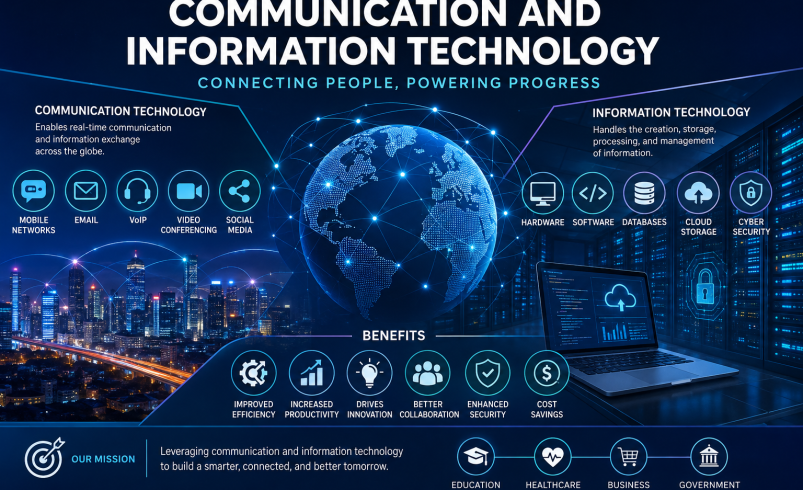

Modern society and business operations are fundamentally shaped by communication and information technology. This pervasive influence extends across every sector, from global enterprises to individual daily routines, acting as the essential backbone for progress and connectivity. Understanding its core components, widespread applications, and strategic importance is no longer optional but a necessity for navigating the complexities of our interconnected world. This article explores the definition, benefits, and strategic application of these technologies, including the crucial role of expert guidance in leveraging their full potential.
Defining Communication and Information Technology
Communication and information technology (CIT) encompasses all technological tools and resources used to create, store, manage, exchange, and process information. It represents the convergence of information technology (IT) and communication technology (CT), working in tandem to facilitate seamless data flow and interaction. While IT primarily focuses on the handling of data, CT emphasizes the transmission of that data and the enablement of human-to-human or human-to-machine interaction. Together, they form the infrastructure that underpins digital operations and interactions, illustrating precisely how information technology works in a broader context.
How Information Technology Works: Core Components and Processes
At its core, how information technology works involves a systematic process of input, processing, storage, and output. This relies on several fundamental components:
- Hardware: Physical components such as computers, servers, networking devices, and storage units.
- Software: Programs and applications that instruct hardware to perform specific tasks, ranging from operating systems to specialized business applications.
- Networks: Interconnected systems that allow devices to share data and resources, including local area networks (LANs) and wide area networks (WANs) like the internet.
- Data Storage: Methods and devices for preserving digital information, from hard drives to cloud-based solutions.
- Databases: Organized collections of data designed for efficient storage, retrieval, and management.
Information flows from input devices (e.g., keyboards, sensors) to processing units (CPUs), is stored temporarily or permanently, and then presented as output (e.g., on screens, through printers, or as data for other systems).
Examples of Communication Technology Shaping Our World
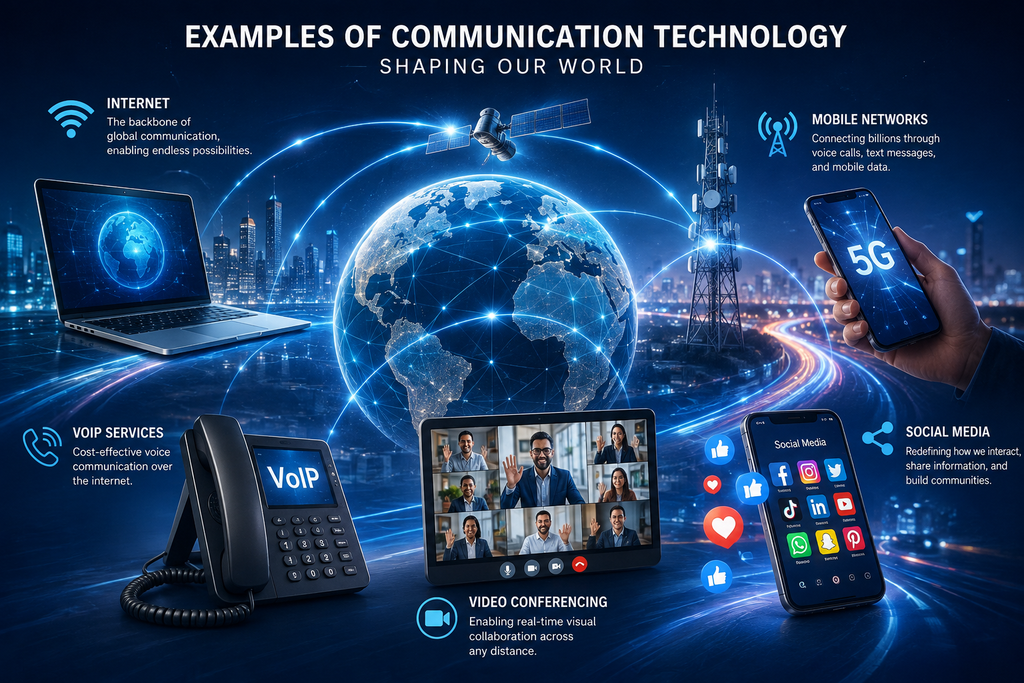
Examples of communication technology are abundant and integrated into nearly every aspect of modern life. The internet, a global network of interconnected computer networks, stands as the most prominent example, enabling everything from email to e-commerce. Mobile networks facilitate voice calls, text messages, and mobile data access, connecting billions worldwide. Voice over Internet Protocol (VoIP) services allow for cost-effective voice communication over the internet, while video conferencing platforms enable real-time visual and audio collaboration across geographical distances. Social media platforms have redefined personal and professional interaction, allowing for instant sharing of information and fostering communities. These technologies collectively enable real-time interaction and information exchange, fundamentally altering how individuals and organizations connect.
The Transformative Impact and Benefits of Communication and Information Technology
The profound positive effects of communication and information technology span across various sectors, from business and education to healthcare and personal life. Its role in driving efficiency, fostering innovation, and enabling global connectivity is undeniable. The impact of communication technology, combined with the extensive benefits of information technology has reshaped economies and societies, making it a cornerstone of progress and development.
Benefits of Information Technology: Driving Efficiency and Innovation
The benefits of information technology are extensive, primarily centered on enhancing operational efficiency and fostering innovation. IT facilitates automation of repetitive tasks, significantly reducing manual effort and potential errors. Advanced data analysis capabilities, powered by IT systems, provide organizations with actionable insights for informed decision-making, optimizing strategies and resource allocation. Improved productivity stems from streamlined workflows and faster access to critical information. Furthermore, IT contributes to cost reduction through optimized processes and resource management, while robust security measures protect sensitive data from cyber threats, ensuring business continuity and trust.
Impact of Communication Technology: Fostering Connectivity and Collaboration
The impact of communication technology has revolutionized how individuals and organizations interact. It enables seamless global communication, breaking down geographical barriers and fostering a truly interconnected world. Remote work models, once a niche concept, have become mainstream, allowing businesses to access a wider talent pool and offering employees greater flexibility. Collaborative projects are facilitated by shared platforms and instant messaging, enabling teams to work together irrespective of their physical locations. This technology ensures instant information sharing, accelerating decision-making and response times across various contexts.
The Role of IT in Modern Society and IT in Daily Life
The role of IT in modern society is foundational, influencing nearly every facet of human existence. In healthcare, IT supports electronic health records, telemedicine, and advanced diagnostic tools. Education benefits from e-learning platforms and digital resources, expanding access to knowledge. Governance leverages IT for public services, transparency, and citizen engagement. Entertainment has been transformed by streaming services, online gaming, and virtual reality experiences. Examples of IT in daily life include smart devices that manage home environments, online banking, navigation apps, and personalized content recommendations, all powered by sophisticated information systems that simplify and enrich our routines.
Strategic Application: The Value of IT Consulting in a Connected World
Leveraging the full potential of communication and information technology requires more than just adopting new tools; it demands strategic planning and expert implementation. This is where the value of IT consulting becomes evident. Organizations, particularly those navigating rapid technological shifts, often seek external expertise to optimize their technology investments and align them with business objectives. Understanding what is IT consulting and its associated benefits of IT consulting is crucial for any entity aiming to thrive in a digitally driven environment.
What is IT Consulting? Guiding Technology Adoption
What is IT consulting It is the practice of advising organizations on how to effectively use information technology to achieve their business goals. IT consultants provide specialized knowledge and experience to help clients plan, implement, and manage IT systems. Their scope of services can range from strategic planning and system integration to cybersecurity and cloud migration, offering objective insights and solutions tailored to specific organizational needs. This guidance ensures that technology investments yield tangible returns and support overarching strategic objectives.
Types of IT Consulting Services: Tailored Solutions for Every Need
The landscape of types of IT consulting services is diverse, offering tailored solutions for various organizational requirements. These services often include strategic planning, cybersecurity assessments, cloud computing solutions, enterprise resource planning (ERP) implementation, and data analytics. Two prominent areas that highlight the strategic importance of this field are IT strategy consulting and digital transformation consulting.IT Strategy Consulting: Aligning Technology with Business Goals
**IT strategy consulting** focuses on helping businesses develop a comprehensive technology roadmap that directly supports their overall strategic objectives. Consultants in this area assess an organization’s current IT infrastructure, identify gaps, and recommend solutions that enhance efficiency, reduce costs, and foster innovation. This involves creating long-term plans for technology adoption, resource allocation, and risk management, ensuring that IT investments are aligned with the business’s vision and growth trajectory.
Digital Transformation Consulting: Navigating the Shift to Digital
Digital transformation consulting assists organizations in integrating digital technology into all areas of their business, fundamentally changing how they operate and deliver value to customers. This involves more than just adopting new software; it’s about reimagining business models, processes, and culture to leverage digital capabilities fully. Consultants guide clients through this complex shift, helping them identify opportunities for innovation, optimize customer experiences, and build a resilient, future-ready enterprise.
Benefits of IT Consulting: Maximizing Technology Investments
The benefits of IT consulting are manifold. Engaging IT consultants provides organizations with access to specialized expertise that might not be available in-house, leading to more informed decisions and optimized technology solutions. Consultants can improve operational efficiency by identifying bottlenecks and implementing best practices. They help reduce risks associated with technology implementation, ensuring compliance with industry regulations and security standards. Furthermore, consultants often introduce innovative approaches and technologies, fostering a culture of continuous improvement and competitive advantage.
IT Consulting for Small Business: Leveling the Playing Field
For smaller enterprises, IT consulting for small business offers a significant advantage. Small businesses often lack the resources for a dedicated, in-house IT department with diverse specializations. Engaging an IT consultant provides access to expert insights and strategic guidance without the overhead of full-time staff. This allows small businesses to implement sophisticated IT solutions, enhance cybersecurity, streamline operations, and leverage emerging technologies to compete effectively with larger organizations. It essentially levels the playing field by democratizing access to high-level technological expertise.
How to Choose an IT Consultant and Identifying Reputable IT Consulting Firms
Selecting the right IT consultant or firm is a critical decision. When considering how to choose an IT consultant, evaluate their experience in your specific industry and their track record of successful projects. Look for specialization that aligns with your needs, whether it’s cloud migration, cybersecurity, or data analytics. Request client testimonials and case studies to gauge their effectiveness and client satisfaction. A reputable consultant will demonstrate a clear understanding of your business objectives and propose solutions that are practical and scalable. When identifying reputable IT consulting firms, consider their certifications, partnerships with technology vendors, and their approach to project management and client communication. Due diligence, including interviews and reference checks, is essential to ensure a good fit.
Digital Communication Trends and The Future of Communication Tech
The landscape of communication and information technology is dynamic, constantly evolving with new innovations and challenges. Understanding current digital communication trends and anticipating the future of communication tech is vital for individuals and organizations alike to remain relevant and competitive.
Current Digital Communication Trends: Staying Ahead of the Curve
Several significant digital communication trends are shaping how we interact and exchange information. Artificial intelligence (AI) is increasingly integrated into communication tools, powering chatbots, virtual assistants, and predictive text, enhancing efficiency and personalization. There’s an increased reliance on cloud-based platforms for collaboration and data storage, offering flexibility and scalability. Enhanced cybersecurity measures are paramount as communication becomes more digital, protecting sensitive information from growing threats. The rise of immersive communication experiences, such as augmented reality (AR) and virtual reality (VR), is beginning to transform remote collaboration, training, and entertainment, offering more engaging and interactive forms of interaction.
The Future of Communication Tech: Innovations on the Horizon
The future of communication tech promises even more transformative advancements. Quantum communication, leveraging principles of quantum mechanics, holds the potential for ultra-secure data transmission, impervious to traditional eavesdropping. Advanced Internet of Things (IoT) integration will lead to more interconnected environments, where devices communicate seamlessly to automate tasks and provide real-time data. Brain-computer interfaces (BCIs) are emerging as a frontier, potentially allowing direct thought-to-device communication. Furthermore, the decentralization of communication networks, often powered by blockchain technology, could offer greater privacy, security, and resilience, challenging traditional centralized communication models.
Frequently Asked Questions About Communication and Information Technology
What is the primary difference between information technology and communication technology?
While closely related and often integrated, information technology (IT) primarily focuses on the creation, storage, processing, and retrieval of data. It deals with the systems and applications that manage information. Communication technology (CT), on the other hand, specifically focuses on the transmission of that data and the enablement of interaction between individuals or systems. For instance, a database is an IT component, while a video conferencing system is an **example of communication technology** that relies on IT infrastructure to function. Both are integral to **communication and information technology** as a whole, illustrating **how information technology works** in conjunction with communication.
Why is IT consulting particularly beneficial for small businesses?
IT consulting for small business is highly beneficial because it provides access to specialized expertise and strategic guidance that small businesses might not otherwise afford or maintain in-house. Small businesses can leverage consultants to implement robust IT solutions, improve cybersecurity, optimize operations, and develop long-term technology strategies without the significant overhead of hiring a full-time, diverse IT team. This access to high-level expertise helps them compete more effectively and achieve the same benefits of IT consulting as larger enterprises.
How does communication and information technology contribute to digital transformation?
Communication and information technology provides the fundamental tools, infrastructure, and capabilities necessary for digital transformation. It enables organizations to adopt new digital business models, automate processes, enhance customer experiences through digital channels, and leverage data for strategic insights. Services like digital transformation consulting specifically guide businesses in integrating these technologies across all operational areas, ensuring a holistic and effective shift towards a digitally-driven enterprise.
Conclusion: Embracing the Evolution of Communication and Information Technology
Communication and information technology stands as an indispensable pillar of modern existence, profoundly influencing how we live, work, and interact. From defining the core mechanisms of data handling to providing countless examples of communication technology that connect us globally, its impact is undeniable. The role of IT in modern society continues to expand, driving efficiency, fostering innovation, and shaping our daily lives. For organizations, strategically leveraging these advancements, often with the expert guidance of IT consultants, is paramount for sustained growth and competitiveness. As we look towards the future of communication tech and navigate evolving digital communication trends, continuous adaptation and strategic planning will be key to harnessing the full, transformative potential of this dynamic field.
Added E-E-A-T Content
Why Communication and Information Technology Matters Today
Communication and information technology connects people, systems, applications, and data across increasingly digital environments. However, effective technology adoption is not simply about purchasing newer hardware or software. Organizations also need to consider security, scalability, interoperability, user requirements, accessibility, maintenance, and the long-term business value of each technology investment.
A practical approach begins by identifying the problem that technology needs to solve. Businesses can then compare available solutions against measurable requirements such as performance, reliability, security, total cost of ownership, integration capabilities, and ease of use. This approach helps prevent technology decisions from being driven solely by trends and keeps investments aligned with genuine operational needs.
Key Characteristics of Effective Communication and Information Technology
Effective technology environments generally need to support several core characteristics. Reliability helps systems remain available when users depend on them, while scalability allows infrastructure to accommodate changing workloads. Security protects systems and information from unauthorized access, and interoperability allows different applications and platforms to exchange information effectively.
Another important consideration is usability. A technically capable system may still fail to deliver value if employees or customers find it difficult to use. For this reason, technology planning should consider both technical performance and the experience of the people who interact with the system.
How These Components Work Together in a Business Environment
In a practical business environment, these components rarely operate independently. For example, an employee may enter information through a software application running on a computer. The application can send that information through a network to a database, where it is processed and stored. Another authorized user may then retrieve the information through a separate application or dashboard.
This interaction demonstrates why organizations should evaluate their technology environment as an interconnected system rather than treating individual devices or applications as isolated investments. A change to one component can affect network performance, data access, security, user workflows, and other dependent systems.
The Digital Divide and Responsible Technology Adoption
The benefits of communication technology are not distributed equally. Access can be affected by infrastructure availability, affordability, digital skills, device availability, and the quality of internet services. Organizations and policymakers therefore need to consider accessibility alongside technological advancement.
Responsible adoption also requires attention to privacy, security, accessibility, and the potential consequences of automated or data-driven decisions. A technology can be technically successful while still creating challenges for users if these factors are overlooked. Considering these issues during planning can help organizations build more inclusive and sustainable digital environments.
Measuring the Business Value of IT Investments
Technology investments should ideally be evaluated using measurable outcomes rather than assumptions about their value. Depending on the project, organizations can monitor indicators such as processing time, system availability, support requests, operating costs, employee productivity, customer response times, security incidents, or user adoption.
A useful evaluation process can include:
- Defining the business problem before selecting a technology.
- Establishing measurable objectives and success criteria.
- Comparing implementation and ongoing operating costs.
- Assessing integration, security, and scalability requirements.
- Testing the solution with a controlled group of users when appropriate.
- Measuring results after implementation.
- Reviewing the system periodically as business requirements change.
This approach gives decision-makers evidence for determining whether an IT investment is delivering its intended value and where further improvements may be necessary.
Security and Privacy as Core IT Priorities
As organizations become more dependent on connected systems, security and privacy should be treated as core components of technology planning rather than optional additions. Common areas of consideration include identity and access management, secure configuration, software updates, data protection, backups, employee awareness, monitoring, and incident response.
A practical security strategy should also account for the organization’s size, industry, data sensitivity, regulatory obligations, and technology environment. Recognized cybersecurity frameworks can provide a structured way to identify risks, establish priorities, and evaluate improvements. Organizations should avoid assuming that a single security product can address every risk because effective cybersecurity depends on multiple complementary controls and ongoing management.
Practical Example: Connecting IT Systems Across a Business
Consider a business that manages customer information, sales, inventory, and employee communication through separate systems. If these systems cannot exchange information effectively, employees may need to enter the same data multiple times, increasing the possibility of delays or inconsistencies.
An integrated technology environment can connect relevant applications so that approved information moves between systems more efficiently. However, integration should be planned carefully. Businesses should assess data ownership, access permissions, system compatibility, backup procedures, security requirements, and the effect of the change on employees before implementation.
This example illustrates an important principle of communication and information technology: the value of a system often depends not only on what an individual application can do, but also on how effectively it works with the wider technology environment.
How IT Consultants Assess an Organization’s Technology Needs
A strong IT consulting engagement should begin with assessment rather than immediately recommending a product or platform. An expert may review the organization’s existing infrastructure, applications, network architecture, data flows, security controls, business processes, technical skills, and future requirements.
The assessment can then be translated into a prioritized technology roadmap. High-priority issues typically receive attention based on their business impact, security implications, operational risk, cost, and urgency. This process helps organizations distinguish between technology that is genuinely necessary and technology that may simply be attractive because it is new.
For greater transparency, organizations should also request clear project objectives, implementation milestones, expected deliverables, assumptions, ongoing costs, and methods for measuring success.
Cloud Computing and Modern IT Infrastructure
Cloud computing has become an important part of modern IT environments because organizations can access computing resources without necessarily maintaining all infrastructure on-site. Cloud strategies can involve software, platforms, infrastructure, or combinations of these approaches.
However, moving to the cloud should not automatically be treated as the best solution for every workload. Businesses should evaluate data sensitivity, regulatory requirements, performance needs, integration dependencies, migration complexity, vendor dependency, backup arrangements, and long-term costs before selecting a cloud strategy.
An expert assessment should therefore compare cloud, on-premises, and hybrid approaches according to the organization’s actual requirements rather than assuming that one infrastructure model is universally superior.
IT Consulting Implementation Checklist
Before starting a major IT consulting project, organizations can use the following checklist to improve planning and accountability:
- Define the business problem and desired outcome.
- Document the existing technology environment.
- Identify critical applications, systems, and data.
- Assess cybersecurity, privacy, and compliance requirements.
- Establish a realistic budget, including ongoing costs.
- Define project milestones and responsibilities.
- Determine how success will be measured.
- Plan employee training and change management.
- Establish backup, recovery, and continuity requirements.
- Review the results after implementation and identify further improvements.
A structured checklist does not replace professional assessment, but it can help organizations ask better questions and maintain visibility throughout a technology project.
How to Verify an IT Consultant’s Expertise
Credentials can provide useful signals, but they should be evaluated alongside practical evidence. Organizations can strengthen their due diligence by asking consultants for relevant project examples, references, documented methodologies, and explanations of how they measure project success.
It is also useful to determine who will actually perform the work. A firm’s sales team, senior consultant, and implementation team may have different levels of experience. Before signing an agreement, clarify the assigned team’s responsibilities, escalation process, project timeline, security obligations, ownership of documentation, and post-implementation support.
These checks help distinguish genuine expertise from broad marketing claims and make the selection process more transparent.
Evaluating Emerging Technology Before Adoption
Emerging technologies can create opportunities, but organizations should evaluate them based on evidence rather than novelty. Before adopting an emerging communication technology, decision-makers should consider whether it solves a clearly defined problem, whether the technology is sufficiently mature, how it integrates with existing systems, what security and privacy risks it introduces, and whether the organization has the skills required to operate it.
A controlled pilot can be useful when appropriate. Testing a technology with a limited use case allows an organization to evaluate performance, usability, security, cost, and user acceptance before committing significant resources.
Expert Considerations for the Future of IT
Future technology adoption will require more than technical capability. Organizations will increasingly need to balance innovation with cybersecurity, privacy, interoperability, workforce skills, governance, and financial sustainability.
For emerging technologies such as AI, IoT, quantum communication, and brain-computer interfaces, readers should distinguish between technologies that are already commercially established and concepts that remain under active research or development. Clear evidence, independent testing, recognized standards, and credible research are especially important when evaluating predictions about future capabilities.
What factors should businesses consider before adopting new technology?
Businesses should consider the problem being solved, expected business value, implementation cost, ongoing operating expenses, cybersecurity, privacy, regulatory requirements, compatibility with existing systems, scalability, employee skills, vendor support, and potential migration or exit costs. A technology decision is stronger when these factors are evaluated together rather than based only on features or short-term pricing.
How can organizations improve the security of their IT environment?
Organizations can begin by identifying critical systems and information, controlling user access, keeping software and systems maintained, using appropriate backups, monitoring for unusual activity, training employees, and preparing an incident response process. Security should be treated as an ongoing risk-management activity rather than a one-time technology purchase.
Why is data quality important in information technology?
Data quality directly affects the usefulness of reports, analytics, automation, and business decisions. Inaccurate, incomplete, duplicated, or outdated information can produce misleading results even when the underlying technology is functioning correctly. Organizations should therefore establish appropriate processes for data validation, ownership, access, maintenance, and governance.
What is the difference between digital transformation and simply adopting new technology?
Adopting a new tool usually means introducing a specific technology into an existing process. Digital transformation is broader because it can involve changes to workflows, customer experiences, organizational processes, business models, employee responsibilities, and decision-making. The technology is an enabler; successful transformation also requires people, processes, governance, and measurable business objectives.
Expert Takeaway: Making Technology Decisions With Confidence
The most effective approach to communication and information technology is not to adopt every new innovation, but to select technologies that solve clearly defined problems and deliver measurable value. Organizations can strengthen their technology decisions by combining practical requirements with security, privacy, scalability, interoperability, user experience, and long-term cost considerations.
For readers evaluating IT solutions or consulting services, credible evidence should remain central to the decision-making process. Case studies, relevant experience, transparent methodologies, recognized professional standards, independent research, and measurable results can provide stronger evidence of expertise than general technology claims alone.