






Computer information technology (CIT) is a foundational discipline that underpins nearly every aspect of modern business and daily life. It encompasses the study, design, development, implementation, support, and management of computer-based information systems. From the devices we use to communicate to the complex networks that power global commerce, CIT professionals ensure that technology functions efficiently and securely. This article explores the core concepts of CIT, delves into the diverse career opportunities it offers, outlines educational pathways, clarifies its distinction from computer science, and highlights the significant benefits of pursuing a career in this dynamic field.
Understanding the Core of Computer Information Technology
To truly grasp the scope of this field, it is essential to define what is computer information technology and its fundamental role in managing and processing information across various sectors.
Defining the Field: Systems, Networks, and Data
At its heart, computer information technology involves the practical application of technology to solve organizational and individual problems. This includes working with hardware (servers, computers, mobile devices), software (operating systems, applications), networks (local area networks, wide area networks, the internet), and data management systems. The field often focuses on computer information systems, which are integrated sets of components for collecting, storing, processing, and distributing information. Professionals in CIT ensure these systems are reliable, secure, and accessible, facilitating seamless operations.
Key Functions and Business Impact
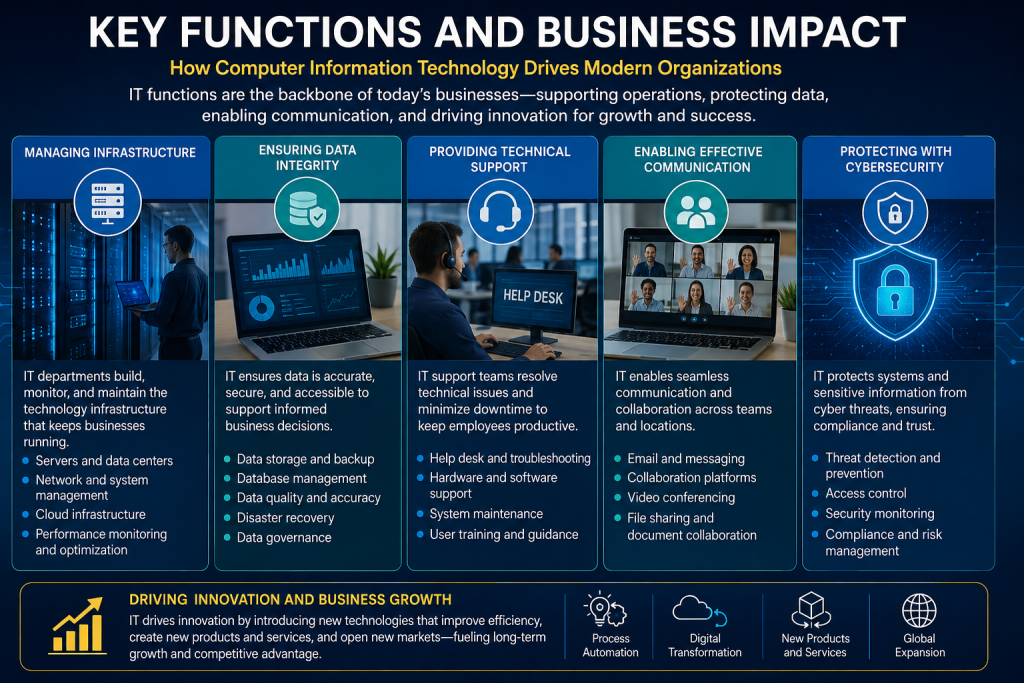
The functions of computer information technology are broad and critical. IT departments support business operations by managing infrastructure, ensuring data integrity, and providing technical support. They enable effective communication through email, collaboration platforms, and teleconferencing. Cybersecurity, a vital component of CIT, protects sensitive information from threats, maintaining trust and compliance. Furthermore, IT drives innovation by implementing new technologies that enhance efficiency, create new products, and open new markets for organizations of all sizes.
A Practical Example of Computer Information Technology in Action
Consider a business where employees suddenly cannot access a shared application. A CIT professional may begin by determining whether the issue affects one user, a department, or the entire organization. They may then check network connectivity, user permissions, server availability, application status, and relevant system logs. Once the underlying problem is identified, the professional applies a solution, verifies that the service is working, and documents the incident for future reference.
This example illustrates why CIT is broader than simply “working with computers.” The field combines technical troubleshooting, system administration, security awareness, communication, documentation, and problem-solving to keep technology aligned with business needs.
How IT Supports Business Continuity
A mature IT environment is not only concerned with keeping systems operational under normal conditions. IT teams also help organizations prepare for disruptions by maintaining backups, documenting recovery procedures, monitoring infrastructure, managing access controls, and testing recovery processes.
For example, if a critical application becomes unavailable, an organization may rely on documented recovery procedures to restore services and reduce operational disruption. This makes areas such as backup management, disaster recovery, business continuity, and incident response important parts of modern IT operations.
Diverse Career Paths in Computer Information Technology
The demand for skilled professionals in computer information technology continues to grow, leading to a wide array of rewarding career opportunities.
Exploring Specific Computer Information Technology Careers
The field offers numerous specializations. Common computer information technology careers include:
- Network Administrator: Manages and maintains an organization’s computer networks, ensuring their smooth operation and security.
- Cybersecurity Analyst: Protects computer systems and networks from cyber threats, implementing security measures and responding to incidents.
- Database Administrator: Designs, implements, maintains, and repairs an organization’s databases.
- IT Support Specialist: Provides technical assistance and support related to computer systems, hardware, and software.
- Software Developer: Designs, develops, and maintains software applications, often working closely with IT teams to integrate solutions.
- Cloud Architect: Designs and implements cloud computing strategies and solutions.
- Systems Analyst: Studies an organization’s current computer systems and procedures and designs solutions to help the organization operate more efficiently.
The Robust IT Job Market Outlook
The IT job market outlook remains exceptionally strong. Projections from various labor statistics agencies consistently show above-average growth for IT occupations. Factors contributing to this growth include the ongoing digital transformation across industries, the increasing reliance on cloud computing, the proliferation of data, and the constant need for enhanced cybersecurity. This stability and expansion make CIT an attractive field for long-term career planning.
Securing Entry-Level IT Jobs
For those looking to enter the field, several **entry-level IT jobs** provide excellent starting points. Positions like IT Support Specialist, Help Desk Technician, Junior Network Administrator, or Junior Cybersecurity Analyst are common entry points. These roles allow individuals to gain practical experience, develop foundational skills, and understand the operational aspects of IT environments. Many organizations also offer internships or apprenticeship programs specifically designed to transition new talent into the IT workforce.
How Computer Information Technology Careers Can Progress
IT careers do not always follow a single path. A professional may begin in technical support and later specialize in networking, cloud computing, systems administration, cybersecurity, or another area.
A possible progression could look like:
IT Support Specialist → Systems or Network Administrator → Cloud, Security, or Infrastructure Specialist → Senior or Leadership Role
The progression depends on an individual’s technical skills, work experience, education, certifications, and career goals. Some professionals specialize deeply in one technical area, while others move toward project management, systems analysis, IT management, or technology leadership.
Understanding the IT Job Market More Carefully
Job prospects can vary considerably by occupation, location, experience level, and specialization, so readers should avoid treating “IT” as one single labor market. For example, the U.S. Bureau of Labor Statistics publishes separate employment projections for individual technology occupations.
This distinction is important when evaluating a CIT career. Instead of relying only on broad statements about IT demand, prospective professionals should research the specific occupation they want to enter, including projected employment, typical education requirements, wages, and the skills employers request.
What Employers May Look for in Entry-Level IT Candidates
Entry-level candidates can strengthen their applications by demonstrating skills rather than relying solely on a degree title. A beginner portfolio might include a home lab, documented troubleshooting exercises, basic networking projects, SQL exercises, scripting projects, or cloud-based practice environments.
Communication and documentation are also important. An entry-level professional may need to explain a technical problem to a nontechnical user, document a solution in a ticketing system, or follow an established troubleshooting procedure.
Building a Foundation: Education and Essential Skills for IT Professionals
Success in **computer information technology** requires a combination of formal education, practical skills, and continuous learning.
Academic Pathways: Information Technology Degree Requirements
While paths vary, many roles in CIT benefit from formal education. Typical **information technology degree requirements** often include:
- **Associate’s Degree:** Provides foundational knowledge in areas like networking, operating systems, and basic programming. Suitable for many entry-level positions.
- **Bachelor’s Degree:** A Bachelor of Science (BS) in Information Technology, Information Systems, or a related field is a common requirement for many professional roles. Coursework typically covers advanced networking, database management, cybersecurity, project management, and systems analysis.
- **Master’s Degree:** For leadership roles, specialized areas, or advanced research, a Master of Science (MS) in IT or a Master of Business Administration (MBA) with an IT concentration can be beneficial.
Relevant coursework often includes programming languages (Python, Java), database systems (SQL), operating systems (Windows, Linux), network protocols, and cybersecurity principles.
Developing Key Skills for IT Professionals
Beyond formal education, specific **skills for IT professionals** are crucial for success. These include:
- **Technical Skills:**
– Networking fundamentals (TCP/IP, routing, switching)
– Operating system proficiency (Windows Server, Linux)
– Cloud computing platforms (AWS, Azure, Google Cloud)
– Database management (SQL, NoSQL)
– Cybersecurity principles and tools
– Basic scripting or programming (Python, PowerShell)
– Hardware troubleshooting
- **Soft Skills:**
– Problem-solving and analytical thinking
– Communication (written and verbal)
– Teamwork and collaboration
– Adaptability and continuous learning
– Customer service orientation
– Attention to detail
Enhancing Your Profile with IT Certifications
Professional **IT certifications** are highly valued in the industry. They validate specific skills and knowledge, often leading to better job prospects and higher salaries. Examples include:
- **CompTIA:** A+, Network+, Security+ (foundational)
- **Cisco:** CCNA, CCNP (networking)
- **Microsoft:** Azure Administrator Associate, Microsoft 365 Certified (cloud, productivity)
- **(ISC)²:** CISSP (cybersecurity)
- **AWS:** Solutions Architect Associate (cloud)
These certifications demonstrate a commitment to specialization and professional development, complementing academic qualifications.
Choosing the Right IT Education Path
The best educational route depends on the type of IT work a student wants to pursue. An associate degree or targeted training may be sufficient for some support-oriented roles, while other positions commonly list a bachelor’s degree as the typical entry-level education.
Before choosing a program, prospective students should compare the curriculum with actual job requirements. Useful questions include:
• Does the program provide hands-on laboratory work?
• Does it cover networking, databases, operating systems, and cybersecurity?
• Are cloud technologies included?
• Does it provide opportunities for internships or projects?
• Does the curriculum align with the IT specialization the student wants to pursue?
Building Hands-On IT Experience
One of the most useful ways to turn theoretical knowledge into practical ability is through projects. A beginner can create a small virtual lab to practice operating-system administration, configure a basic network in a controlled environment, build a simple SQL database, or write a script that automates a repetitive task.
The goal is not to create an unnecessarily complicated project. Instead, the project should demonstrate a clear process: identify a problem, plan a solution, implement it, test the result, document what happened, and explain what could be improved.
This approach also creates evidence that can be discussed during interviews. A project portfolio can demonstrate practical problem-solving even when a candidate has limited professional experience.
How to Choose an IT Certification
Certification selection should follow a career goal rather than simply collecting credentials. Someone interested in technical support may prioritize foundational hardware, operating-system, and networking knowledge, while someone targeting networking, cloud, or cybersecurity may need a different certification path.
Certification requirements also matter. Some advanced credentials expect professional experience or have prerequisites, so candidates should review the issuing organization’s current requirements before planning a certification pathway.
Clarifying the Distinction: IT vs. Computer Science
While often used interchangeably, there is a clear **difference between IT and computer science**, each with distinct focuses and applications.
Focus and Application: Where They Diverge
The primary **difference between IT and computer science** lies in their emphasis. Computer Science is more theoretical and mathematical, focusing on the fundamental principles of computation, algorithm design, and the creation of new computing technologies. Computer scientists often work on developing new software, programming languages, and computational models. In contrast, **computer information technology** is more applied, focusing on the practical implementation, management, and maintenance of existing computer systems and software to support organizational needs. IT professionals ensure that technology works effectively for users and businesses.
Complementary Roles in the Tech Ecosystem
Despite their differences, both fields are crucial and complementary within the broader technology landscape. Computer scientists innovate and create the tools, while IT professionals deploy, manage, and optimize those tools for practical use. A strong tech ecosystem relies on both the theoretical advancements from **computer science** and the practical application and management provided by **computer information technology**.
Which Field May Be Better for Different Career Goals?
Students choosing between IT and computer science should consider the type of problems they want to solve rather than focusing only on the degree names.
Career interest | Potentially relevant field
Network and infrastructure administration | Information Technology
Technical support | Information Technology
Cloud and systems administration | Information Technology
Cybersecurity operations | Information Technology or Computer Science
Software development | Computer Science or Information Technology
Algorithms and computational theory | Computer Science
Data and computing research | Computer Science
Business systems and technology management | Information Technology or Information Systems
There is overlap between the fields, and individual universities structure their programs differently. Students should therefore compare actual course requirements and career outcomes rather than assuming that every IT or computer science program follows exactly the same curriculum.
The Advantages of a Career in Computer Information Technology
Choosing a career in this field offers numerous compelling advantages.
Why Choose Computer Information Technology?
The **benefits of a career in IT** are substantial. The field offers high demand and job security, with a consistent need for skilled professionals across all industries. Competitive salaries are common, reflecting the specialized knowledge and critical role IT plays. Professionals in **computer information technology** have opportunities for continuous learning and skill development, as technology evolves rapidly. This dynamic environment fosters innovation and allows individuals to contribute significantly to an organization’s success, making a tangible impact on operations and strategic goals.
Factors to Consider Before Choosing an IT Career
Although IT can provide many career opportunities, it is important to understand that the field also requires continuous learning. Operating systems, cloud platforms, security practices, development tools, and organizational requirements can change over time.
A strong fit for IT usually involves an interest in problem-solving, technology, learning new systems, communicating with users or colleagues, and working through technical issues methodically. Prospective professionals should also research the specific occupation they want rather than assuming every IT role offers the same salary, schedule, education requirements, or employment outlook.
Frequently Asked Questions About Computer Information Technology
What is the primary focus of computer information technology?
The primary focus of **computer information technology** is the practical application, management, and maintenance of computer systems, software, and networks to support organizational and individual needs. It centers on ensuring technology functions efficiently and securely for users and businesses.
Are IT degrees always necessary for an IT career?
While a degree in IT or a related field is highly beneficial and often preferred, it is not always strictly necessary. Practical experience, strong technical skills, and relevant **IT certifications** can also lead to successful careers, especially for certain **entry-level IT jobs**. Many employers value a combination of education, certifications, and hands-on experience.
What are some common entry-level IT jobs?
Common **entry-level IT jobs** include IT Support Specialist, Help Desk Technician, Junior Network Administrator, Junior Cybersecurity Analyst, and Desktop Support Technician. These roles provide foundational experience and opportunities for growth within the field.
How important are IT certifications for career advancement?
**IT certifications** are very important for career advancement. They validate specialized skills and knowledge, making professionals more competitive in the job market. Certifications can help individuals specialize in areas like networking, cybersecurity, or cloud computing, often leading to higher-paying roles and increased responsibilities.
What’s the main difference between IT and computer science?
The main **difference between IT and computer science** is their focus. Computer science is more theoretical, concentrating on the fundamental principles of computation and creating new technologies. **Computer information technology** is more applied, focusing on the implementation, management, and maintenance of existing technology to solve practical problems for organizations.
What skills should I learn first for a career in IT?
Beginners can start with foundational concepts such as computer hardware, operating systems, networking, troubleshooting, security fundamentals, and basic scripting. Communication and documentation skills are also valuable because many IT roles involve working directly with users and other technical teams.
Can I start an IT career without a bachelor’s degree?
Yes, some IT occupations have education requirements below the bachelor’s-degree level, and relevant certifications or practical experience may also help candidates qualify. Requirements vary significantly by occupation and employer.
How can I gain IT experience before getting my first job?
Students and career changers can build experience through supervised work opportunities, internships, academic projects, practical labs, volunteer technology work where appropriate, and documented personal projects. A portfolio should explain the problem, tools used, steps taken, result, and lessons learned rather than simply listing technologies.
Is cybersecurity part of information technology?
Yes. Cybersecurity overlaps with many areas of IT because protecting systems and information requires secure configurations, identity and access management, monitoring, patching, risk management, and appropriate response procedures.
Conclusion: The Enduring Relevance of Computer Information Technology
**Computer information technology** is an indispensable field that drives progress and efficiency across all sectors. Its continuous evolution ensures a dynamic and challenging environment for professionals. With diverse career paths, a robust job market, and numerous opportunities for growth and specialization, a career in CIT offers significant potential. As technology continues to integrate further into every aspect of society, the need for skilled and adaptable IT professionals will only intensify, solidifying the enduring relevance of this critical discipline.
Expert Sources for Further Research
For readers who want to verify career, education, and cybersecurity information, authoritative sources should be prioritized over unsourced claims. The U.S. Bureau of Labor Statistics provides occupational information covering employment projections, education, wages, and job duties. The National Institute of Standards and Technology provides authoritative cybersecurity guidance and frameworks that can help readers understand how organizations approach cybersecurity risk management.