




The question, “can you use a” one item for the purpose of another, often arises from necessity, curiosity, or a desire for efficiency. Whether you’re in a pinch, looking to save money, or simply wondering about the boundaries of an item’s utility, understanding the specific capabilities and limitations of tools, ingredients, and devices is crucial. While some substitutions or alternative uses are perfectly acceptable and even common, others can lead to suboptimal results, damage, or even safety hazards. This article explores several common scenarios where people ask about using one thing for another, providing clarity on when it’s feasible and when it’s best to stick to the intended item.
<span style=”color:red”>### A Simple Compatibility Checklist Before You Substitute</span>
<span style=”color:red”>Before using one item in place of another, compare more than just their appearance or basic function. Check whether the substitute has the same essential specifications, operating requirements, materials, capacity, or intended use. Consider what could happen if the substitute performs differently or fails under the conditions of the task.</span>
<span style=”color:red”>A useful five-step check is:</span>
<span style=”color:red”>1. Function: Do both items perform the same basic job?</span>
<span style=”color:red”>2. Specifications: Do important measurements, ratings, or requirements match?</span>
<span style=”color:red”>3. Performance: Will the substitute provide an acceptable result?</span>
<span style=”color:red”>4. Safety: Could the substitution create a risk of damage, overheating, contamination, or injury?</span>
<span style=”color:red”>5. Instructions: Does the manufacturer, product documentation, or relevant guidance permit the alternative use?</span>
<span style=”color:red”>When the answer to any safety-critical question is uncertain, using the item specifically designed for the task is generally the more reliable choice.</span>
Can You Use A Regular Drill As An Impact Driver?
Many DIY enthusiasts and professionals alike ponder, “can you use a regular drill as an impact driver?” While both tools drive fasteners, their operational mechanisms and intended applications differ significantly. Understanding these distinctions is key to choosing the right tool for the job.
Core Differences: Torque, Mechanism, and Application
A standard drill operates by continuously rotating a chuck, applying steady torque to drive screws or drill holes. Its power delivery is smooth and consistent. An impact driver, however, uses a percussive, rotational force. When it encounters resistance, an internal hammer mechanism engages, delivering rapid, high-torque blows that help drive fasteners more effectively, especially long screws or those into dense materials. This impact action reduces cam-out (when the bit slips out of the screw head) and wrist strain.
When a Drill Might Suffice (and Its Limitations)
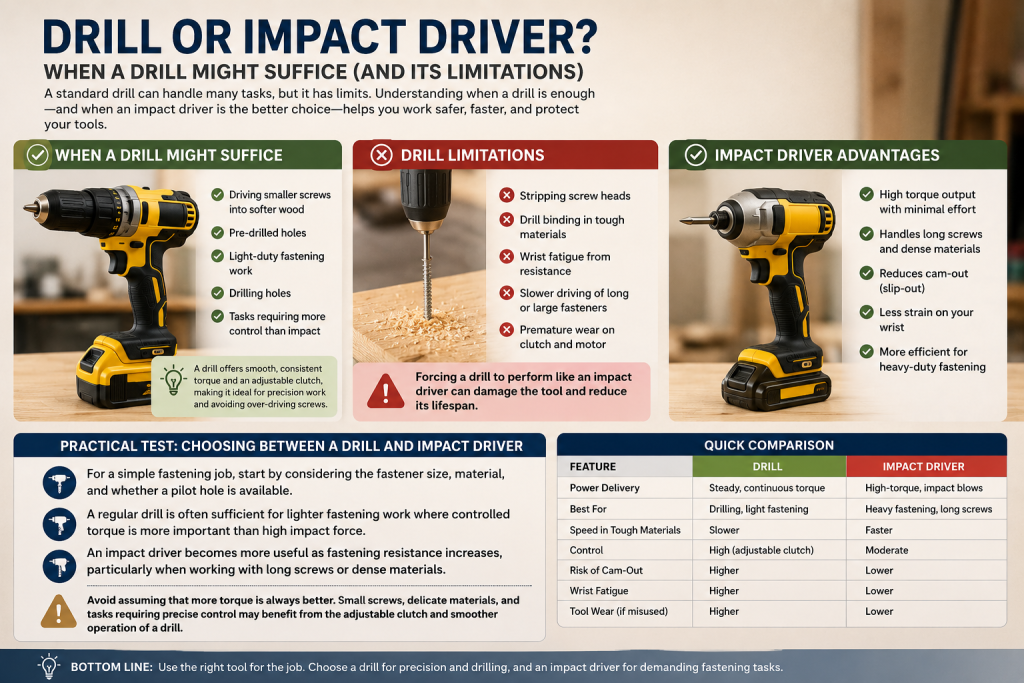
For lighter tasks, such as driving smaller screws into softer wood or pre-drilled holes, a standard drill can certainly get the job done. It’s also the primary tool for drilling holes. However, when faced with larger, longer fasteners, or tougher materials, a drill’s limitations become apparent. You might experience the screw stripping, the drill binding, or significant wrist fatigue as the drill tries to overcome resistance without the benefit of impact action. Attempting to force a drill to perform like an impact driver can also lead to premature wear on the drill’s clutch and motor.
<span style=”color:red”>### Practical Test: Choosing Between a Drill and Impact Driver</span>
<span style=”color:red”>For a simple fastening job, start by considering the fastener size, material, and whether a pilot hole is available. A regular drill is often sufficient for lighter fastening work where controlled torque is more important than high impact force. An impact driver becomes more useful as fastening resistance increases, particularly when working with long screws or dense materials.</span>
<span style=”color:red”>Avoid assuming that more torque is always better. Small screws, delicate materials, and tasks requiring precise control may benefit from the adjustable clutch and smoother operation of a drill.</span>
The Right Tool for the Job: Safety and Efficiency
For optimal results, safety, and tool longevity, it is generally recommended to use the tool designed for the specific task. An impact driver excels at driving fasteners, while a drill is best for drilling. While a drill can sometimes substitute for an impact driver in light applications, it’s not a true replacement for demanding fastening tasks.
Can You Use A Lemon Instead of Lime?
In the culinary world, the question “can you use a lemon instead of lime?” frequently arises when a recipe calls for one and only the other is available. While both are citrus fruits, their distinct characteristics mean the substitution isn’t always seamless.
Flavor Profiles and Acidity Levels
Lemons typically offer a brighter, more overtly sour taste with a slightly sweeter undertone. Limes, especially Key limes, tend to be more tart, sometimes with a subtle bitterness or floral note. Both are acidic, but their specific flavor compounds contribute differently to a dish’s overall profile. Lemons generally have a pH of 2.0-2.6, while limes are slightly higher at 2.0-2.8, but the perceived tartness can differ.
<span style=”color:red”>### What to Consider Before Making the Citrus Swap</span>
<span style=”color:red”>The best substitution depends on what the citrus contributes to the recipe. If the primary purpose is acidity, a lemon may work well. If the aroma, zest, or distinctive lime flavor is central to the dish, the difference can be much more noticeable.</span>
<span style=”color:red”>For recipes where citrus juice is combined with other strong ingredients, start with a conservative amount of the substitute and adjust to taste. This avoids changing the acidity or flavor balance more than necessary.</span>
Culinary Substitutions: When It Works and When It Doesn’t
For general acidity in marinades, salad dressings, or to brighten a sauce, a lemon can often substitute for a lime, and vice-versa, with acceptable results. For example, if a recipe calls for a squeeze of lime over tacos, a squeeze of lemon will still provide a pleasant tang. However, for dishes where the specific flavor of lime is central, such as a classic Key lime pie, a mojito, or certain Thai or Mexican dishes, using a lemon will significantly alter the intended taste. The unique aromatic compounds of lime are difficult to replicate.
Best Practices for Ingredient Swaps
When making such a substitution, consider the dominant flavor contribution. If it’s primarily for acidity, the swap is often fine. If the specific citrus flavor is a star, it’s best to stick to the original ingredient. You might also need to adjust quantities, as lemons can sometimes be perceived as less potent in tartness than limes, requiring a bit more to achieve the same acidic punch.
Can You Use A PS4 Controller On PC?
PC gamers often wonder, “can you use a PS4 controller on PC?” The good news is, yes, the PlayStation 4’s DualShock 4 controller is largely compatible with Windows PCs, offering a comfortable and familiar gaming experience.
Connecting Your PS4 Controller: Wired and Wireless Methods
Connecting a PS4 controller to a PC can be done in two primary ways. The simplest is via a USB cable; simply plug the micro-USB end into the controller and the USB-A end into your PC. Windows will typically recognize it as a generic gamepad. For wireless play, you’ll need a Bluetooth-enabled PC. Hold down the PlayStation button and the Share button on the controller simultaneously until the light bar flashes. Then, go to your PC’s Bluetooth settings, search for new devices, and select “Wireless Controller.”
Driver Installation and Software Compatibility
While some modern PC games offer native support for the DualShock 4, many older titles or those not specifically designed for it might require additional software. Steam’s Big Picture Mode has excellent built-in support, allowing you to configure the controller for most games in your library. For broader compatibility and advanced customization, third-party tools like DS4Windows can emulate an Xbox 360 controller (which has widespread PC support) using your DualShock 4, enabling button remapping, touchpad functionality, and light bar control.
<span style=”color:red”>### Compatibility Tip: Check the Game Before Troubleshooting the Controller</span>
<span style=”color:red”>A controller can connect successfully to Windows and still fail to work correctly inside a particular game. If the controller appears in Windows but does not respond in the game, check the game’s controller settings and its supported input devices before assuming the hardware is faulty. Platform-specific configuration can also affect button prompts and controller mapping.</span>
Enhancing Your PC Gaming Experience
Using a PS4 controller on PC can significantly enhance the experience for certain game genres, such as fighting games, platformers, and racing simulators, where analog input and tactile feedback are beneficial. With proper setup, you can enjoy a console-like experience on your computer.
Can You Use A VPN For Streaming?
The question “can you use a VPN for streaming?” is common among those looking to access content beyond their geographical boundaries or enhance their online privacy. The answer is generally yes, but with important considerations.
How VPNs Interact with Streaming Services
A Virtual Private Network (VPN) encrypts your internet connection and routes it through a server in a location of your choice. This masks your actual IP address, making it appear as though you are browsing from the VPN server’s location. Streaming services often use geo-blocking technology to restrict content based on your geographical location due to licensing agreements. By connecting to a VPN server in a different country, you can potentially bypass these restrictions and access content libraries available in that region.
Overcoming Geo-Restrictions and Buffering Issues
Many users successfully employ VPNs to access a wider range of movies and TV shows. However, streaming providers are increasingly sophisticated at detecting and blocking VPN traffic. This means that while some VPNs work reliably, others may be detected, preventing access. Furthermore, routing your internet traffic through an additional server can sometimes introduce latency and reduce connection speed, potentially leading to buffering or lower video quality, especially if the VPN server is far away or overloaded.
<span style=”color:red”>### Before Using a VPN With a Streaming Service</span>
<span style=”color:red”>Check the streaming provider’s current terms of service before relying on a VPN for access to region-specific content. Availability and enforcement policies can change, and a VPN does not guarantee access to a particular library. Performance can also vary depending on the VPN server, network conditions, distance, and the streaming provider’s ability to identify VPN traffic.</span>
Legal and Service Provider Terms
While using a VPN for streaming is generally legal in most countries, it often violates the terms of service of streaming platforms. These platforms reserve the right to terminate accounts that circumvent geo-restrictions. While enforcement varies, it’s a factor to consider. It’s also important to ensure that VPN usage itself is legal in your specific jurisdiction.
Can You Use A Coffee Filter For Tea?
When you’re out of tea bags or a proper infuser, you might wonder, “can you use a coffee filter for tea?” While technically possible, it’s not the ideal method for brewing a flavorful cup.
Material and Filtration Differences
Coffee filters are typically made from finely woven paper, designed to trap very fine coffee grounds while allowing brewed coffee to pass through. This fine filtration is crucial for coffee, preventing sediment. Tea bags, on the other hand, are often made from a coarser, more permeable paper or mesh, allowing tea leaves to expand and water to circulate freely. Loose leaf tea infusers are designed with even larger perforations to maximize water flow and leaf expansion.
Brewing Methods and Flavor Impact
Using a coffee filter for tea can lead to a less robust and flavorful brew. The fine pores of the coffee filter can restrict the expansion of tea leaves, which is essential for proper infusion and flavor extraction. Additionally, the paper material itself can impart a subtle papery taste to the tea, especially if the filters are bleached. The essential oils and nuanced flavors of tea might also be absorbed by the filter, resulting in a weaker, less aromatic cup.
<span style=”color:red”>### A Better Way to Use a Coffee Filter for Tea</span>
<span style=”color:red”>If a coffee filter is the only option available, avoid tightly packing the tea into a small space. Give the leaves enough room to contact the hot water and allow the liquid to pass through the paper. The exact result will depend on the tea type, filter design, and brewing method.</span>
Alternative Tea Infusion Techniques
If you don’t have a dedicated tea infuser, better alternatives to a coffee filter include a fine-mesh strainer (for steeping directly in a cup and then straining), a French press (for larger leaf teas), or even a clean, thin cloth tied around the leaves. These methods allow for better water circulation and leaf expansion, leading to a more satisfying tea experience.
Can You Use A Gift Card Without A PIN?
A common question when using stored-value cards is, “can you use a gift card without a PIN?” The answer depends on the type of transaction and the card’s specific features.
Understanding Gift Card Security Features
A Personal Identification Number (PIN) on a gift card serves as a security measure, similar to a debit card PIN. It helps prevent unauthorized use, especially for online transactions or when the card is lost or stolen. Many gift cards, particularly those from major retailers or those that function like debit cards (e.g., Visa, Mastercard gift cards), come with a PIN, often hidden under a scratch-off panel.
Online vs. In-Store Transactions
For online purchases, a PIN is almost always required to verify the transaction. Without it, the payment will likely be declined. For in-store transactions, the requirement can vary. If the gift card is swiped or inserted into a chip reader, a PIN might not be necessary, as the transaction is processed similarly to a credit card. However, if the card number needs to be manually entered, or if it’s a general-purpose gift card, a PIN may be requested. Store-specific gift cards often have simpler processing and may not require a PIN for in-store use.
<span style=”color:red”>### The Issuer Matters More Than the General Rule</span>
<span style=”color:red”>Gift-card procedures vary by issuer, card type, merchant, and transaction method. Before assuming that a PIN is required—or that a card can be used without one—check the instructions printed on the card and the issuer’s official support information. This is especially important for online purchases and general-purpose prepaid cards.</span>
What to Do If You Lose Your PIN
If your gift card has a PIN and you’ve lost or forgotten it, first check the back of the card for instructions or a website address. Many cards have the PIN printed directly on them, sometimes under a silver scratch-off strip. If not, visit the gift card issuer’s website or contact their customer service. They may be able to retrieve or reset the PIN for you, provided you can verify ownership of the card.
Can You Use A Microwave As An Oven?
The question, “can you use a microwave as an oven?” highlights a fundamental difference in how these appliances cook food. While both heat food, their methods are distinct, leading to different culinary outcomes.
Fundamental Differences in Heating Mechanisms
Microwaves heat food by using electromagnetic radiation to excite water molecules within the food, causing them to vibrate rapidly and generate heat. This process heats food from the inside out (though not exclusively). Conventional ovens, on the other hand, use radiant heat (from heating elements) and convection (circulating hot air) to cook food from the outside in. This allows for browning, crisping, and even cooking throughout larger items.
When a Microwave Excels (and Its Limitations)
A microwave excels at reheating leftovers, defrosting frozen foods, and quickly cooking items with high water content, such as vegetables or popcorn. Its speed and efficiency for these tasks are unmatched. However, its limitations become apparent when attempting oven-specific tasks. A microwave cannot brown, crisp, or caramelize food. It won’t bake a cake with a golden crust, roast a chicken with crispy skin, or melt cheese to a bubbly, golden finish. Foods cooked solely in a microwave often have a steamed texture.
<span style=”color:red”>### Why Microwave and Oven Results Differ</span>
<span style=”color:red”>The main practical difference is not simply how quickly the food becomes hot, but how heat is delivered and how the food’s surface behaves during cooking. Conventional oven cooking can produce the dry surface conditions and temperatures needed for browning and crisping. A standard microwave generally does not create the same surface environment, which is why foods that depend on a browned exterior can have a noticeably different texture when microwaved.</span>
Achieving Oven-Like Results with Specific Foods
Some modern appliances are combination microwave ovens, which integrate both microwave and convection heating elements, allowing for faster cooking with browning capabilities. For standard microwaves, specific accessories like browning dishes can help achieve a crispier texture for certain foods, but they cannot fully replicate the consistent, all-around heating of a conventional oven.
Can You Use A Car Battery For A Boat?
When considering power sources for marine applications, “can you use a car battery for a boat?” is a common query. While a car battery might seem like a convenient substitute, marine environments demand specific battery types for safety and performance.
Starting vs. Deep Cycle Batteries: Key Distinctions
Car batteries are primarily designed as “starting” batteries. They deliver a high burst of current for a short period to crank an engine, after which the alternator takes over. They are not designed for deep discharge cycles. Marine batteries, however, come in two main types: starting and deep cycle. Marine starting batteries are similar to car batteries but built to withstand the marine environment. Deep cycle marine batteries are designed to provide a steady, lower current over a long period and can be repeatedly discharged and recharged without significant damage, making them ideal for powering accessories like lights, fish finders, and trolling motors.
Marine Battery Requirements and Safety
Marine batteries are constructed to be more robust than car batteries. They are typically sealed to prevent acid leaks, designed to resist vibration from boat movement, and often feature corrosion-resistant terminals. Using a standard car battery in a boat can pose several risks: it’s not built to handle the constant vibrations, it’s not designed for deep discharges (which can quickly shorten its lifespan if used for accessories), and it may not be properly sealed, leading to potential acid spills in a confined marine space, which is a significant safety hazard.
<span style=”color:red”>### Match the Battery to the Boat’s Actual Electrical Load</span>
<span style=”color:red”>Battery selection should also consider what the battery is expected to power. Engine starting, trolling motors, navigation equipment, fish finders, lighting, and other accessories can have very different power requirements. Check the boat and battery manufacturer’s specifications for the required battery type, capacity, starting rating, and installation requirements rather than choosing a battery based only on physical size.</span>
Powering Your Vessel Effectively
For reliable and safe operation, it is always recommended to use marine-specific batteries for your boat. A marine starting battery for engine cranking and a deep cycle marine battery (or a dual-purpose marine battery) for powering accessories will ensure the vessel has the appropriate and safe power supply.
Can You Use A Laptop Charger For A Different Laptop?
The question “can you use a laptop charger for a different laptop?” often arises when a charger is lost or damaged. While it might seem convenient, using an incompatible charger can lead to serious issues.
Voltage, Amperage, and Connector Compatibility
Three critical factors determine charger compatibility: voltage (V), amperage (A), and the physical connector type. The charger’s output voltage must match the laptop’s required input voltage exactly or be within a very narrow tolerance (typically +/- 0.5V). If the voltage is too high, it can damage the laptop’s internal components. If it’s too low, the laptop may not charge or operate correctly. The charger’s amperage (current) should be equal to or greater than the laptop’s requirement. A lower amperage charger might not provide enough power, leading to slow charging or the laptop not charging at all while in use. Finally, the physical connector must fit securely and correctly into the laptop’s charging port.
<span style=”color:red”>### A Practical Charger Compatibility Checklist</span>
<span style=”color:red”>Before connecting a replacement charger, compare the specifications printed on both the laptop and adapter. Check the required input voltage, the charger’s output voltage, current rating, connector type, polarity where applicable, and total power rating. For USB-C charging, also check whether the laptop and charger support the appropriate USB Power Delivery requirements rather than assuming that every USB-C charger provides the same charging capability.</span>
<span style=”color:red”>A connector that physically fits is not, by itself, proof of compatibility. When specifications are unclear, consult the laptop manufacturer’s documentation or use a replacement adapter specifically listed for the model.</span>
Risks of Using an Incompatible Charger
Using a charger with incorrect voltage is the most significant risk, potentially causing irreversible damage to the laptop’s motherboard, battery, or other internal circuits. An undersized amperage charger can overheat, damage the charger itself, or fail to charge the laptop effectively. An ill-fitting connector can cause physical damage to the port or create intermittent connections, leading to charging issues. In severe cases, an incompatible charger can pose a fire hazard.
Identifying the Correct Power Adapter
Always check the specifications on your laptop (often on a sticker on the bottom or near the charging port) and on the original charger. Look for the “Output” voltage and amperage. When purchasing a replacement or using a universal charger, ensure these specifications, along with the connector type, match precisely. Reputable universal chargers often come with multiple tips and voltage settings, but careful selection is still necessary.
Frequently Asked Questions About Compatibility
Can you use a phone charger for a tablet?
Generally, yes, you can you use a phone charger for a tablet, provided the voltage matches (typically 5V for USB devices). However, phone chargers usually have a lower amperage output (e.g., 1A or 2A) compared to tablet chargers (e.g., 2A or 2.4A). While it will charge the tablet, it will do so much more slowly. Using a phone charger with a significantly lower amperage than required by the tablet might also cause the phone charger to overheat or wear out faster.
Can you use a regular light bulb in a 3-way lamp?
Yes, you can you use a regular, single-filament light bulb in a 3-way lamp. However, it will only operate at one brightness setting, typically the highest one, when the switch is cycled. A 3-way lamp is designed to work with a special 3-way bulb, which has two filaments that light up independently or together to provide three distinct brightness levels (e.g., 50W, 100W, 150W).
Can you use a standard screwdriver as a pry bar?
It is strongly advised against using a standard screwdriver as a pry bar. Screwdrivers are designed for applying torque to fasteners, not for leverage or prying. Using one as a pry bar can bend or break the shaft, damage the tip, or cause the screwdriver to slip, potentially leading to injury. Dedicated pry bars are designed with stronger materials and appropriate tip shapes for such tasks.
<span style=”color:red”>### How We Evaluate Whether One Item Can Replace Another</span>
<span style=”color:red”>A useful substitution is not determined by convenience alone. The most reliable approach is to compare the original item’s purpose with the substitute’s specifications, operating conditions, limitations, and safety requirements.</span>
<span style=”color:red”>For tools and electronics, specifications and manufacturer instructions should take priority. For food substitutions, the ingredient’s role in the recipe—such as acidity, moisture, texture, or flavor—matters more than simply finding another ingredient in the same category. For household and safety-sensitive applications, the consequences of failure should be considered before experimenting with an alternative.</span>
<span style=”color:red”>Where an alternative has been personally tested, the result can provide useful first-hand context. However, a single successful test does not guarantee that the same substitution will work with every model, material, recipe, environment, or use case. Manufacturer documentation and product-specific requirements should therefore remain the final reference for safety-critical decisions.</span>
<span style=”color:red”>### When Should You Avoid a Substitution?</span>
<span style=”color:red”>Avoid improvising when the substitution involves electricity, batteries, chargers, high heat, pressurized equipment, structural loads, or other situations where an incorrect match could cause damage or injury. The same principle applies when a manufacturer explicitly specifies a particular component or accessory.</span>
<span style=”color:red”>For lower-risk substitutions, such as replacing one citrus fruit with another in a recipe, experimentation is usually more forgiving. Even then, expect differences in flavor, texture, performance, or appearance rather than assuming the substitute will behave identically.</span>
Informed Choices: Understanding What You Can Use
The common thread through all these scenarios is the importance of understanding specific requirements and limitations. While the impulse to ask “can you use a” alternative item is natural, the answer often lies in a careful consideration of design, function, and potential consequences. Making informed decisions about tool, ingredient, or device compatibility ensures safety, optimizes performance, and prevents unnecessary damage or disappointment. Always prioritize using the correct item for its intended purpose when possible, and if a substitution is necessary, proceed with caution and awareness of the potential trade-offs.