



⚡ Quick Summary:
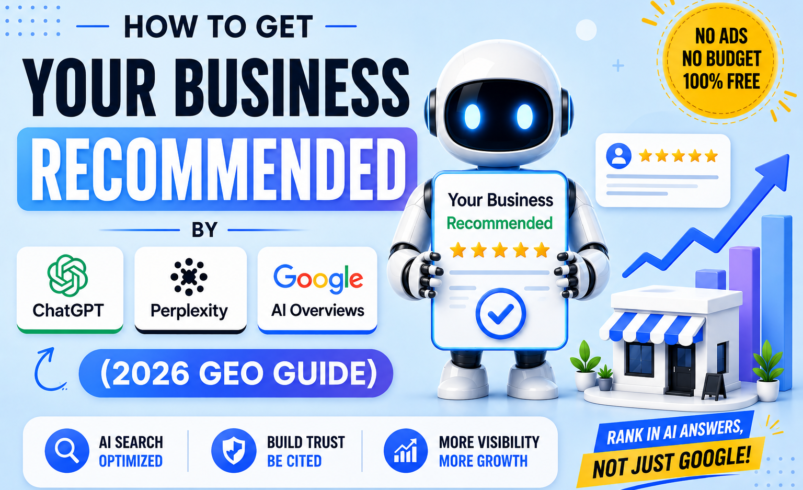
If you want to know how to get recommended by chatgpt, Generative Engine Optimization (GEO) is the practice of structuring your business’s web presence so AI platforms like ChatGPT, Perplexity, and Google AI Overviews can confidently cite you. Each platform retrieves information differently — Bing-blended, self-crawled, or Google-indexed — so the core fix is the same: consistent, structured, verifiable facts across your site, listings, and reviews, with zero ad spend required.
📊 GEO Data Comparison Table: How the Major AI Platforms Actually Retrieve Information
Understanding how each platform finds content is the single highest-leverage piece of technical knowledge in GEO — optimize for the wrong mechanism and nothing else you do matters.
| Platform | Retrieval Mechanism | Key Technical Requirement | Paid Placement? |
|---|---|---|---|
| ChatGPT (OpenAI) | Blended stack: Bing’s index + OpenAI’s crawler (OAI-SearchBot) + live page-fetch bot (ChatGPT-User) | Must be indexed in Bing Webmaster Tools; allow OAI-SearchBot in robots.txt | No (Purely organic visibility) |
| Perplexity | Independent index refreshed by PerplexityBot on proprietary Vespa-based search stack | Allow PerplexityBot in robots.txt; avoid JavaScript-only content dependency | No (No paid-ad equivalent available) |
| Google AI Overviews (Gemini) | Draws directly from standard Google Search index via Googlebot | Must be indexed in Google Search; Google-Extended token must be allowed | No (Appears on ~13–15% of search queries) |
| Microsoft Copilot | Runs on Bing search index and API (same engine feeding ChatGPT) | Active Bing Places profile + Bing Webmaster Tools indexing | No (Covers both Copilot & ChatGPT) |
Key takeaway: ChatGPT and Bing Copilot share Bing as a foundation, Perplexity is entirely independent, and Google AI Overviews requires traditional Google SEO first — you cannot skip regular Google indexing and expect an AI Overview citation.
📚 What Is GEO and Why Does It Matter?
Generative Engine Optimization (GEO) is the discipline of making your business’s information easy for AI systems — not just search engines — to find, trust, and repeat back to a user asking for a recommendation.
Here’s the beginner-friendly version: traditional SEO answers the question “How do I rank #1 on Google for this keyword?” GEO answers a different question: “How do I become the answer an AI gives when someone asks a question, in a natural-language way, without ever seeing a ranked list?”
This matters because the discovery layer has genuinely fragmented in 2026:
- ChatGPT confirmed more than 900 million weekly active users in February 2026, and its mobile app crossed 1 billion monthly active users by June 2026, per Sensor Tower data reported by Reuters — the fastest consumer app in history to hit that scale.
- Perplexity’s usage has grown substantially among researchers and technically sophisticated users who specifically prefer synthesized, cited answers over a list of blue links.
- Google AI Overviews already sits on top of a meaningful share of standard Google searches, meaning even people who “just Google it” are increasingly seeing an AI-written answer before any organic result.
The practical implication for a small or mid-size business: if none of these systems can confidently describe and cite you, you are functionally invisible to a fast-growing share of your potential customers — regardless of how well your website performs in classic keyword rankings.
📚 How to Get Recommended by ChatGPT, Perplexity & Google AI: Platform Breakdown
ChatGPT: Win the Bing + OpenAI Blended Stack
ChatGPT’s retrieval architecture has evolved since 2024. Today, it operates as a blended stack. Bing’s index is a necessary floor. If Bing omits your page, ChatGPT cannot fetch it. However, OpenAI also runs its own crawler, OAI-SearchBot. It uses a separate fetch bot, ChatGPT-User, for live page reads during conversations.
Action steps:
- Claim and fully complete a Bing Places business listing (free, ~15 minutes)
- Verify your site in Bing Webmaster Tools and submit your sitemap
- Confirm your
robots.txtexplicitly allowsOAI-SearchBotandChatGPT-User - Keep NAP (Name, Address, Phone) data identical across your site, Bing Places, and Google Business Profile
Perplexity: Win an Entirely Independent Index
Perplexity does not borrow anyone else’s index. It rebuilt its retrieval system in-house in 2025 on Vespa, an open-source engine, and crawls the web directly through PerplexityBot, maintaining a proprietary index described as covering hundreds of billions of pages with extremely frequent refresh cycles.
Action steps:
- Explicitly allow
PerplexityBotinrobots.txt - Ensure your key content exists in raw server-rendered HTML — PerplexityBot, like most AI crawlers, does not reliably execute JavaScript, so client-side-rendered React/Vue/Angular content can appear empty to it
- Structure pages with clear headings, bulleted facts, and direct statements — Perplexity rewards content built for clean extraction
- Since Perplexity has no ad platform, visibility here is 100% earned through content quality and crawlability — there is no paid shortcut to test against
Google AI Overviews (Gemini): Win Standard SEO First, Then Structure
This is the platform most likely to trip up businesses that assume “AI optimization” is a separate track from SEO. Gemini has no crawler of its own — it grounds every AI Overview answer in Google’s existing Search index, built by the familiar Googlebot, and gated for AI use specifically through the Google-Extended robots.txt token.
Action steps:
- You cannot get an AI Overview citation without already being crawled and indexed by standard Googlebot — traditional SEO fundamentals are the prerequisite, not an alternative
- Confirm
Google-Extendedis allowed inrobots.txtif you want your indexed content eligible for AI Overviews (blocking it does not affect regular Search ranking, only AI use) - Lead each page section with a direct, self-contained sentence that answers the implied question outright — AI Overviews favor passages it can quote cleanly over prose it has to interpret
- Build genuine topical authority: a single isolated article gives Google’s system far less evidence than a cluster of pages that consistently cover the same subject area
📚 Key Technical Considerations & Common Pitfalls
- JavaScript-rendered content is a blind spot for most AI crawlers. PerplexityBot, OAI-SearchBot, and Google-Extended all read raw HTML; content that only appears after client-side rendering may be effectively invisible. Verify with a “view source” check, not just a browser render.
- Confusing “indexed” with “selected” is the most expensive mistake. Google already crawls nearly every public page — being indexed guarantees nothing. AI Overviews still only cite 3–5 sources per query out of a near-infinite eligible pool; the competitive battle is for selection, not access.
- Treating GEO as a paid channel is a scam pattern, not a strategy. None of the four platforms above — ChatGPT, Perplexity, Google AI Overviews, or Bing Copilot — sell placement inside their organically generated answers. Any vendor promising “guaranteed AI ranking” for a fee should be treated with real skepticism.
- Server response time and crawl budget matter more than people expect. Slow-loading pages may be abandoned by a crawler before the content is even read, regardless of how well-written that content is.
- Blocking one crawler doesn’t always mean what people assume. Disallowing
Google-Extended, for instance, only opts content out of Gemini/AI Overview grounding — it has no effect on regular Google Search crawling, indexing, or ranking. Read each platform’s documentation before making a robots.txt change.
📚 Best Practices & Actionable Recommendations
- Start with the free technical floor for each platform: Bing Places (ChatGPT/Copilot), a clean
robots.txtallowingPerplexityBot, and confirmed Googlebot indexing (AI Overviews). This is unglamorous but non-negotiable — nothing else works if the crawler can’t reach the page. - Write in self-contained, answer-first passages. Every major platform — regardless of retrieval mechanism — rewards a paragraph that could be lifted out of context and still make complete sense.
- Build real, consistent NAP data and genuine reviews. Consumer trust research such as BrightLocal’s annual Local Consumer Review Survey has repeatedly found that recent, detailed reviews shape buying decisions more than star ratings alone — and this same consistency signal is what AI systems use to judge trustworthiness.
- Test with non-branded prompts, weekly, across all four platforms. Ask the way a real customer would — “best [service] in [city]” — without naming your business, and log whether you appear and where. A single lucky mention isn’t a trend; three consistent weeks is a real signal.
- Don’t abandon traditional SEO to chase GEO. Google AI Overviews in particular makes this explicit: you cannot skip standard indexing and ranking fundamentals and expect AI citation success. GEO is an additional layer on top of SEO, not a replacement for it.
Frequently Asked Questions
Does ChatGPT use Google or Bing for search?
Neither exclusively anymore. As of 2026, ChatGPT uses a blended stack of Bing’s index plus OpenAI’s own crawler, OAI-SearchBot. Bing indexing remains a necessary floor check either way.
Can I pay to appear in AI-generated answers?
No. None of the major platforms — ChatGPT, Perplexity, Google AI Overviews, or Bing Copilot — offer paid placement inside their organically generated responses.
Why does Perplexity show different results than ChatGPT for the same question?
Perplexity runs its own independent crawler and index (PerplexityBot), completely separate from Bing or Google. Different index, different citations.
Do I need to rank on Google first to appear in AI Overviews?
Yes. Gemini has no crawler of its own — it grounds AI Overview answers entirely in Google’s existing Search index, so standard indexing is a prerequisite.
How do I check if AI crawlers can even access my site?
Check your robots.txt for OAI-SearchBot, PerplexityBot, and Google-Extended, then verify in server logs that each bot is actually visiting — allowing a crawler and confirming it arrives are two different steps.
How long does GEO take to show results?
There’s no fixed timeline industry-wide. Perplexity’s near-real-time crawling can surface fresh content within days, while broader recognition across platforms typically builds over weeks to months through consistent, verifiable mentions.

2 Comments
-
[…] How to Get Your Business Recommended by […]
-
[…] 📌 Recommended Reading How to Get Recommended by ChatGPT in 2026 (SEO & Optimization Guide) → […]